




Demonetisation at 10: Hit or miss? Research says it's both
Nearly all banned notes came back and UPI took off, but with GST, RERA, other reforms following close behind, it's hard to say what Demonetisation alone achieved

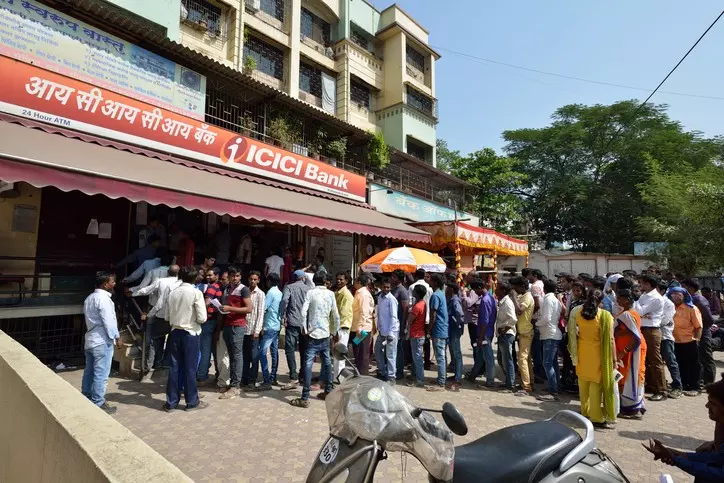
On November 8, 2016, following a televised speech by Prime Minister Narendra Modi, the Government of India announced that ₹500 and ₹1,000 notes would cease to be legal tender. These notes accounted for about 86 per cent of the currency in circulation by value.
The Centre gave several reasons: to catch “black money” (income hidden from tax authorities), to stop fake notes and the funding of illegal activity, to bring more business into the formal, taxed economy, and, as a later hoped-for benefit, to get people using digital payments.
Also read | Five promises of demonetisation: 10 years later, what is the score?
A decade later, researchers have studied what happened. The short answer is it was mixed. There was real short-term pain, a lasting change in how people pay, and limited success on most of the original goals. It is also hard to separate the effects of Demonetisation from other reforms that followed soon after.
This was not India’s first attempt at demonetisation. High-value notes were also withdrawn in 1946 and 1978. In 1946, over 93 per cent of the withdrawn money came back to banks, and in 1978 about 85 per cent did.
What happened to cash
Official statistics from the Reserve Bank of India (RBI) and the National Payments Corporation of India (NPCI) provide a clear picture of how cash and digital payments have evolved since 2016.
The old money didn't go away: Almost all the old money came back. Of the ₹15.42 lakh crore in old notes withdrawn (a lakh crore is a trillion rupees), ₹15.31 lakh crore, or 99.3 per cent, was deposited. The idea was that people hiding illegal cash would be unable to deposit it, and the money would effectively vanish. That did not happen.
Cash is still king: Cash held by the public was about ₹18 lakh crore just before the announcement. It dropped sharply, then recovered. By March 2026 there was ₹41.24 lakh crore of banknotes in circulation, and by late October 2026 about ₹43 lakh crore. The ₹500 note now makes up about 85 per cent of the total value.
Cash and the economy: An economy grows over time, so a better measure is cash as a share of everything the country produces (GDP). That share was 11.9 per cent in 2015-16 and 12.1 per cent in March 2026. The pandemic briefly pushed it to 14.4 per cent. India holds far more cash in rupee terms, but the economy has grown alongside it.
Also read | Demonetisation and GST: A tale of two economic 'mis'adventures
Fledgling digital rupee: The Central Bank Digital Currency (CBDC), or digital rupee (e₹), remains insignificant, at around ₹1,100-1,130 crore in late October 2026. Cryptocurrency is not included in this analysis because it cannot be considered digital legal tender. A CBDC, by contrast, is digital legal tender. Cryptocurrency is a speculative asset and is taxed in India at 30 per cent, like other speculative activities, including casino games and horse racing. Taxing an asset does not make it legitimate.
What happened to digital payments
This is where the change is dramatic. The Unified Payments Interface (UPI), the instant phone-based payment system launched in April 2016, handled about 1.8 crore transactions in 2016-17. By 2025-26 it handled roughly 24,000 crore, around 13,000 times as many.
In October 2026 alone UPI processed over 25 billion transactions worth ₹31.5 lakh crore. Over 750 banks now support it.
The overall verdict on Demonetisation is that it was neither an unqualified success nor an outright failure. There was limited success in meeting several stated objectives, substantial but largely temporary disruption, uneven distributional effects and changed payment habits.
Taken together, these numbers set the scene for what researchers found about the policy’s goals, its costs, and who bore them. It appears that Indians continue to hold cash for emergencies while using digital payments for their convenience.
The long-term impact on counterfeiting and illicit financing is difficult to assess. A one-time withdrawal of currency can disrupt its circulation, but lasting results depend on effective enforcement and institutional capacity.
GST complicates tax impact
The impact of Demonetisation cannot be isolated, as several other reforms, including the Goods and Services Tax (GST), also contributed to these outcomes.
The impact on tax compliance in particular is difficult to isolate because the GST came into effect in July 2017, less than a year after the Demonetisation move.
Researchers Da-Kai Wu and Yi-Chun Ko found a sustained rise in sales and production tax revenue, but no comparable change in income and profit taxes. They attributed the gains in indirect tax revenue more plausibly to GST and found no change in the size of the informal economy.
Also read | Demonetisation verdict explained | What dissenting SC judge, 4 other judges said
One of the objectives of Demonetisation was to curb tax evasion by reducing the use of cash in economic activities where income was under-reported. A study by Santosh Anagol, Vimal Balasubramaniam, Tarun Ramadorai and Antoine Uettwiller examined whether the policy reduced under-reporting in real estate transactions, a sector long suspected of widespread cash use and tax evasion.
The study of property transactions in Mumbai found no significant change in overall under-reporting. However, it found reductions in some segments, including transactions between individuals and those involving smaller developers. The effects appear to have been sector-specific rather than uniform. The authors highlighted that while Demonetisation itself did not reduce under-reporting in developer sales transactions overall, subsequent formalisation measures, including the RERA Act in April 2017 and GST in July 2017, may have influenced market practices.
Economic cost of cash crunch
India’s large informal sector, where people are mostly paid in cash and work without formal contracts, shaped how the sudden currency shortage was felt.
To measure the damage, Gabriel Chodorow-Reich, Gita Gopinath, Prachi Mishra and Abhinav Narayanan compared districts according to how much of their cash was wiped out. Using RBI data on how old and new notes were distributed across the country, they worked out which districts were hit hardest by the shortage and which were hit less.
Districts that lost more cash saw sharper falls in ATM withdrawals, slower growth in bank lending and a faster shift to electronic payments such as e-wallets and card machines in shops. Employment and economic output were also affected.
Output was gauged by how bright districts looked from space at night, since brighter areas generally have more economic activity. By this measure, employment and output were about 2 percentage points lower in October-December 2016 than they otherwise would have been. The effect gradually faded over the following months.
This does not mean that India’s annual GDP fell by 2 per cent. The estimate covers a single quarter and compares districts with one another.
Non-uniform burden
The burden was not uniform. It depended on how much people relied on cash and how easily they could switch to other ways of paying. One study estimated the average loss at about 1 per cent of household spending, with larger losses for those who depended heavily on cash.
Surprisingly, however, a study by Areendam Chanda and C Justin Cook found that poorer regions and households did relatively better, and even improved in absolute terms, over the following 18 months. Results can differ depending on the place, the household and the method of measurement.
The shock also reached businesses. Exporters whose customers at home faced greater cash shortages saw their real exports fall, even when the exporters themselves did not depend directly on cash.
A shift in how Indians pay
The clearest behavioural change was in payment habits. The shift to digital payments was associated with higher consumer spending, which remained elevated even after cash availability recovered, researchers have noted.
This points to a lasting change in payment behaviour, although it does not establish that Demonetisation alone explains the subsequent growth of India's digital payments ecosystem.
Daily wage workers, small traders, agricultural labourers, street vendors, micro-enterprises and households dependent on cash faced delayed payments, lost working days and uncertainty over wages. Women engaged in informal work and those managing household cash may have faced distinct challenges.
Evidence on these experiences remains limited because reliable, high-frequency and disaggregated data are scarce. The absence of adequate measurement should not be mistaken for the absence of costs.
A decade-long assessment
The overall verdict on Demonetisation is that it was neither an unqualified success nor an outright failure. There was limited success in meeting several stated objectives, substantial but largely temporary disruption, uneven distributional effects and changed payment habits.
Most research points to how difficult it is to isolate the impact of a single policy when other reforms follow soon afterwards.
Also read | SC on demonetisation: Sound judgment on unsound policy
The more relevant question today is whether Demonetisation led to lasting gains in tax compliance, formalisation and institutional capacity. The answer depends on sustained administrative reforms, credible enforcement and reliable measurement.
A comprehensive assessment must consider aggregate outcomes as well as who bore the burden of the costs of this forced formalisation exercise and how effectively public systems manage sudden transitions.
However, measuring the impact remains difficult because of a lack of adequate data. Satellite-based night-light intensity data, for instance, cannot capture the full extent of the disruption.