Bangladesh developments are casting their shadow on West Bengal, a bordering state that is scheduled for election next May.
A number of protests were held in the state in recent days by the main Opposition party, the BJP, in the wake of a lynching of a Hindu man, Dipu Chandra Das, by an irate mob in Bangladesh on charges of blasphemy.
His body was also burnt by the mob.
Aftermath of Hadi’s death
The incident came during a period of unrest in Bangladesh after youth leader, Sharif Usman Hadi, was shot in broad daylight in Dhaka some weeks back. Political parties in Bangladesh accused former Prime Minister Sheikh Hasina and India for the attack even before investigations could make any headway.
The Bangladesh police claimed that Hadi's two assailants were now under its custody, after they were handed over by the Meghalaya authorities. But India has categorically denied that they were found in the country.
The issue is likely to add fresh strain in the tense relations between India and Bangladesh, say observers.
The protests in West Bengal against Bangladesh came amid the Narendra Modi government’s attempt to reform the electoral rolls to identify illegal Bangladeshi immigrants posing as legitimate voters in India.
There have also been complaints from local people that several properties have been bought by Bangladeshi nationals in bordering areas with the tacit support of Mamata Banerjee's ruling Trinamool Congress (TMC).
Muslims in West Bengal
West Bengal has a Muslim population of over 24.6 million that makes it about 27 per cent of the state’s population, according to the 2011 census. Most of them are ethnic Bengalis. But some accounts talk about the presence of outsiders and have pegged the Muslim population in the state to be nearly 30 per cent.
BJP’s chief minister aspirant, Suvendu Adhikari, led a big demonstration of BJP cadres and Hindu religious leaders before the Bangladesh deputy high commissioner’s office in Kolkata, to protest the recent attacks on Das and other Hindus in Bangladesh.
Adhikari warned if attacks on Hindus continued in Bangladesh, then the vast Hindu population in India will not watch such attacks silently and will do whatever measures are required to prevent them.
The BJP has had an extremely impressive rise in West Bengal in the past decade and is currently the main Opposition party in the state, after marginalising both the left parties and the Congress, both of which have ruled the state for years.
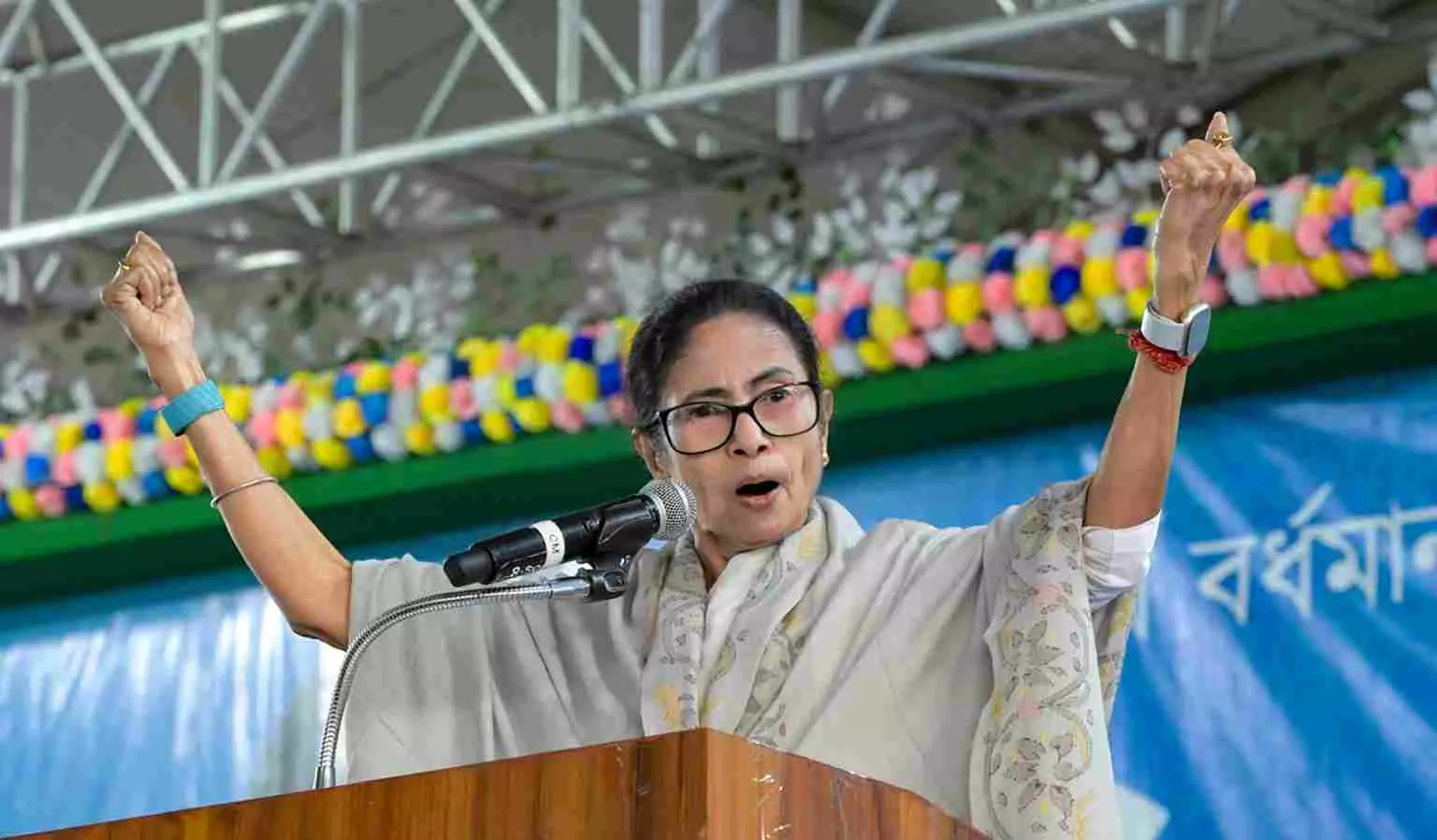
The BJP is now trying its best to come to power in West Bengal by replacing Mamata Banerjee, the current chief minister of the TMC, who is seeking a fourth consecutive term in power.
Bangladesh impact
The developments in Bangladesh have dominated discussions in the media and state’s political circles in recent days.
Traditionally, developments of 'one Bengal' have left its impact on the 'other Bengal' across the border.
The students' protest that threw out Hasina from power last year, had a huge impact on the youth in West Bengal during the RG Kar hospital movement against Mamata’s government over the rape of a young lady doctor by goons allegedly belonging to the ruling party.
“Developments in Bangladesh, especially the lynching and burning of Dipu Das has affected people in West Bengal, as the Hindus here are concerned over what is happening to their co-religionists in the neighbouring country,“ said Shankar Ghosh, a BJP member of the state legislative assembly from North Bengal.
Ghosh acknowledged that Bangladesh developments could become an issue for West Bengal in the run-up to the Assembly election in the state, especially, if there are similar attacks on Hindus in the coming months.
He felt the development in Bangladesh could be turned against Mamata, as she is already under pressure from the BJP and other parties for the alleged “appeasement of the Muslims” in West Bengal, at the cost of the Hindu majority in the state.
Mamata aspires for 3rd term
Mamata Banerjee’s TMC has been in power since May 2011. However, the Bharatiya Janata Party (BJP), the main Opposition, has shown a steady rise in strengthening its organisation and influence in the state. It is now making an all-out effort to replace the TMC government in the forthcoming election.
In the current Assembly, of the 294 seats Mamata’s party holds 215 seats, while the BJP has 77 seats and leads her rival by a 10 per cent vote share. The Muslims have voted for Mamata’s TMC after she managed to defeat the ruling CPI (M)-led Left Front in 2011, ending its 34-year rule in West Bengal.
The BJP on the other hand, have tried to consolidate the majority Hindu votes to replace Mamata’s TMC government and come to power. But, despite the media hype and the growing narrative of anti-incumbency, Mamata has managed to win consecutive elections to remain in power.
A major reason for Mamata’s victory has been the support she has so far enjoyed from the majority of the Muslim voters in the state. And, despite the BJP’s attempt to consolidate the Hindu vote against her, large sections of Hindu voters in the state have so far been reluctant to switch allegiance and support the BJP.
However, both the appeasement of Muslims and the lack of development in the state, are becoming part of the conversation along with charges of rampant corruption as a narrative among sections of voters against Mamata in West Bengal.
In this mix, whether the attacks against Hindus in Bangladesh can be linked to Mamata’s soft corner for Muslims in West Bengal, is still being debated by commentators.
Sources close to Mamata pointed out that developments in Bangladesh may not be a worry at this stage but could turn into a problem if they continue once election dates for West Bengal are formally announced.
But others remained skeptical about the state BJP’s ability to dislodge Mamata. They argue that despite the hype the party builds up before elections in the state, it is never matched by the choice of voters at the hustings.
“Mamata still manages to maintain a 10 per cent lead in vote share over the BJP, and this is not a cakewalk for the latter to close,” observed Nirmalya Mukherjee, a Kolkata-based political commentator.
Further, he said that unless there is a movement against Mamata from the grassroot level, it will be difficult to break the hold her TMC has over voters in West Bengal.
The coming months will perhaps give an indication whether any such movement at the grassroot level is indeed building up against Mamata that can scuttle her plans for a fourth term victory.