As Trump courts China, can the QUAD retain its strategic relevance?
As Washington seeks to stabilise ties with Beijing, India's continued stake in the QUAD rests on its strategic and economic benefits beyond countering China

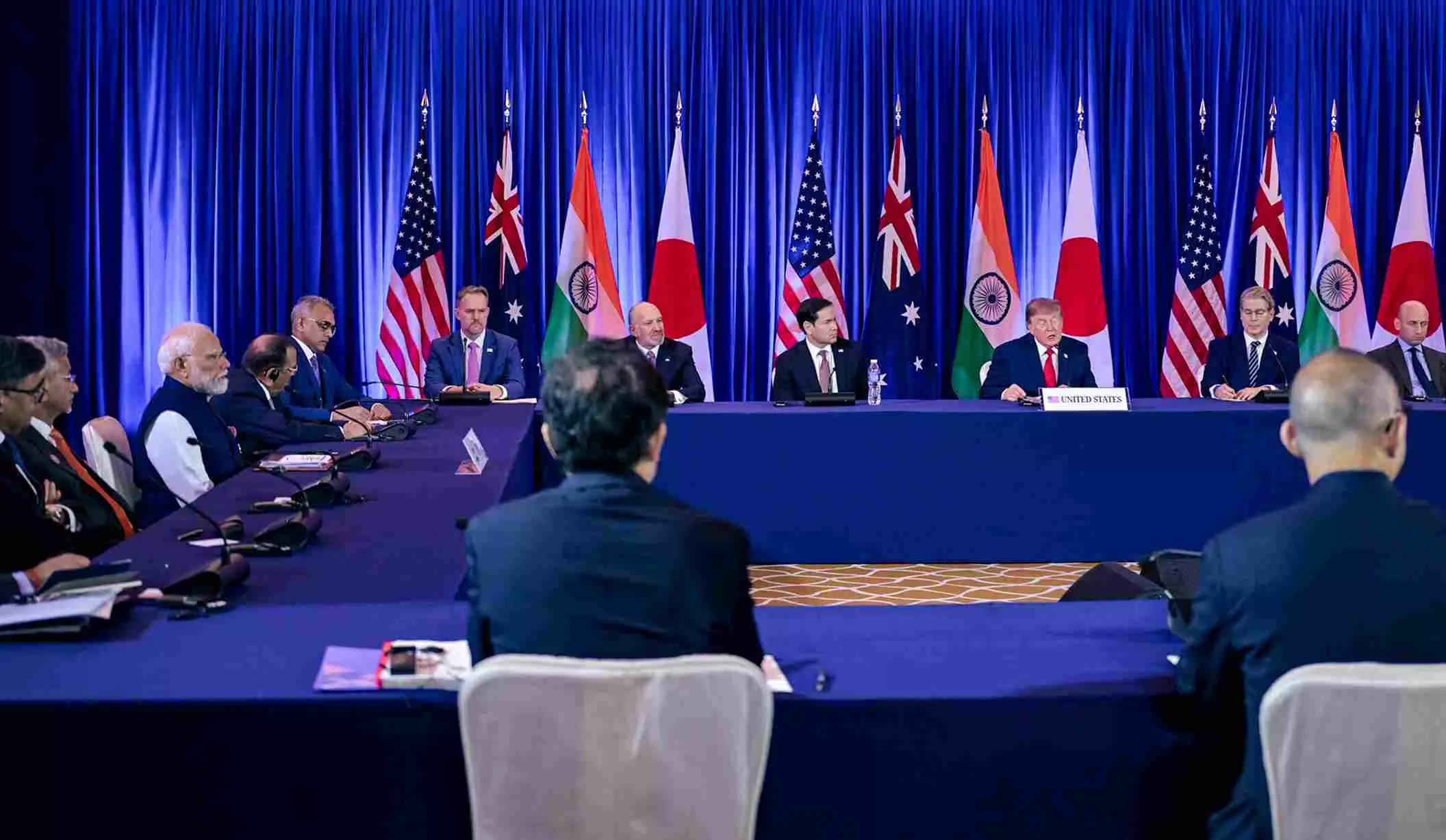
Fifty-five minutes. That is all the time US President Donald Trump has set aside for the QUAD leaders’ summit in Manila, during a hectic 24-hour stopover before heading to China for talks with President Xi Jinping. The timing and brevity of the meeting are telling. Once seen as a major strategic grouping to counter China’s growing influence in the Indo-Pacific, the QUAD appears to have lost much of its earlier momentum as Washington and Beijing seek to establish a measure of strategic stability in their bilateral relationship.
Also read | Quad Summit: Trump calls Modi a ‘very tough man’, lauds him as a ‘great leader’
The grouping is still being kept afloat, though there is little public appetite to acknowledge that its strategic significance has diminished. Much of the credit for fitting the meeting into Trump’s packed Manila schedule, towards the end of the ASEAN and East Asia summit engagements, goes to Secretary of State Marco Rubio. The question is whether the QUAD can regain its strategic purpose or whether it is increasingly becoming a forum that its members are reluctant to abandon but have little urgency to advance.
Trump’s charm offensive
Ahead of the meeting, as the four leaders — Prime Minister Narendra Modi, Japan’s Sanae Takaichi, Australia's Anthony Albanese and Trump — posed for a photograph, the US president appeared relaxed and was in the mood to field reporters’ questions. He called Modi a “tough leader” and Takaichi “even tougher”. A sombre-looking Modi, meanwhile, appeared keen to usher everyone into the meeting room.
“For India, the QUAD is a constructive and trusted partnership. From maritime security to trusted supply chains, new technologies to disaster response, it has been our endeavour that the QUAD provides trusted solutions,” the Prime Minister said in his address. “I am confident that our meeting today will help us in setting concrete goals for the next phase of our cooperation,” Modi added.
Trump, in his speech, painted a rosy picture of the QUAD, speaking of the revival of the grouping. “It was quite a year we had. The QUAD’s revival and our cooperation has only grown much deeper. We are all friends. It’s a lot easier that way.” He went on to add: “These nations represent some of the most important partnerships in the entire world. We are among the most successful nations in the world ... Our countries are the four corners of a free, stable and most prosperous Indo-Pacific.”
He also spoke about the new AI initiative within the QUAD, saying, “We want to ensure that the future of this critical technology is dominated by nations that share our values and our common interests.”
Australian Prime Minister Anthony Albanese identified critical minerals and artificial intelligence as priorities for the QUAD’s economic future, while also underlining the importance of maritime security in the region.
QUAD seeks to deepen cooperation
Beyond the rhetoric, the summit produced a series of initiatives covering technology, maritime security, critical minerals and cybersecurity. In their joint statement, the four leaders outlined the following initiatives and commitments:
● AI Accelerator: Highlighted the importance of the AI Accelerator, announced by their foreign ministers in Atlanta. The initiative is intended to coordinate and fund efforts to support trusted access to AI, its deployment and technical assistance across the Indo-Pacific.
● Quad Business Leaders’ Forum: Announced that the forum would be held in early 2027, bringing together business leaders, government officials and policy experts from QUAD countries to foster stronger business ties, including commercial deals and partnerships.
● Indo-Pacific Maritime Surveillance Collaboration: Announced a new initiative to enhance information-sharing and maritime domain awareness. In 2027, their respective P-8 and P-3C patrol aircraft are scheduled to take part in a maritime exercise for the first time in a QUAD context, with the aim of making the seas safer.
● Cable connectivity: Announced the expansion of the QUAD Partnership for Cable Connectivity and Resilience to secure trusted communications infrastructure across the Indo-Pacific, including through upcoming undersea cable projects in the Indian Ocean.
● Cybersecurity: Announced enhanced QUAD cooperation on cybersecurity to help ensure an open and secure cyberspace.
● Terrorism: Unequivocally condemned terrorism and violent extremism, including cross-border terrorism.
The grouping also reiterated its support for ASEAN centrality and ended on a familiar note: “Together, we are committed to upholding a free and open Indo-Pacific.”
From revival to renewed uncertainty
Yet, despite the rosy picture the leaders painted of QUAD cooperation, past experience suggests that Trump cannot be relied upon to sustain his commitment. He could turn his back on the grouping tomorrow if closer engagement with China served his interests.
Also read | Jensen Huang, Alice Huang and China spy allegation: Who benefits from the controversy?
The QUAD has experienced several highs and lows over the years. The idea first took shape after the 2004 tsunami, when the navies of Japan, the US, India and Australia worked together in relief operations. But it was only in 2007 that the first meeting of QUAD officials was held in Manila on the sidelines of an ASEAN summit. Shinzo Abe, the late Japanese prime minister, was the driving force behind the initiative.
The grouping fell apart in 2008. Changes of government in Australia and Japan, coupled with Chinese pressure, led to its dissolution. It was revived in 2017 as concerns grew over China’s expanding military power and increasingly assertive actions in the Indo-Pacific. In 2021, the QUAD was elevated to the summit level.
While Trump was enthusiastic about the QUAD during his first term, as he took on China, he has paid scant attention to the grouping during his second tenure.
Trump’s China pivot clouds QUAD
Ironically, the QUAD summit is taking place just ahead of Trump's visit to Shenzhen, China, for the Asia-Pacific Economic Cooperation (APEC) summit. All eyes will be on his meeting with Chinese President Xi Jinping, as the two leaders seek to stabilise their relationship and protect their respective economies amid global turbulence and an intensifying race for AI supremacy between the world’s two most powerful countries.
The Nvidia espionage scandal adds another layer of uncertainty to the relationship. Even as Trump seeks strategic stability with Xi, members of his administration are calling for tighter export controls to plug loopholes in existing restrictions on the sale of high-end chips to China. Additional measures have been put in place to strengthen vigilance and prevent top-of-the-line US-manufactured chips from finding their way into China.
Besides this, Trump, Xi Jinping and Russian President Vladimir Putin are expected to hold a trilateral meeting on the sidelines of the APEC summit. Trump’s interest in the QUAD will depend to a large extent on how US ties with China evolve during the remaining two years of his presidency.
Much of Washington’s interest in the QUAD is driven by its security interests in the Indo-Pacific. How, then, should India view the grouping?
India’s case for staying engaged
For India, the QUAD’s value extends beyond its original objective of balancing China. It offers access to technology, critical minerals and maritime cooperation without requiring New Delhi to enter into a formal military alliance with Washington.
Also read | Why Trump may have shielded NVIDIA despite spy warnings
As Ambassador Anil Wadhwa points out, unlike Japan and Australia, India is not a defence partner of the US. “The US has turned to AUKUS (Australia, UK and US) as a military grouping to counter China, but still sees some value in keeping the QUAD going as an additional pressure point.”
By being part of the QUAD, India stands to gain in areas such as technology, critical minerals and underwater cooperation, he explains.
“India is happy to cooperate in a non-military manner with other like-minded democracies,” says Wadhwa. “Even if US interest wanes, the other three partners are fully supportive of mutually beneficial cooperation, which is a good development for India.”
The QUAD’s original strategic rationale remains, but its future will depend on whether Washington is willing to give it the political attention and strategic commitment it once promised.