The CIGI senior fellow examines the origins of the allegations, challenges the reported US intelligence assessment and argues that the controversy may be distracting attention from political and economic pressures in the US.
Jensen Huang, Alice Huang and China spy allegation: Who benefits from the controversy?
Einar Tangen questions timing of espionage allegations, arguing that the controversy serves political, corporate and regulatory interests in Washington

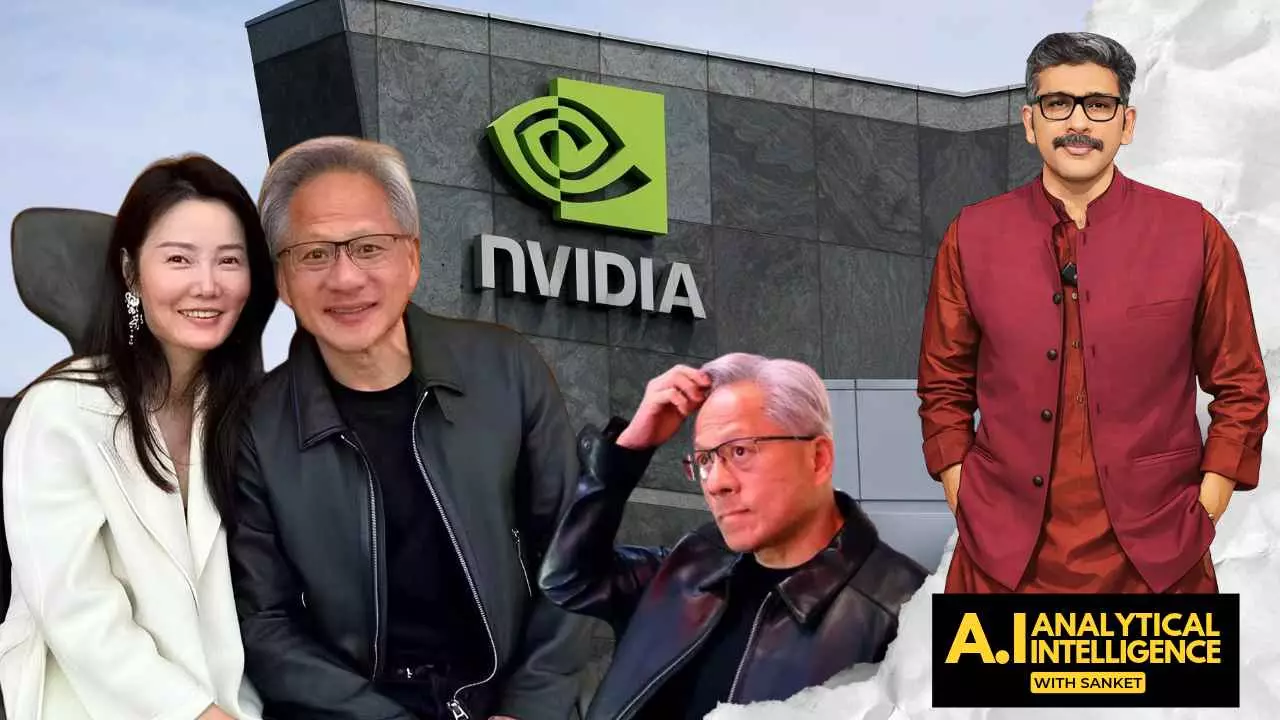
The controversy surrounding Nvidia co-founder Jensen Huang, his relationship with former Megaspeed executive Alice Huang and allegations of Chinese espionage has raised questions about the intersection of technology, geopolitics and national security.
While reports in the US suggest Chinese intelligence recruited Alice Huang to gather information on Nvidia, Beijing has rejected the allegations. Speaking in the the latest episode of The Federal's special programme AI With Sanket, Einar Tangen, senior fellow at the Centre for International Governance Innovation (CIGI), examines the origins of the allegations, questions the absence of publicly available evidence and discusses who could benefit from the controversy.
Edited excerpts:
The allegations surrounding Alice Huang reportedly date back to 2024. Why have they suddenly come to the forefront now?
In 2024, allegations were communicated to the governments of Taiwan and Singapore, which expressed concerns about her and many others. At that time, there were genuine concerns about Nvidia chips being used in China.
In 2025, US President Donald Trump was briefed about her. We do not have any proof of what those concerns were based on. However, they briefed him a couple more times.
Also read: Why Trump may have shielded NVIDIA despite spy warnings
Whatever information was given to him was apparently not convincing, as he continued to maintain an active dialogue with Jensen Huang. Jensen was very concerned about ensuring that Nvidia had an open market in China, which accounted for a huge part of the company's market.
Alice was an executive at a Singapore-based company that purchased $4.2 billion worth of chips. The company provides computing services.
Chinese private companies that could not directly obtain Nvidia chips had to find alternative ways of accessing computing power. The Chinese government itself had, in essence, outlawed Nvidia chips because it viewed them as a security threat.
This was largely influenced by what Donald Trump had said during negotiations: that the US would provide chips that might come with some extra special features. These were not the leading chips, and the Chinese government responded by doubling down on indigenous innovation, putting considerable resources into companies such as Huawei.
Huawei and Nvidia are different. Understanding what Nvidia is doing, beyond knowing how successful it is, is not particularly important to Huawei because the company is pursuing a different technological approach.
Private Chinese companies are very interested in Nvidia chips because they are faster and somewhat more efficient. This gives them an advantage as they compete fiercely with one another.
Who benefits from bringing these old allegations back into the news?
For Donald Trump, this is welcome news. He tries to put something out almost every day that distracts the press from the Epstein files, domestic problems and the international situation.
The second group is the AI technology companies and Wall Street.
They are facing a potential write-down. There is an AI bubble. It is not that AI has no value; the problem is that its value has been inflated. If you add up the valuations of all the companies involved, their combined value is actually greater than the GDP of the United States.
These valuations depend on the assumption that trillions of dollars will eventually be devoted to their solutions.
That has traditionally been the American and European business model: develop the intellectual property and then extract value from everybody else.
But the Chinese beat them to the punch. They adopted a different approach. They were not going to build a closed AI system. They developed open AI models, allowing people to access the underlying libraries for free.
That undermines the business plans of American companies with enormous valuations.
The third group, I would say it was Congress.
Remember, under Donald Trump and a Republican majority, he had said, 'Let AI be AI.' Let these companies go out, compete and win. I do not know how you win a race that never ends, but putting that aside, Trump's position was that there should be no restrictions on these companies.
Also read: Nvidia CEO Jensen Huang resigns, Colette Kress named interim chief executive
Then his party spectacularly lost the election. People were upset, and AI was among the major issues on their minds.
So, here is a group pushing for greater restrictions on AI. Suddenly, a sensational and salacious case falls into its lap, or somebody brings it to its attention, and it becomes a cause célèbre.
Already, we are seeing numerous investigations by different committees of Congress and the Senate.
So, three interests are being served here. The person whose interests are not being served, of course, is Jensen Huang. He may have had indiscretions, but nothing has been proved.
You have questioned the allegations coming from Washington as speculation and an attempt to deflect attention. But aren't you also speculating about the motives of the people involved?
I am saying that the accusation is there, but no facts have been put forward publicly.
Let me put forward what has been reported in the American media. US intelligence reportedly concluded that Alice Huang was recruited by China's Ministry of State Security (MSS) to collect intelligence on Nvidia, advanced AI chips and Jensen Huang. The objective was possibly to influence greater chip sales and availability to China or obtain insights into US policy. A memo containing this assessment was reportedly shared with senior officials, and electronic surveillance allegedly supported the assessment of her role and relationship. None of these details has been officially disclosed by the US government. How do you respond to these reports?
First, as the head of the CIA has said, intelligence agencies lie, cheat and steal, and then tell people that they do not. They also lie to the American people.
It is not just the CIA. Almost all intelligence services try to mislead people to gain an advantage.
I think you and I can agree that the United States views China as an existential threat.
We can also agree that the US has been advertising for spies and intelligence assets on the internet. Generally, you do not do that. That is not Spycraft 101.
Also read: Elon Musk signs petition seeking Jensen Huang's reinstatement as Nvidia CEO
This goes back to 2010, when the entire network of CIA assets in China was somehow discovered and dismantled. Many of those people were killed or sentenced to life imprisonment.
Since then, CIA officials and others have repeatedly said that the United States is essentially flying blind in China.
But now we are expected to believe that their intelligence assessment capabilities have improved to the extent that they know exactly who is recruiting whom and for what purpose.
But what if the Chinese government publicly says that it does not want Nvidia chips while simultaneously using agents to gather information and establish closer connections with the company? Information itself can be valuable. Could that not be part of China's strategy?
That would be a great strategy if they were actually doing it.
But consider what Donald Trump said on 60 Minutes. He said China was investing more money in developing AI than he had ever seen.
Where are they investing that money? Why would China be pouring tens of billions of dollars into Huawei and other companies to develop an entirely different solution if its objective was simply to acquire Nvidia chips and use them?
Does that make sense?
Would the idea be to throw away all that money? I do not think China has money to throw away.
There are many problems in China that the government is trying to solve, and money is a scarce commodity.
So, this speculation that China is deliberately creating a diversion or pursuing a completely different strategy as a cover is not supported by following the money.
It is always possible, but it is not probable. I think you would agree.