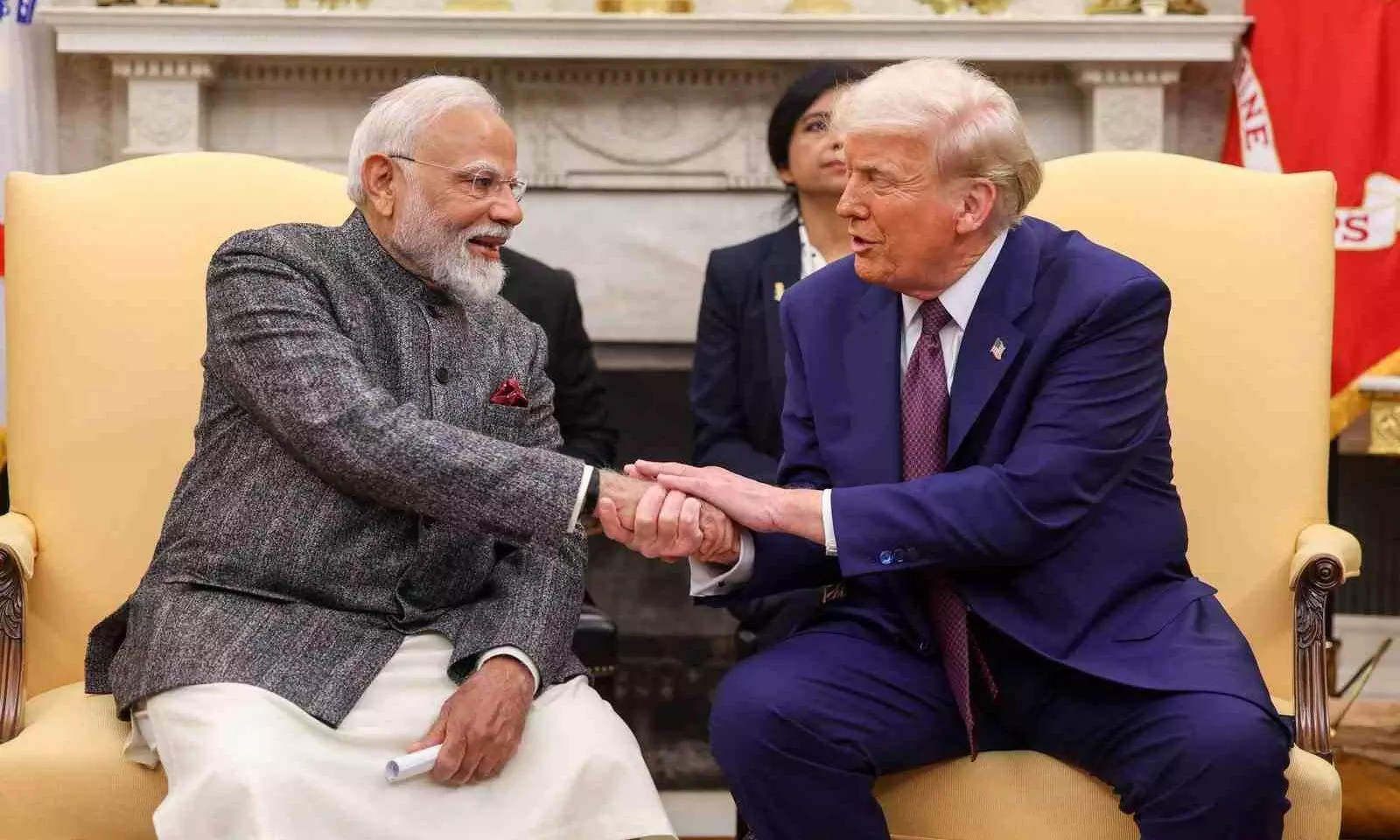
Ahead of the G7 summit, Prime Minister Narendra Modi appears reluctant to publicly confront Donald Trump and risk straining ties.
3 Indian lives lost: India's diplomatic shrug exposes Modi's muscular image
New Delhi routinely flexes its muscles with neighbours like Pakistan and Bangladesh, yet shrinks from taking on Trump and Washington

India’s muted reaction to America’s targeting of oil tankers manned by Indian seafarers off the coast of Oman, resulting in the death of three Indians will be a blow to Prime Minister Narendra Modi’s image as India’s strongest leader since Independence, ready to leap to the defence of his countrymen.
His admirers have constantly mocked Modi’s predecessor Manmohan Singh for being weak-kneed in the face of grave provocation against India. But neither the Prime Minister nor any of his Cabinet colleagues have uttered a word after three successive attacks on Indian sailors by the US so far. It was left to the MEA to issue a statement.
India's meek response raises questions
India's mild response raises uncomfortable questions about the limits of New Delhi's strategic autonomy. No one disputes that the United States remains the world's pre-eminent power, or that India benefits enormously from access to American technology, investment and defence cooperation. Yet friendship cannot be a one-way street. The use of Hellfire missiles against vessels crewed by Indians warranted a much stronger reaction.
Also Read: India-US trade deal: Have farmers’ interests been traded away?
New Delhi routinely adopts a muscular tone with neighbours such as Pakistan and Bangladesh, but appears far more hesitant when dealing with Washington. Prime Minister Narendra Modi's reluctance to publicly challenge President Donald Trump may reflect the desire to preserve a relationship that is recovering after a turbulent start last year, particularly ahead of their expected meeting at the G7 summit. But India is not without leverage of its own.
As one of the world's largest markets and a major source of skilled talent, it is a country whose partnership is actively sought. Strategic ties with the United States are important, but so too is the principle that Indian lives and interests cannot be treated as collateral damage.
Excuses hold no water
Excuses like the claim that many Indian seafarers operate shadow or dark fleets carrying Iranian oil are beside the point. The fact that three Indian lives were lost is what is important.
The irony is that India and the US tom-tom their relations as a comprehensive global strategic partnership anchored by shared democratic values and mutual interests in free and open navigation. The least that the US could do is to apologise. There was no such gesture.
''Prime Minister Modi should convey to President Trump that the three Indian seafarers were not “ collateral damage” but victims of a wrongful attack requiring accountability, and demand that strikes in commercial shipping in Hormuz must be avoided, urge a diplomatic de-escalation of the conflict rather than unilateral maritime enforcement that harms third parties,’’ says Anil Wadhwa, a former Indian ambassador to Oman.
``We need to escalate our demands for concrete guarantees to protect Indian seafarers, and also ask that India-US and Oman jointly conduct an investigation to ensure full transparency,’’ adds Wadhwa.
''India’s stance must be firm yet strategically measured: we should strongly condemn the attack as a disproportionate violation of international maritime law, demand an immediate and permanent cessation of all US strikes on commercial shipping,’’ he added.
'Wishy-washy statement'
Jason Meeks, the US Chargé d'Affaires, was summoned by the ministry for the second time this week. The MEA's statement released on Friday is, at best, wishy-washy.
``A strong protest was lodged with him regarding the continuing attacks by U.S. naval forces on commercial vessels carrying Indian mariners in the Gulf of Oman, which have already resulted in the tragic and avoidable loss of three Indian lives.’’ India also conveyed concern over the use of ``lethal force’’, an obvious reference to the Hellfire missiles that were fired at the engine room of the ships. New Delhi expressed ``strong concerns’’ and asked the US forces to take all measures to prevent the loss of civilian lives.
Also Read: India must recalibrate its Pakistan policy as isolation strategy fails
Could the mandarins in the ministry not come up with a stronger statement to convey India’s anger over the loss of lives?
The irony is that India and the US tom-tom their relations as a comprehensive global strategic partnership anchored by shared democratic values and mutual interests in free and open navigation. The least that the US could do is to apologise. There was no such gesture.
The US Central Command (CENTCOM) admitted that it had fired Hellfire missiles at the engine room of the MT Settebbello, a Palau-flagged tanker. That none of the vessels was an Indian-flag carrier is besides the point. The fact is that three Indian citizens were killed, and America owes an explanation.
'India should have moved a resolution'
``The Central Command, it appears, has not acted right. Even if firing were required to make the ship change its course, it is customary to fire into the air, near the ship, and if necessary, the side of the ship. Never at the engine room and cause fire there unless the intention is to kill the sailors,’’ says Ambassador KP Fabian, a retired Indian diplomat who served in Iran and Qatar.
A government that prides itself on speaking for Indians everywhere cannot afford to be selective about whose actions it is willing to question.
``Washington showed it did not take it seriously when another attack followed after India’s earlier protest.” He went on to say that India, as the chair of BRICS, should have moved a resolution when the foreign ministers met in Delhi last month, to send a humanitarian mission to the stranded ships as they might have run short of food, medicines and so on. The mission should have included doctors and nurses.``As a good part of the sailors are Indians, why didn't MEA think about it ?’’ he asked.
A government that prides itself on speaking for Indians everywhere cannot afford to be selective about whose actions it is willing to question.