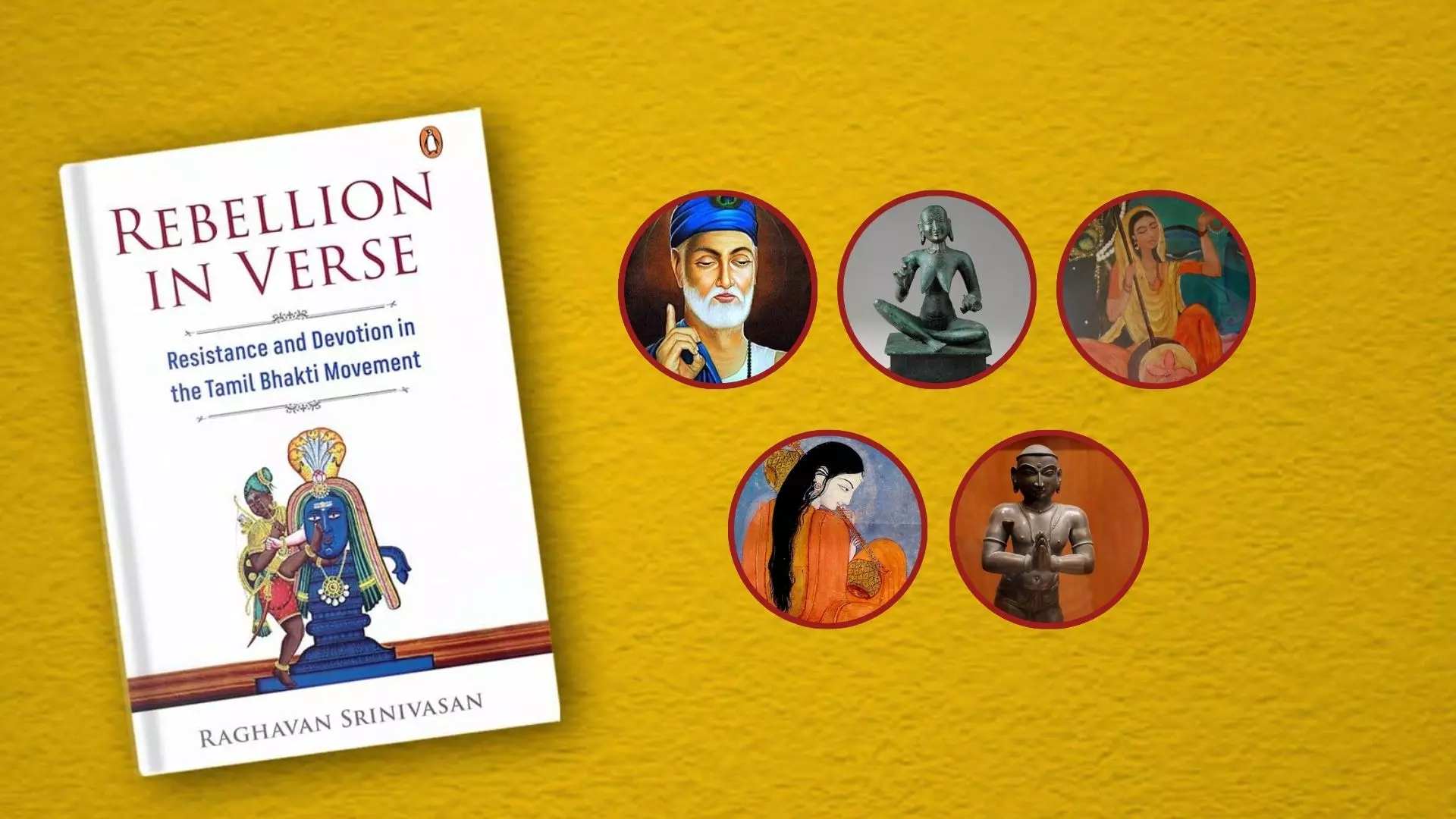
Raghavan Srinivasan discusses Bhakti roots
Raghavan Srinivasan on how Tamil saints led India’s first spiritual rebellion, Bhakti Movement
Raghavan Srinivasan talks about his book, Rebellion in Verse, which traces Bhakti’s roots in Tamilakam, where devotion, poetry, caste defiance, and language merged into a movement

Long before northern mystics like Kabir, Meera Bai, or Guru Nanak sang of divine love, the earliest tremors of India’s devotional revolution were already echoing across Tamilakam. In this wide-ranging interview, Raghavan Srinivasan, author of Rebellion in Verse: Resistance and Devotion in the Tamil Bhakti Movement (Penguin Random House India) argues that Bhakti was not born as quiet piety but as cultural dissent, shaped by poet-saints such as Appar and Karaikkal Ammaiyar, and other figures from the margins who challenged caste hierarchy, priestly authority, and the monopoly of sacred language. Their choice to sing in Tamil rather than Sanskrit, he suggests, was not merely literary, it was political. He also talks about why this early southern movement resonated with both commoners and kings like Rajaraja Chola, whether Bhakti’s egalitarian core survived its journey north, and how women mystics such as Andal transformed devotion into something intimate, bold, and even defiant.
At a moment when Bhakti is often invoked in modern identity politics, Srinivasan returns us to its original pulse: a poetic uprising that insisted the divine belonged equally to everyone. “Bhakti emerged from a social churning that challenged caste, ritual hierarchy, and the monopoly over God,” says Srinivasan. In the book,
In his book Rebellion in Verse: Resistance and Devotion in the Tamil Bhakti Movement, published by Penguin Books, he argues that the Tamil Bhakti movement predated and shaped devotional currents in the north. Srinivasan talks about the movement’s origins, its political undercurrents, women mystics, royal patronage, and why its message remains urgent today. Excerpts:
Your central argument is that the Tamil Bhakti movement was a precursor to the northern Bhakti movement. Could you explain how it spread?
Yes, that is what distinguishes my book from many others. There are books on the Bhakti movement that focus largely on devotion. I wanted to talk about rebellion. Very few people know that the Bhakti movement had its origins in Tamil Nadu. People have heard about Mirabai’s bhajans, Kabir’s dohas, or Guru Nanak. But this was a long trend that continued for centuries with a core principle that remained the same.
Also read: How Assam’s Kaziranga National Park became a stronghold for the vulnerable fishing cats
In the south, the movement began between the sixth and ninth centuries. Most of the saints lived between the late fifth and ninth centuries. During their lifetimes, their corpus was not gathered together. That happened later. From Tamil Nadu, the movement spread to Karnataka. You would have heard of the Lingayat movement associated with Basava. From there, it spread to Maharashtra, and then to many areas in the north and east. You find Bhakti saints in Odisha, West Bengal, and even the Northeast speaking the same language.
They were all against casteism. They opposed discrimination based on caste or wealth. They challenged denying temple access to so-called outcasts. The basic idea was simple: everyone should have access to God. God is not a monopoly of the higher castes or Brahmins. You do not need an intermediary.
You argue that Bhakti was not just spiritual but also political and social. How so?
One cannot deny that the movement was devotional and religious. It developed iconography and drew on the Puranas. But many have written about that. I wanted to focus on the socio-political changes it brought. There was a big churning in the sixth century when empires like the Pallavas were being established. Economic growth led to rigid structures and widening inequality. Certain sections became richer, while artisans and agricultural communities struggled.
As trade flourished and cities expanded, many from villages migrated to urban centres. Like today’s migration, they lost kinship networks and support systems. In Tamil Nadu, workers, artisans, carpenters, and fishermen settled in cities and felt a void. That is when the saints stepped in. Many of them came from ordinary or marginalised sections. They offered a simple path—no elaborate rituals, no expensive sacrifices. Even if you had no money, you could pick leaves and flowers and offer them to God. That was Bhakti at that time.
You trace the roots of the movement to the Sangam period. How did Sangam literature influence Bhakti?
Yes, it was a wellspring. But Bhakti had its own ideology and style. Sangam literature, though much has been lost, still survives in considerable corpus. It broadly dealt with kings and their valour, and with ordinary people — their love, separation, and daily lives. It was rich in geography and cultural detail.
It was loved because it spoke of ordinary concerns. People could relate to it. But there was a gap between the later Sangam phase and the Bhakti period. Between the fourth and sixth centuries, inscriptions are scarce. Buddhism and Jainism were influential. What divides the Sangam period from the Bhakti movement is economic development and urbanisation. Empires emerged, administrative systems became rigid, and society transformed. Bhakti belongs to that changed world.
Was the decision to write in Tamil rather than Sanskrit a political act?
In a way, yes. Early Sangam works were entirely in Tamil. Later, during the epic period, there was more Sanskrit influence. By the sixth century, Sanskritisation was advanced. Even Pallava inscriptions were in Sanskrit. But artisans and ordinary people could not access Sanskrit texts or afford elaborate rituals. Royal courts used Sanskrit, but it did not meet people’s aspirations.
So Tamil once again became the medium of poetry. It was a way to restore access to spirituality for the common person.
Let’s talk about women poets like Andal and Karaikkal Ammaiyar. What made their poetry so powerful?
We cannot look at their poetry without understanding their situation as women. Andal and Karaikkal Ammaiyar wrote brilliant poetry that remains popular even today. Their verses are recited daily in homes.
Andal was adopted by a poor Brahmin priest who was himself a saint. She refused to marry in the conventional sense and declared she would marry only God. That was a bold statement for her time.
Also read: How a rehabilitation centre in Kerala gives rescued elephants chain-free, natural environment
Karaikkal Ammaiyar came from a wealthy family. Her husband was a merchant. She gave up wealth and beauty, turned herself into an ascetic figure, and travelled singing songs on Shiva. She showed that if you wanted independence, you could pursue it, even if society did not fully allow it.
It was not a period of gender equality. Women faced discrimination. To achieve sainthood, they had to be extraordinary — more so than male saints. Yet they were eventually revered, and male saints wrote about them. That was acceptance.
Did Andal’s poetry foreshadow Mirabai’s?
I am not sure there was a direct connection. The centuries apart make it difficult to establish. It is not recorded. But Mirabai was certainly influenced by the movements around her. She did not get her ideas suddenly. Perhaps she heard of Andal or the Tamil Bhakti movement — we do not know.
The confidence in Mirabai’s bhajans — the assertion that she could choose devotion over marriage — echoes a similar spirit. Being with God is symbolic. It is a statement that you want to depart from your daily, imposed life.
What role did royal patronage, especially under Rajaraja Chola, play in shaping Bhakti?
Rajaraja Chola I ruled when temple construction expanded dramatically. Until the Chola period, the Bhakti corpus was not fully compiled. During the Chola era, massive temples were built. These temples required an ideological base.
Intelligent rulers took advantage of the movement and made it larger than life. The corpus of poems was compiled and later gathered geographically. What survives today largely comes from that period. Otherwise, much would have been lost.
Why did you feel it was urgent to chronicle the Nayanars and Alvars today?
Today, we are fighting against the same issues the saints fought against — caste discrimination and inequality. If people receive good education at affordable cost, marginalisation will reduce. That is what the saints did — they educated through poetry and song. Today, access to temples can depend on money. You may have to pay large sums for privileged access. You cannot approach God without a priest. Rituals dominate. The saints spoke of love, equality, and respect for all. Leading poets among the Nayanars and Alvars praised saints from marginalised castes, such as hunters and fishermen. They set an example.”
In times of bigotry and appropriation, has the essence of their message been lost?
At one level, saints have been reduced to statues. Their verses are memorised, but their histories are forgotten. People do not know the lives of outcaste saints or their struggles. In many temples, you see statues of Nayanars and Alvars near the main deity. But the message is lost. What I have tried to do is revive that message.
The content above has been transcribed from video using a fine-tuned AI model. To ensure accuracy, quality, and editorial integrity, we employ a Human-In-The-Loop (HITL) process. While AI assists in creating the initial draft, our experienced editorial team carefully reviews, edits, and refines the content before publication. At The Federal, we combine the efficiency of AI with the expertise of human editors to deliver reliable and insightful journalism.