How fishing-permit delays became an ‘unwritten ban’: SC’s purse-seine ruling decoded
As SC finds TN verified only 31 of 257 applications for EEZ access, here’s how purse-seining works, why TN restricts it and why two govts control the journey

The Supreme Court’s ruling on purse-seine fishing begins with a simple geographical problem. Tamil Nadu prohibits this fishing method in the sea closest to its coast. The Centre can permit it farther out. A boat must cross the first area to reach the second.
The case asked how Tamil Nadu could protect coastal fish while allowing passage to Centre-regulated waters. The Court combined conservation, tracking, a special route, and faster permits.
What did Supreme Court decide?
In its September 2 judgement in Fisherman Care v Government of India, a Bench of Justices Pamidighantam Sri Narasimha and Alok Aradhe examined applications for “access passes”, the central government’s permission for eligible fishing boats to operate in India’s Exclusive Economic Zone or EEZ. The EEZ is the sea between roughly 22 and 370 kilometres from the coast, where the Centre controls the use and conservation of resources such as fish.
As of August 3, fishermen had filed 257 applications. Tamil Nadu was yet to verify 226, while only six passes had been issued. The Court said such delay virtually created an impermissible “unwritten ban”.
Also read: New deep-sea fishing rules favour corporates, rue small-scale fishers
It directed Tamil Nadu to process applications effectively and on time. The state must also mark a transit channel, an officially designated sea route through which boats carrying purse-seine nets can cross coastal waters and proceed farther out.
What is purse-seine fishing?
Sardines, mackerel and tuna often swim near the surface in a tightly packed group called a school. Sardines are small fish, rich in natural oils, that gather in very large groups near the coast. Mackerel are somewhat larger, fast-swimming fish commonly eaten in India. Tuna are much larger open-sea fish that travel long distances and have high commercial value.
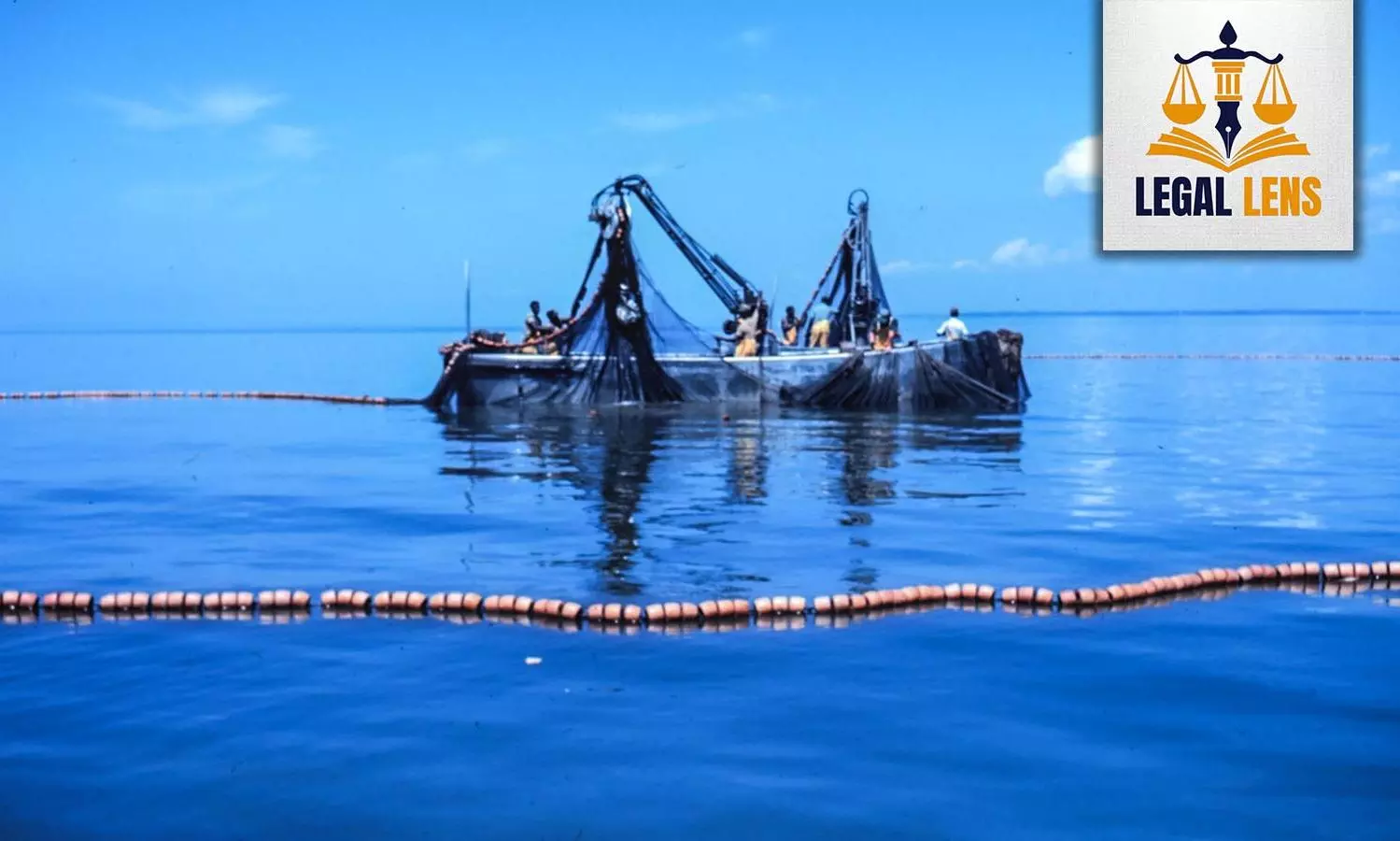
Purse-seine fishing catches these fish by surrounding the school. After locating it, a boat travels in a circle while releasing a long wall of netting. Floats keep the upper edge at the surface, while weights pull the lower edge down.
Once the circle is complete, the crew pulls a cable threaded through metal rings along the bottom. This closes the net like the drawstring of a purse, enclosing the fish from the sides and underneath. The crew then draws the net towards the boat and lifts or pumps the concentrated fish on board.
A trawler catches fish by towing a net through the water or along the seabed. A purse-seine boat catches by encircling a visible group near the surface.
Purse-seining can capture a large part of a school in one operation. But this efficiency also creates a conservation concern. A school may contain juvenile fish, meaning fish below breeding age. Catching them early reduces the number that can reproduce and replenish the fish stock, the population of that species living in the area.
Also read: Why Kerala is opposed to Centre’s deep-sea fishing draft rules
Mesh size is another important factor. It means the width of the openings in a fishing net. Larger openings allow smaller fish to escape. The Food and Agriculture Organization says purse-seining can target a species identified before the net is set, while enclosing fish of different sizes within that school. A 2025 NITI Aayog strategy discusses larger mesh sizes for targeting larger fish.
Why did Tamil Nadu restrict the method?
On March 25, 2000, Tamil Nadu prohibited purse-seining and pair trawling in its coastal waters to conserve the fishery, particularly juvenile fish. Pair trawling uses two boats to pull one large net between them.
Tamil Nadu’s 2020 Marine Fishing Regulation Rules continued to regulate fishing methods and boat movements in coastal waters. Fishermen sought permission to carry purse-seine nets through this area and deploy them after crossing the coastal boundary. Tamil Nadu feared that boats could use the nets during transit, making enforcement difficult.
Where does Tamil Nadu’s authority end?
A nautical mile is a distance unit used at sea and equals 1.852 kilometres. India’s territorial waters extend 12 nautical miles, roughly 22 kilometres, from the baseline. The baseline is the legal coastal line from which sea distances are measured.
Territorial waters are the belt of sea closest to the coast over which India has full governing authority. State governments regulate fisheries, meaning the catching, conservation and management of fish, within this belt.
Beyond it lies the EEZ, extending up to 200 nautical miles, roughly 370 kilometres, from the baseline. India has exclusive rights to use and conserve natural resources such as fish in this area under the Maritime Zones Act, 1976.
Also read: How Andhra fishermen’s desperate chase for catch lands them in foreign jails
The Constitution divides law-making subjects through lists. Entry 21 of the State List assigns coastal fisheries to states. Entry 57 of the Union List assigns fishing farther out to Parliament and the central government, called the Union in the judgement.
The Court called the powers “co-equal and autonomous”. Tamil Nadu independently controls coastal fishing and the Centre controls EEZ fishing. A boat leaving a Tamil Nadu harbour crosses both areas.
How did the dispute develop?
The Madras High Court upheld Tamil Nadu’s restriction in April 2021. Fishermen then approached the Supreme Court for access to the EEZ.
In August 2022, the Court asked the Centre to form an expert committee, a specialist group studying purse-seining. Its first report favoured regulation over complete prohibition, recommending specified areas and seasons, boat and net limits, catch declarations and location-transmitting devices.
In January 2023, the Court temporarily allowed registered boats to purse-seine in the EEZ. Conditions included location trackers, approved places for bringing catches ashore, fixed operating times, crew identity cards and journey data.
The committee’s May 2024 final report proposed annual transit permits, specified harbours, emergency alerts and catch logs recording the fishing area, days and quantity caught. It assessed the overall impact as limited while recognising risks from overfishing, which means catching fish faster than populations can replenish themselves, and juvenile capture.
How does the access-pass system work?
The Centre formally published the Sustainable Harnessing of Fisheries in the EEZ Rules, 2025 on November 4, 2025. The access-pass system began operating across 13 coastal states and Union Territories in February 2026.
Also read: As pollution depletes catch, Gujarat fishermen at peril of getting nabbed in Pakistani waters
Applications are filed through the ReALCRaft, short for Registration and Licensing of Fishing Craft, a national portal for registering fishing boats and processing licences. A Tamil Nadu fisheries officer checks the documents and physically inspects the boat. A central fisheries officer then decides whether to issue the pass. Access, therefore, depends on action by both governments.
The rules require an ecosystem-centred plan, meaning limits based on the health of marine habitats and fish populations. Boats must report catches, carry crew identity cards and follow controls against juvenile capture and fishing that evades permission or conservation rules.
The pass applies to mechanised boats, which use engines for movement and fishing operations, and motorised boats longer than 24 metres, which use engines mainly for movement. Traditional craft powered by oars or sails are exempt.
Why did the delay become a rights issue?
Article 19(1)(g) of the Constitution protects a citizen’s right to choose and pursue a profession, occupation, trade or business. The government may impose fair restrictions for purposes such as safety and conservation.
Also read: Kerala govt, Opposition unite to oppose Centre’s offshore mining plan
The Court said both governments were legally responsible for making their connected rules work. It called the application figures “rather disturbing” and found a lack of coordinated effort. “Not processing the applications in time virtually amounts to imposing an unwritten ban, which is impermissible in law,” it held.
The Court also invoked “cooperative federalism”. The term means Centre-state coordination where their separate responsibilities meet. In this case, it requires Tamil Nadu to complete verification and regulate passage while the Centre operates the EEZ permission system.
What changes after the judgement?
Tamil Nadu retains its prohibition on purse-seine fishing within the first 12 nautical miles. The Centre’s access-pass, tracking, catch-reporting and conservation rules apply in the EEZ.
The new transit channel is intended to connect these two systems. It should help Tamil Nadu monitor boats crossing coastal waters while giving fishermen a workable path to their authorised fishing area.
The judgement’s practical test will lie in implementation: Movement of the 226 pending applications, timely decisions on future requests and a clearly marked route from Tamil Nadu’s harbours to the EEZ.