Mekedatu is all about drinking water, not irrigation: Karnataka minister
Tamil Nadu, which is objecting to the reservoir project, will also benefit from it, says Karnataka Irrigation Minister N Chaluvaraya Swamy in exclusive interview

Karnataka is deftly moving pieces to make the controversial Mekedatu balancing reservoir project a reality amid pending environmental approvals.
Armed with a new Detailed Project Report (DPR), the state is hopeful of securing all clearances in the next two months. The plan is to start work early next year and wrap it up in three years.
Bengaluru’s water needs
Karnataka Irrigation Minister N Chaluvaraya Swamy said groundwork is being fast-tracked, given the precarious and dwindling water situation across the state, particularly in Bengaluru.
Karnataka Irrigation Minister N Chaluvaraya Swamy
For the record, the project, which will be the largest dam (67.17 TMC) built on the Cauvery in the state so far, is primarily meant to provide potable water for a projected population of 2 crore in and around Bengaluru. According to the new DPR, the estimated cost will exceed Rs 14,000 crore.
“The Mekedatu balancing reservoir project is a primarily drinking water project, let us be very clear. Bengaluru, whose population is currently around 1.50 crore, will receive drinking water from it in future. The project has reserved about 4.75 TMC of water to supply Bengaluru city," Chaluvaraya Swamy told The Federal.
"The water crisis will be severe this year. The project will also help supply potable water to Bengaluru South, Bengaluru Rural, Mandya and the surrounding districts. Combined, water needs are for over 2 crore people. We need to think ahead and get the project executed quicker,” he added.
More power to Bengaluru
Chief Minister DK Shivakumar has already asked Karnataka, particularly Bengaluru and neighbouring districts, to brace for a huge water and power crisis after the poor rainfall/monsoon this year. According to IMD data for August, Bengaluru recorded a 54 per cent rainfall deficit.
Surveys, studies and other related works are being undertaken so that the entire process goes smooth by the time the final approval comes in.
The project also aims to generate power. A blueprint has been prepared for generating about 400 MW, which would be added to the state grid once the project is complete.
Not for irrigation
The minister added that water won’t be used for irrigation at all, one of Tamil Nadu’s biggest concerns. “Will we use water for irrigation or not—that was one of Tamil Nadu’s worrying factors. Recently, our officials made it clear to Tamil Nadu that water won’t be used for irrigation at all. They seemed convinced by the explanation,” the minister said.
The minister said Karnataka officials recently sent Tamil Nadu a Standard Operating Procedure (SOP) that answers questions on water flow, and that the Central Water Commission (CWC) has responded positively.
DK Shivakumar will soon meet Union Jal Shakti Minister CR Patil and, with the cooperation of all the MPs, convince Prime Minister Narendra Modi of the project’s benefits.
How Tamil Nadu will benefit
The minister said that not just Karnataka, but Tamil Nadu will also benefit.
“About 112.88 TMC of surplus Cauvery water flowed into the sea over the last five years. We could have saved the water. The Mekedatu project is, therefore, the only permanent solution: It will benefit both states even in times of drought and store at least 22 TMC of drinking water,” he said.
One big hurdle on Karnataka’s side is getting Forest Department clearance. “We need to set aside equivalent forest land that would get submerged. Forest will be built elsewhere to compensate for the loss. I am holding regular meetings with all District Deputy Commissioners to identify land (revenue and deemed forest land) which can be set aside,” he added.
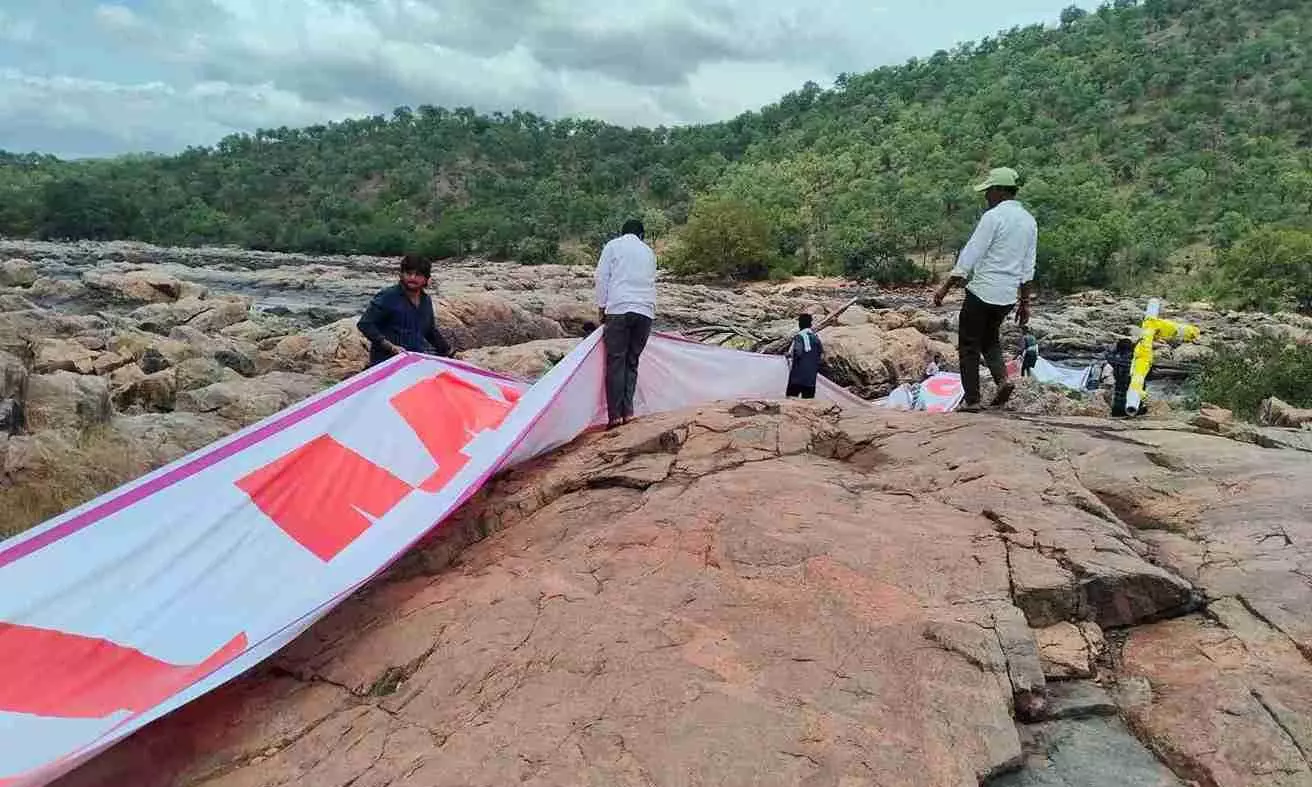
The proposed site of the dam that will submerge 5,173 hectares of land, of which 4,800 hectares is forested.
93 pc of land to be submerged is forested
Amid environmental concerns, the dam will submerge 5,173 hectares of land, of which 4,800 hectares is forest. On farmers and people getting displaced, he said all of them would be relocated.
The aim is to begin work as soon as alternative land is available for the submerged area and to complete it within three years. If all goes well, he said, the work will start next August.
According to the new DPR, the estimated cost will exceed Rs 14,000 crore by the time the project is completed. “When the project was first prepared in 2019, it was estimated at Rs 4,500 crore. In 2024, the estimate rose to Rs 9,000 crore,” he said.
The site for the dam has been marked 2 km from the confluence of the Cauvery and Arkavathi rivers, before Mekedatu. The dam will be 99 metres high and store 67.17 TMC of water, and by that yardstick will be the biggest dam on the Cauvery this side.
Chaluvaraya Swamy said he would soon meet Tamil Nadu Chief Minister C Joseph Vijay to brief him and allay the state’s concerns about the project.
Mekedatu project: Key facts
Project type: A proposed balancing reservoir and dam on the Cauvery River near Mekedatu in Karnataka.
Primary purpose: To provide drinking water for Bengaluru and surrounding regions, not irrigation.
Beneficiaries: Designed to meet water needs of more than 2 crore people, including Bengaluru, Bengaluru South, Bengaluru Rural, Mandya.
Water allocation for Bengaluru: About 4.75 TMC of water reserved for Bengaluru's drinking water supply.
Storage capacity: The reservoir will store 67.17 TMC of water, making it the largest dam on the Cauvery in Karnataka.
Power generation: The project includes a hydroelectric component with planned generation of approximately 400 MW.
Claimed benefits for Tamil Nadu: Karnataka argues the reservoir would help store surplus Cauvery water that currently flows to the sea and could provide benefits during drought years.
Location: The dam site is proposed 2 km upstream of the confluence of the Cauvery and Arkavathi rivers, near Mekedatu.
Dam specifications: Proposed height of 99 metres.
Estimated cost: The latest DPR estimates the cost at over Rs 14,000 crore.
Environmental impact
Total land to be submerged: 5,173 hectares
Forest land affected: 4,800 hectares (about 93% of submerged area)
Displaced people and farmers to be relocated.
Why Mekedatu became contentious
Water expert and former irrigation secretary Captain Rajarao said the Mekedatu project is not a recent development and blamed successive Karnataka governments for the delay.
“Mekedatu is not at all a recent development. It was approved after the 1924 Cauvery Treaty, but the tribunal never settled how to use the river’s surplus water, which is why it is contentious today,” S Rajarao told The Federal.
He criticised the state for waiting for Environment Department clearance instead of using the “deemed terms of reference” provision to submit a detailed project report and move the process forward.
“Had it been done, Mekedatu would not have been the controversy that it is today. However, it looks like this new government under DK Shivakumar is acting fast, and they might make it happen finally,” he said.