Hazy logic: Why India’s air pollution keeps recurring, season after season
India’s air pollution crisis, back in focus due to Diwali, is not a failure of science or policy design, but of governance, enforcement and political will

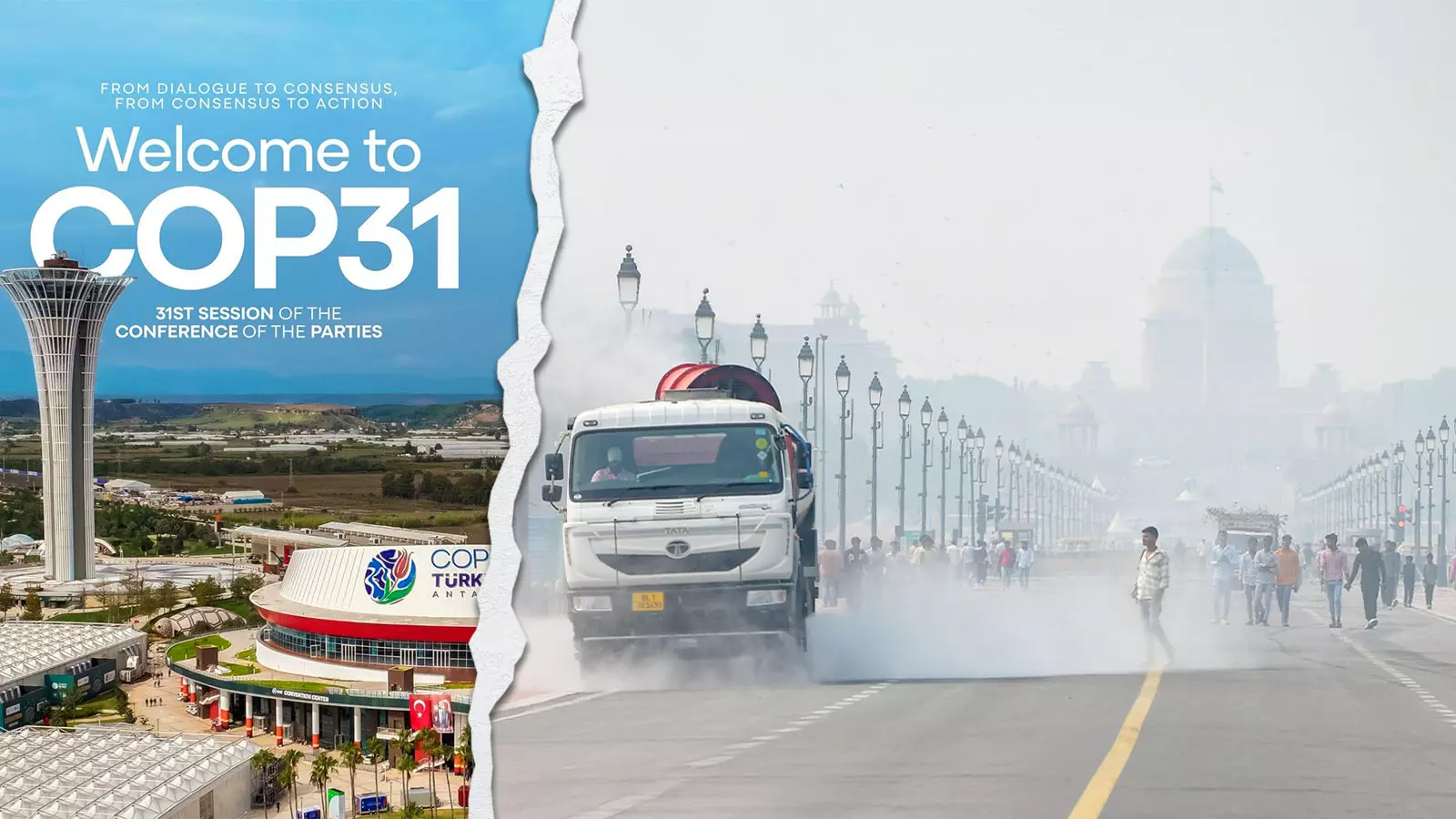
Outside the Antalya Expo Centre in Türkiye, where delegates from nearly 200 countries have gathered for the annual United Nations climate summit, the Mediterranean air is crisp and clear. Inside, delegates are discussing how to cut methane, black carbon and other pollutants that harm health and warm the planet.
Thousands of kilometres away, India is emerging from another Diwali under a thick blanket of toxic air. The haze over the northern plains is familiar, but the problem is no longer confined to the north or winter. Even coastal cities are discovering that geography offers no immunity from pollution.
At the Türkiye summit, the Climate and Clean Air Coalition is pressing governments to turn commitments on short-lived but deadlier climate pollutants into action. India faces a more immediate test.
Why do years of warnings, programmes and judicial interventions still fail to protect its citizens from filthy air?
Also read: Yogi Adityanath downplays Diwali pollution concerns, says ‘it will subside’
The ritual is familiar. Pollution rises, restrictions follow, courts intervene and urgency fades when the air improves. The next season begins much as the last one ended. India has learnt to manage pollution’s headlines, not pollution itself.
Beyond the haze
Diwali firecrackers make the crisis visible, but they are not its cause. India’s air is burdened by emissions from homes, industry, power plants, transport, agriculture and waste burning. Research has shown that fine-particle sources that harm health vary across Indian airsheds. Homes, industry and power generation all contribute. Crop residue burning can worsen particular episodes, but it cannot explain pollution throughout the year.
Even Chennai, often assumed to enjoy better air because of its coastal location, is not immune. The postponement of a tennis final amid smoke and poor visibility was a reminder that pollution does not respect geography. Coastal immunity is a comforting myth, not a public health strategy.
The health toll is severe. ‘The State of Global Air 2025’ assessment estimated that more than two million deaths in India could be linked to air pollution in 2023. A Lancet Planetary Health study found that a 10 microgram increase in annual PM2.5 exposure was associated with an 8.6 per cent rise in annual mortality.
Watch: Delhi pollution: Why did air quality monitors fail on Diwali night?
This is a chronic public health emergency. PM2.5 is fine particulate matter, so small it bypasses the body’s natural defences, enters the lungs and bloodstream, and increases the risk of serious heart and respiratory diseases.
There is a climate cost as well. Black carbon, produced by incomplete burning of fuels and biomass, is part of fine particle pollution. It absorbs sunlight and warms the atmosphere. Deposited on snow and ice, it hastens melting. Black carbon is not synonymous with PM2.5. One is a pollutant, the other a measure of particle size. The World Health Organization explains why reducing short-lived climate pollutants matters.
Rules without results
India’s National Clean Air Programme covers 130 cities. Official figures show that 108 recorded lower annual PM10 concentrations in 2025-26 than in 2017-18, and 14 met the national PM10 standard. These gains do not mean the air is safe. The programme’s headline progress figures focus on PM10, while finer PM2.5 particles pose more serious health risks. An independent assessment by the Centre for Research on Energy and Clean Air has highlighted uneven results, monitoring gaps and incomplete source studies.
The deeper weakness is institutional. Air crosses state and municipal borders but government action rarely does. Central ministries, state pollution control boards and local governments share responsibility, but no single institution is consistently answerable for the air people breathe. Plans are drawn up city by city even when pollution travels across a region.
Also read: CPCB explains why its post-Diwali AQI readings didn’t breach 500
Science points to ways of managing pollution across airsheds. It requires states and cities to share data, coordinate plans and enforce common standards. Monitoring stations must be treated as essential infrastructure. None of this happens consistently in the country.
The Supreme Court’s 29 October judgment in Arjun Gopal v Union of India exposes the implementation gap. The court said it lacked enough evidence to determine whether the blanket firecracker ban imposed in the National Capital Region in 2024 had worked. States had also failed to provide the scientific assessment of green crackers it had sought.
The court ordered monitoring reports before, during and after Diwali, and instructed authorities to inspect stations reported to be non-functional. The judgment lays bare the absurdity. Governments have imposed restrictions without collecting enough evidence to establish whether they work.
A court can order a ban. It cannot maintain monitoring stations, run pollution control boards or make neighbouring states cooperate. Firecracker restrictions cannot compensate for weak enforcement against dust, industry, vehicles and open burning. The failure is not a shortage of orders. It is a shortage of governance that follows through.
Who pays for change?
Sivakasi’s fireworks industry supports manufacturers and workers whose livelihoods cannot simply be discarded. Green crackers developed with technical support from government research labs are designed to reduce particulate emissions by at least 30 per cent against conventional products under the institute’s testing criteria. These so-called green crackers are not pollution-free, and their benefits depend on certification, production and enforcement. The standards are a starting point, not a substitute for regulation.
A green transition that leaves small manufacturers with the costs and workers with the risks will not be fair or durable. A 2025 study of 120 Sivakasi workers has documented insecure employment and occupational hazards. Cleaner production must go with safer work, social protection and support for businesses adapting to new standards.
Justice begins at home
The economic case is strong. A United Nations 2026 assessment examined 25 measures across energy, industry, transport, agriculture, household energy and waste. It estimates that every dollar invested in integrated climate and clean air measures could generate about $15 in benefits. This return spans sectors and includes health and productivity gains. It is not a calculation for firecracker restrictions alone.
Also read: Indian EV sector gets big boost with govt staff cars mandate
India is right to demand climate finance and fairness from countries with greater historical responsibility for global warming. But it cannot separate that argument from its duty to protect its citizens. Climate justice is also about who breathes the pollution, bears the health costs and risks losing a livelihood in the transition.
At the Türkiye climate summit, governments are being asked to turn promises into action. India should not need another winter of choking air, another postponed sporting event or another Supreme Court intervention to recognise the urgency. Clean air cannot remain a seasonal campaign. It must become a measure of whether governments are doing their job.