India’s 5.6 crore pending cases: Who is the biggest litigant of them all?
The government accounts for half of India’s 5.6 crore pending court cases; its own policy to fix this has failed badly

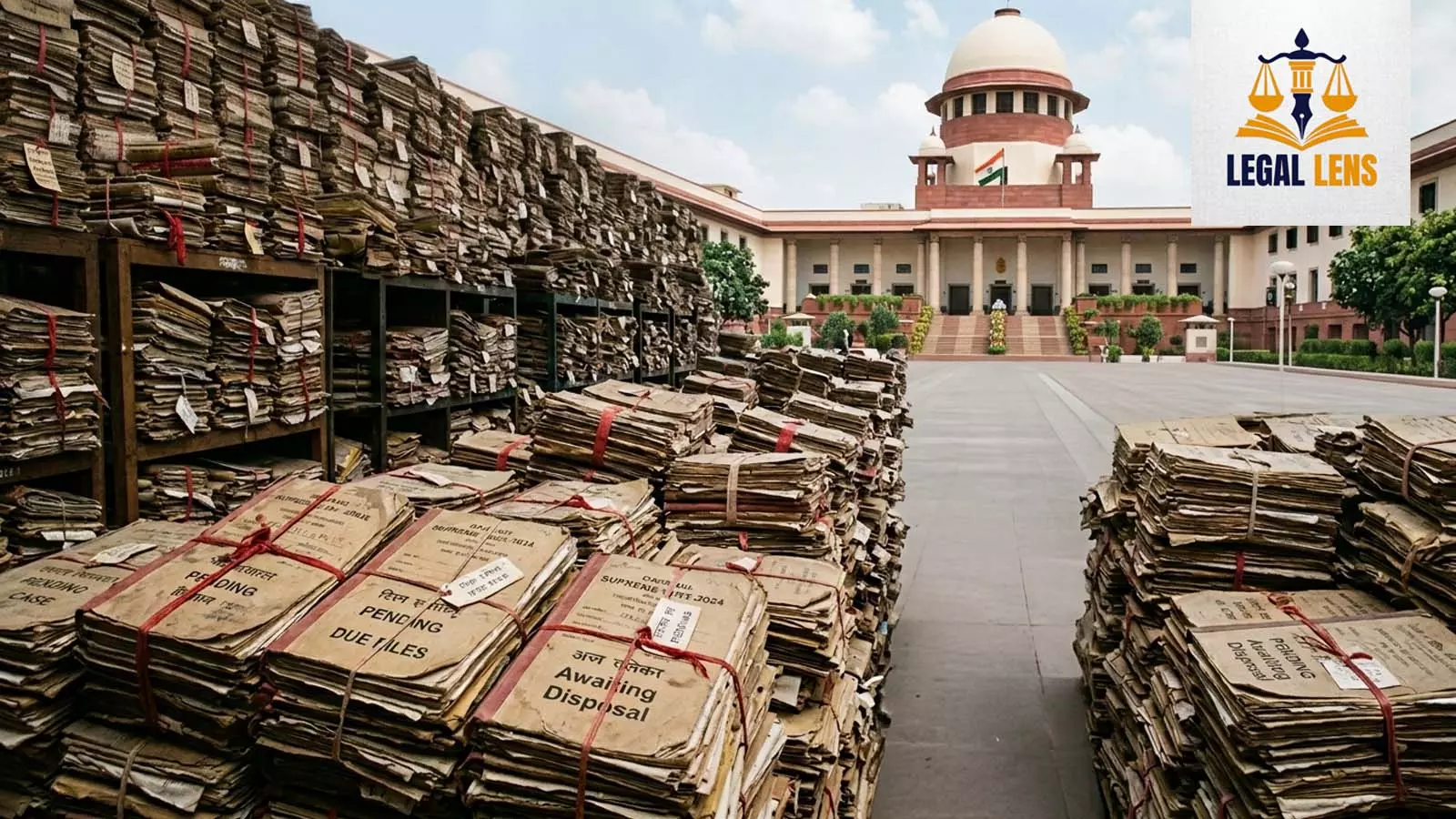
The Indian judiciary is currently paralysed by a monumental backlog of 5.6 crore pending cases, a figure that highlights a system pushed to its breaking point.
What is shocking is that the government is responsible for roughly half of this entire legal burden, acting as the single largest litigant in the country and effectively clogging the very wheels of justice it is tasked to maintain.
In the Supreme Court, pendency has reached an all-time high of 92,828 cases as of January 2026. At the current rate of disposal, the Court would need 1.4 years to clear its docket even if no fresh cases are filed. Fresh cases, of course, keep coming. In just one year, between February 2025 and February 2026, the court received 80,471 cases but disposed of only 65,752.
Flagging government's role
Who is largely responsible for this quagmire? The government – which itself accounts for roughly half this burden. Various estimates put the state’s share of pending litigation at 46 to 50 per cent across all courts.
The Law Commission flagged this as early as in its 126th Report (1988) on government litigation policy. Again, in its 230th Report (2009) reaffirmed that the Central and state governments are the biggest litigants.
India has roughly 15 judges per million people, according to the 2025 India Justice Report, compared with 150 in the United States. Over 1.8 lakh cases have been pending for more than 30 years.
One estimate puts the government’s share of admitted Supreme Court cases at 73 per cent. In 2017, the Department of Justice's action plan to reduce government litigation acknowledged that 46 per cent of all pending cases involve the government.
Also read: Docket overload hinders quality judgments, delays justice: SC judge
The pattern holds at every level: district courts, high courts, tribunals, and the Supreme Court.
The government's own record underscores the gap between instruction and practice. In a Lok Sabha reply in December 2021, the law minister disclosed that the National Litigation Policy was still "under consideration", 11 years after its original formulation. The same reply revealed that the Central Board of Indirect Taxes and Customs had instructed its field formations not to contest further by filing appeals, especially, in cases where the issue had been lost at two successive stages.
The Central Board of Direct Taxes similarly clarified that appeals should not be filed merely because the tax effect exceeds the prescribed monetary limit; each case was to be decided on its merits. In the Sukhwinder Singh case, the government lost before both the single judge and the division bench.
Its own CBIC rule, applied by analogy, required it to stop. It did not.
The consequences are severe. India has roughly 15 judges per million people, according to the 2025 India Justice Report, compared with 150 in the United States. Over 1.8 lakh cases have been pending for more than 30 years. About 77 per cent of India's prison inmates are undertrials, many waiting years for courts to hear their cases.
What is disturbing is that every government appeal that need not have been filed consumes time that a prisoner, a pensioner, or a landowner could have used.
NLP: Paper exercise
The government has long recognised the problem. In 2010, the ministry of law and justice framed a National Litigation Policy (NLP). The policy declared: “Government must cease to be a compulsive litigant.”
It laid down clear rules. In service matters, no appeal was to be filed over an individual grievance which had no wider implications. Direct appeals to the Supreme Court had to be reserved for extraordinary cases. Challenges to tribunal orders were to be “an exception and not a matter of routine”.
Government publicly complains about backlog while feeding that backlog through relentless appeals. The state becomes “both the complainant and the cause” — Justice Nagarathna
Also, ministries were to set up Empowered Committees to filter cases before they reached court.
The NLP was updated in 2015. The government launched a digital tracking system called LIMBS that year to monitor cases across 55 ministries. In 2017, the department of justice followed up with an Action Plan to Reduce Government Litigation. Revenue authorities raised monetary thresholds for tax appeals.
Also read: From 2G to coal, why India’s biggest ‘scams’ keep ending in acquittals
Sixteen years later, the NLP remains largely a paper exercise. No functioning Empowered Committee filters frivolous appeals at the ministry level. The revenue departments routinely file appeals below their own prescribed monetary limits. And, service-matter petitions over individual grievances continue to clog Supreme Court dockets.
Why government keeps filing
The reason the government keeps filing cases is structural. A government officer who settles a dispute risks an audit objection or a vigilance inquiry. An officer who files an appeal, however hopeless, faces no such risk.
Filing signals diligence, while settling invites suspicion. The result is predictable: appeals become the default. The NLP recognised this problem but offered no effective mechanism to overcome it.
At the Supreme Court Bar Association’s first National Conference in Bengaluru on March 21, the Supreme Court judge who is in line to become the first woman Chief Justice of India, Justice BV Nagarathna, put it sharply. The government, she said, occupies a dual role: provider of judicial infrastructure and the largest generator of litigation. It publicly complains about backlog while feeding that backlog through relentless appeals.
The state becomes “both the complainant and the cause,” Justice Nagarathna pointed out.
While Justice Sandeep Mehta added that government officers are the “biggest stumbling block” to mediation. At national Lok Adalats, he said, hardly any department comes forward with a positive response.
Textbook case
Eleven days later, the critique found a concrete illustration. A bench of Justices Nagarathna and Ujjal Bhuyan dismissed the Centre’s appeal against a high court order reinstating a CISF constable dismissed for 11 days’ absence.
The case, Union of India v. Sukhwinder Singh (2026) was a textbook violation of the NLP: an individual service-matter grievance, concurrent findings by two courts, and no question of principle. The government had also filed the SLP 64 days beyond the limitation period.
Also read: 8,630 complaints against Indian judges in 10 years, outcomes undisclosed
The bench imposed costs of Rs 25,000 and asked what has become a recurring judicial question: “Pendency, pendency; who is the biggest litigant?”
The Supreme Court’s registry had flagged two similar CISF dismissal cases in its office report. In the Union of India v Pranab Kumar Nath (2025 INSC 1479), the court upheld a constable’s dismissal for bigamy. In Union of India v Subrata Nath ([2022] 18 SCR 605), it found that the Calcutta high court had impermissibly re-appreciated evidence. The government won both.
The similarity, however, was superficial. In those cases, the misconduct was either a criminal offence or the high court had overstepped its jurisdiction. In Sukhwinder Singh, both charges had collapsed on the facts, and both courts had applied settled proportionality principles. The government’s law officers ought to have recognised the distinction before filing.
What needs to change?
The court imposing costs of Rs 25,000 will not solve the problem. What is needed is a structural overhaul of the incentive system that produces these appeals.
At the SCBA conference, Justice Nagarathna proposed a Judicial Reforms Commission with representatives from the judiciary, the Bar, and the government. She called the current situation a “systemic equilibrium” where every actor behaves rationally as an individual but destructively as a collective. Judges grant adjournments, lawyers seek them. Governments file routine appeals and breaking this equilibrium requires coordinated intervention.
Simpler steps are possible immediately. Empowered Committees within each ministry, as the NLP envisaged, could review every proposed appeal against clear criteria before it is filed. Officers who settle disputes within policy could be shielded from audit objections through standing instructions. Law officers could be required to record written reasons for advising an appeal in any service matter. Departments could face internal consequences when courts impose costs.
The government wrote a litigation policy in 2010. It drew up an action plan in 2017. It built a digital tracking system. None of this has worked because the underlying incentive remains unchanged.
The state will change only when it becomes safer for a government officer to accept a court order than to appeal it. Until then, as Justice Nagarathna put it, the government will remain both the complainant about backlog and its principal cause.