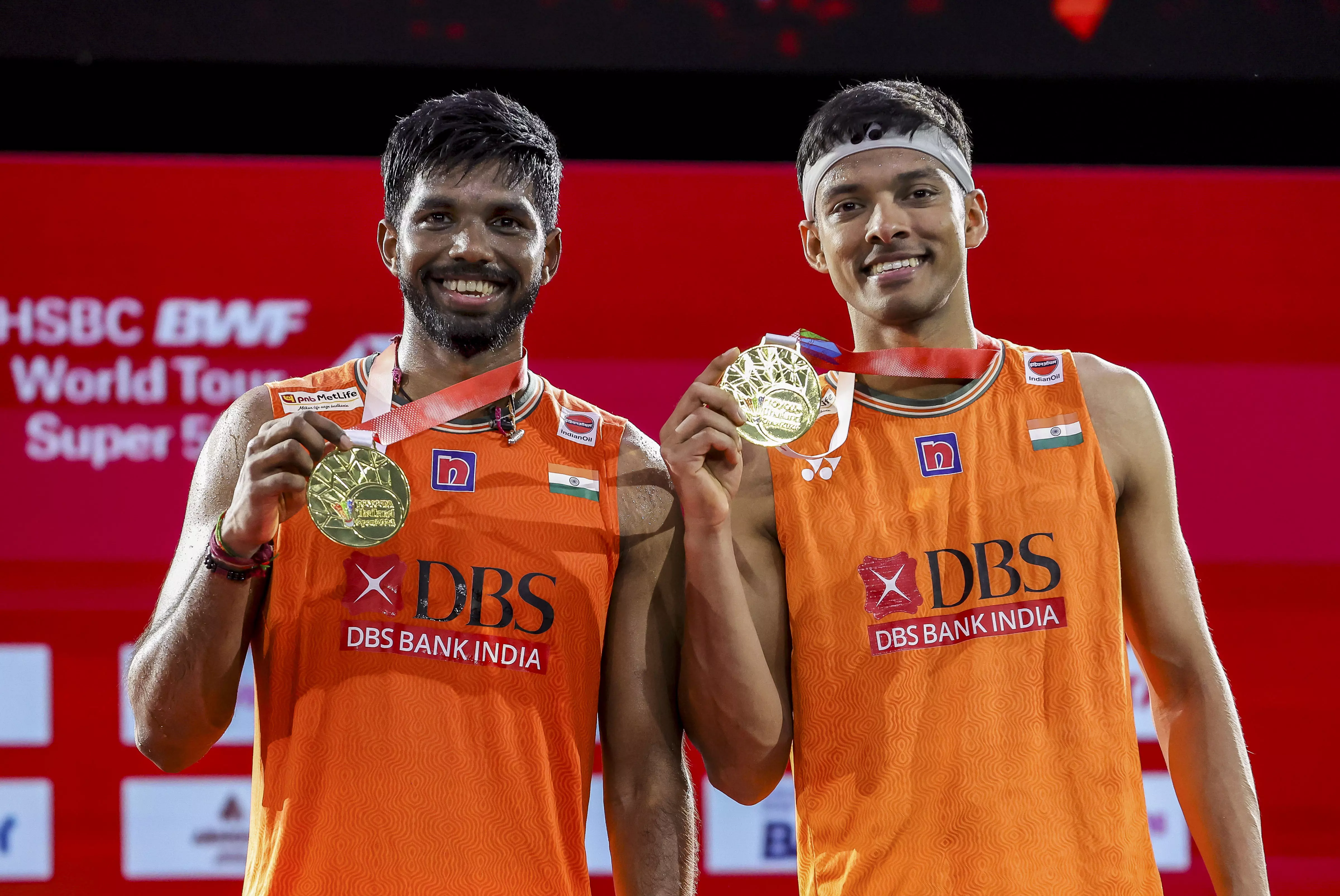
Satwik and Chirag are India's best-ever doubles pair, ranked among the world's finest for five years running — and still having to ask why nobody's watching. PTI
Beyond the IPL blitz, what non-cricket sport faces is appalling
As IPL dominates headlines, Indian athletes from badminton, swimming and athletics reveal the visibility, funding and support crisis beyond cricket

The IPL season is once again captivating India’s sports buffs. Every evening, social media timelines explode with debates and highlights. Cricket, especially in the IPL era, has become more than a sport in India. But while the IPL frenzy continues to dominate attention, the past week in Indian sport has exposed the biggest contradiction in the country’s sporting ambitions.
Away from the spotlight of IPL glitz, three completely different stories involving Indian athletes revealed something deeper about how Indian sport still functions. First, the star badminton pair of Satwiksairaj Rankireddy and Chirag Shetty questioned why India’s Thomas Cup bronze medal barely generated conversation back home. Satwik later went even further during the Thailand Open, openly admitting that badminton still struggles for mainstream visibility in India because “people are more interested in the IPL and other things happening around them.”
Beyond the IPL bubble
Then Olympian swimmer Sajan Prakash spoke candidly about the financial insecurity faced by non-cricket athletes in India and how he often had to participate in multiple events simply to sustain his career. A few days before that, junior pole vault champion Kavin Raja found himself stranded at Rajahmundry railway station for over 12 hours while travelling with his pole vault equipment after a national event. According to reports, railway personnel cut the ropes securing the poles to the train window grills, forcing athletes to pull the emergency chain and jump off the moving train to recover equipment worth nearly ₹1 lakh each.
Also Read: Wrestling Federation bars Vinesh Phogat from competing in comeback tournament
Individually, these are unrelated incidents but together, they point toward a larger truth that India’s sporting ambitions are growing much faster than India’s sporting culture. And the timing of these stories makes the contradiction even sharper. India is aggressively positioning itself as a future global sporting hub. Ahmedabad is officially set to host the 2030 Commonwealth Games, while the country’s push to host the 2036 Olympics is gradually gathering momentum. Massive infrastructure projects are already being discussed around the proposed sporting ecosystem in Gujarat, including new arenas and sports enclaves expected to cost thousands of crores.
The language around Indian sport has changed dramatically over the last decade. India no longer merely wants participation in global events. It wants sporting relevance along with Olympic legitimacy. Clearly evident that it wants to present itself as a future sporting superpower.
The applause problem
Becoming a sporting nation, however, is not just about hosting mega-events. Rather, it’s also about building a culture where athletes across sports disciplines feel consistently valued and supported. It is not enough to put them in limelight briefly during Olympic cycles or moments of national celebration. That is where India seems to be still struggling. When Neeraj Chopra wins Olympic gold, the country erupts. When India wins the Thomas Cup, social media briefly lights up. During the Olympics, athletes from across disciplines become national heroes overnight.
Also Read: BCCI's IPL crackdown: Reels in restricted zones, late-night outings among reasons
But once the event passes, so does much of the ecosystem around them. That’s precisely why Satwik and Chirag’s comments struck such a chord. They were not demanding money or grand receptions. Satwik himself clarified that they simply wanted greater recognition and support for achievements outside cricket.
Non-cricket sport in India is still often consumed as episodic patriotism rather than continuous sporting culture. The attention arrives during medal moments. But post that the emotional and commercial investment needed to sustain athletes round the year, and year after year, still remains largely missing.
What cricket built
This is also where cricket becomes an important contrast as a proof of what a fully developed sporting ecosystem can achieve. Indian cricket did not reach this stage accidentally. Its ecosystem evolved through decades of television investment, grassroots aspiration, and eventually the IPL’s commercial explosion. The IPL accelerated everything further from storytelling to branding and fan engagement.
Also Read: IPL final venue row: 'BCCI run by government; 10,000-ticket demand reason rubbish'
An uncapped cricketer can become a national figure within weeks. A strong IPL season can transform careers financially and socially overnight. Fans know players’ stories even before they play for India. Outside cricket, however, many Indian sports still function in bursts of national attention rather than continuous public engagement.
This is the larger debate India needs to have urgently. The next leap in Indian sport has to be cultural. Cricket has shown India what happens when a sport receives sustained emotional and commercial investment.
Badminton is perhaps the clearest example of this contradiction. India has produced Olympic medallists, All England finalists and former world No. 1 players. Satwik and Chirag themselves are possibly the best doubles pair India has ever produced and are rated among the finest doubles pairs in the world over the past five years. Yet, despite consistent international success, it’s disturbing that they still find themselves discussing visibility gaps in a cricket-dominated landscape.
The cost of competing
The issue, of course, is not limited to badminton. Stories like Sajan Prakash’s reveal the financial realities many athletes continue facing outside cricket’s ecosystem. Meanwhile, incidents involving athletes like Kavin Raja expose how even basic structural support systems remain largely absent in several Olympic disciplines.
Also Read: BCCI issues strict SOPs to IPL franchises, warns of ‘honey trap’ risk
The latest example is also of Vinesh Phogat. Nearly two years after the heartbreak of missing out on an Olympic medal in Paris following her disqualification before the final, Vinesh had expressed interest in returning to competitive wrestling. But recent selection decisions and eligibility-related debates have once again pushed her into the middle of uncertainty, potentially affecting her road toward major international events. In many ways, the episode reflects another long-standing reality of Indian sport, where athletes are not only competing against opponents, but are often forced to navigate institutional roadblocks as well.
Even structurally, questions around India’s sporting priorities continue to surface. Recent reports have revealed that large portions of sports development funds were allegedly used to upgrade facilities for bureaucrats rather thanto benefit athletes. Whether isolated or systemic, such stories underline how uneven the sporting ecosystem still feels beneath India’s grand Olympic ambitions.
India’s real sporting test
This paradox between vaulting ambitions at the top and harsh ground realities for most non-Cricket athletes makes this moment in Indian sport particularly poignant. Olympic conversations are becoming serious and India is keen to position itself as a year-round sporting destination. But many athletes still suffer from visibility gaps, financial insecurity and inconsistent structural support outside cricket.
This is the larger debate India needs to have urgently. The next leap in Indian sport has to be cultural. Cricket has shown India what happens when a sport receives sustained emotional and commercial investment. The big question is whether India is now willing to extend that eco-systemic thinking beyond one key sport.
Hosting the Olympics may help India look like a sporting nation. But becoming one will need a far deeper cultural shift.