



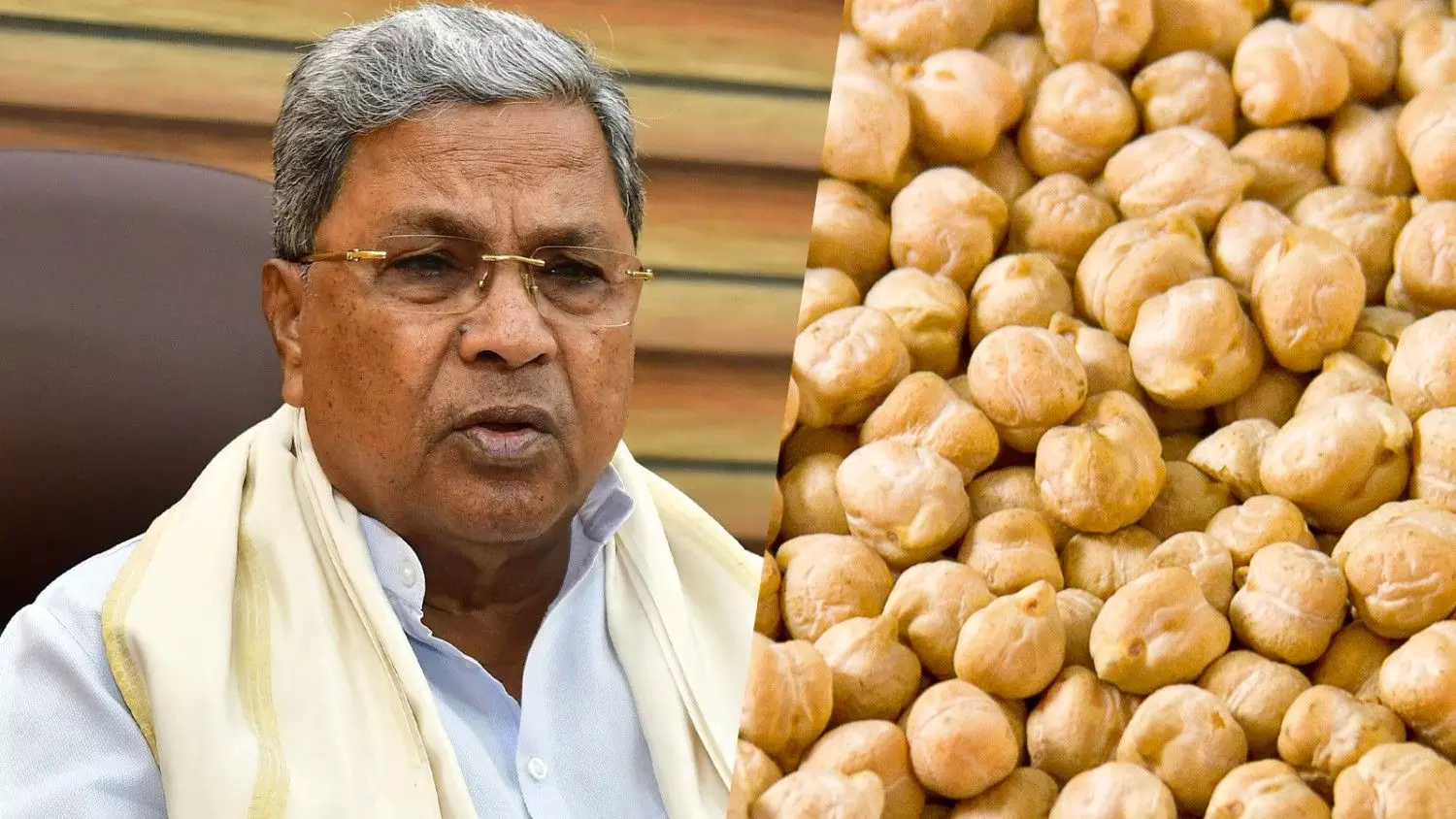
An alarming fall in prices of Bengal gram (chickpeas) in major agricultural produce markets in Karnataka has left the state's Siddaramaiah government concerned.
Siddaramaiah seeks Centre's immediate help as chickpea prices crash in Karnataka
The CM urges PM Narendra Modi to start procurement at MSP as market rates for the crop drop to Rs 800 per quintal, leaving farmers in deep distress

Karnataka Chief Minister Siddaramaiah has written to the Centre urging it to save the state’s chickpea (Bengal gram) farmers after the price of their products witnessed a steep fall in the state’s major agriculture produce markets, leaving the community in dire straits and looking to a bleak future.
Also read: How India ‘subsidises’ the poisoning of air and water through fertilisers
While the minimum support price (MSP) announced by the central government is Rs 5,875 a quintal for the 2026-27 Rabi marketing season, the produce is being sold at a lower rate between Rs 4,260 and Rs 5,813 across major markets in Karnataka, and even as low as between Rs 800 and 1,200 in many markets, the CM said in his letter, adding that such a poor situation prevails when the crop's harvest is set to intensify.
He, therefore, sought an immediate intervention to prevent the market of chickpeas from collapsing before their harvest season peaks between January and March. He brought the attention of both Prime Minister Narendra Modi and Union Agriculture Minister Shivraj Singh Chouhan to the problem.
'Time is of essence'
In his letter dated January 14 (Wednesday), Siddaramaiah wrote, “I urge the Government of India to immediately accord approval for procurement of chickpeas under the Price Support Scheme (PSS) and direct Central Nodal Agencies such as NAFED and NCCF to operationalise procurement centres in Karnataka without delay. Time is of the essence. Every passing day without procurement deepens farmers’ losses and undermines the very purpose of MSP.” He also posted his letter on X.
I have written to the Prime Minister Shri @narendramodi and the Union Agriculture Minister Shri @ChouhanShivraj highlighting the severe crisis faced by Bengal gram farmers in Karnataka.
— Siddaramaiah (@siddaramaiah) January 14, 2026
Despite a Minimum Support Price (MSP) of ₹5,875 per quintal, market prices have fallen far… pic.twitter.com/j1VTyyewRS
He said the state government is “fully prepared to shoulder its responsibilities” under the PSS framework and has issued the necessary notifications, furnished undertakings as per PSS guidelines, and is committed to facilitating procurement logistics. The CM added that the state government will fully cooperate with the central bodies to ensure that the operations are smooth and transparent.
Bengal gram a key crop in Karnataka
In his letter, the Congress leader also said that Bengal gram is one of Karnataka’s principal pulse crops, which is cultivated across 9.24 lakh hectares with an estimated production exceeding 6.2 lakh metric tonnes.
Also read: Two journalists of The Federal Karnataka win prestigious awards
He said farmers in several regions of Karnataka, including Dharwad, Gadag, Belagavi, Vijayapura, Kalaburagi, Bidar, Raichur, Koppal, Ballari, Bagalkot and others are supported by the crop’s cultivation. Many of these farmers are small and marginal, and for them, Bengal gram is the only source of income after months of hard work, challenged by unpredictable climate conditions.
'Eroding farmers' faith'
On the fall of prices, Siddaramaiah said in his letter that it is not merely a market aberration but a human crisis. “When the declared MSP does not translate into real procurement on the ground, it erodes farmers’ faith in the institutional framework meant to protect them. Many growers, burdened by input costs, credit obligations and household needs, are being pushed into distress sales at the very moment when public intervention is most needed.”
Also read: Stone mining threatens Bengaluru ISRO space network centre | Ground Report
This is not the first time that Karnataka’s Bengal gram farmers have faced such a crisis. In 2018, the crop’s price had plummeted by 22-25 per cent below the support price. Two years ago, in 2024, farmers were forced to resort to distress sales owing to the delay in the implementation of the price support scheme by the Centre. The farmers have also protested in the past due to alleged lack of coordination between the Centre and state government, which led to their suffering.
(The article was first published in The Federal Karnataka)