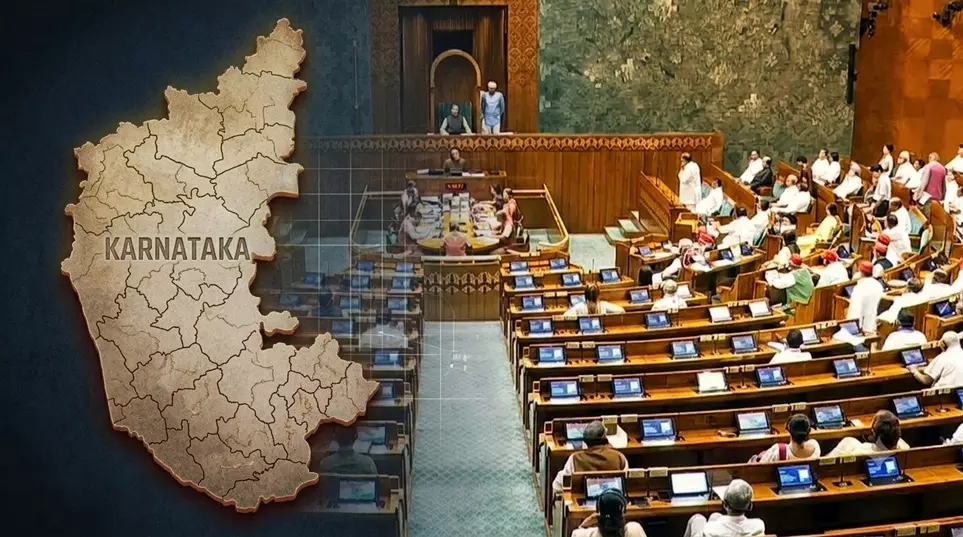
The delimitation exercise could shift voters' geographic concentration and the political strength of individual communities in Karnataka. (AI-generated image)
AHINDA vote at risk? Delimitation raises concerns in Karnataka
Siddaramaiah to meet AHINDA leaders as the Congress weighs how redrawn constituencies could affect its core support base

The Cabinet has cleared the delimitation Bill for a special Parliament sitting from November 30. On paper, a 50 per cent increase in Lok Sabha seats would leave each state's share intact. But across the country, Opposition parties and political observers fear the real issue lies elsewhere: who redraws constituency boundaries, how seats are reserved, and what happens to the votes.
We have a series of copies from across the states, beginning with a take from Telangana and then West Bengal. Here is the third one.
The Union Cabinet's clearance of the delimitation Bill has set off alarm bells in Karnataka's Congress, where leaders fear that redrawing constituency boundaries could splinter the consolidated AHINDA vote bank.
A senior leader close to Siddaramaiah said the former Chief Minister plans to convene a separate meeting with AHINDA leaders in the coming days to assess how delimitation could affect the bloc's electoral strength.
On paper, the proposed 50 per cent increase in Lok Sabha seats would take Karnataka from 28 seats to 42 if the uniform formula is applied as announced. But political observers say protecting the state's overall share does not settle the larger question: where the new constituencies will be created, how existing boundaries will change and how reserved seats will be distributed. The Bill is slated to come up in a special Parliament sitting from November 30.
Why the map matters more than the number
Karnataka's regions have distinct political and social profiles. The Congress has traditionally drawn support from parts of Old Mysore and from sections of Dalits, minorities and other backward classes. The BJP is strong in several coastal and northern districts, while the JD(S) retains influence in pockets of Old Mysore. Fresh boundaries could change the geographic concentration of voters and the strength of individual communities, altering the calculations of all three parties.
Muslim and Dalit leaders will be watching closely how constituencies with significant minority and Scheduled Caste populations are reorganised. The allocation and rotation of SC and ST reserved seats will also face scrutiny.
Reservation questions
Former Congress MP and advocate VS Ugrappa questioned the legal criteria for delimitation and the redistribution of SC/ST reserved seats. He said population-based delimitation would have penalised southern states for controlling population growth, but added: "If existing seats are increased by a uniform percentage and 33 per cent reservation for women is accommodated within the expanded strength, no region will lose its representation."
Ugrappa pointed to Section 9(1)(c) and (d) of the Delimitation Act, 2002, which requires ST seats to be identified in areas with the highest concentration of their population, and SC seats to be spread across a state as far as practicable, in proportion to population.
Citing Ballari, Raichur, Chitradurga and Davanagere, he questioned the concentration of reserved seats, and sought rotation of long-reserved constituencies such as Pavagada, Mudigere and Anekal without compromising constitutionally mandated representation.
The Centre, he said, must consult Opposition parties before finalising the legislation.
Cross-party reactions
Former Legislative Council Chairman Basavaraj Horatti said more seats alone would not help unless states got fair recognition. "At present, North India's voice is stronger in Parliament, and this is likely to continue. Merely increasing the number of seats is not enough. States must receive fair recognition. Otherwise, there is no purpose in undertaking delimitation," he said. He nonetheless felt the exercise could gain acceptance since the proposal accommodates some opposition demands.
JD(S) leader and former minister Bandappa Kashampur said the real implications would be clear only once the details emerged. "We have to wait and see how the delimitation will be carried out. The number of constituencies will increase, but we need to understand which areas will come under which constituencies," he said.
The BJP has presented the proposal as an effort to address southern concerns.
Belagavi district BJP vice-president Mahantesh Vakkund said it provides a uniform 50 per cent increase, with representation based on the 1971 Census protected for another 25 years, under an 850-seat Lok Sabha. Earlier population-based efforts failed after Opposition objections, he said. "Now that the views of the opposition parties have been taken into consideration, there is a possibility of the proposal receiving acceptance," he said.
Regional anxieties
The exercise could also deepen regional tensions within the state. Population growth in Bengaluru and surrounding areas may shift parliamentary and Assembly representation towards southern Karnataka, worrying North Karnataka leaders about their region's political voice.