







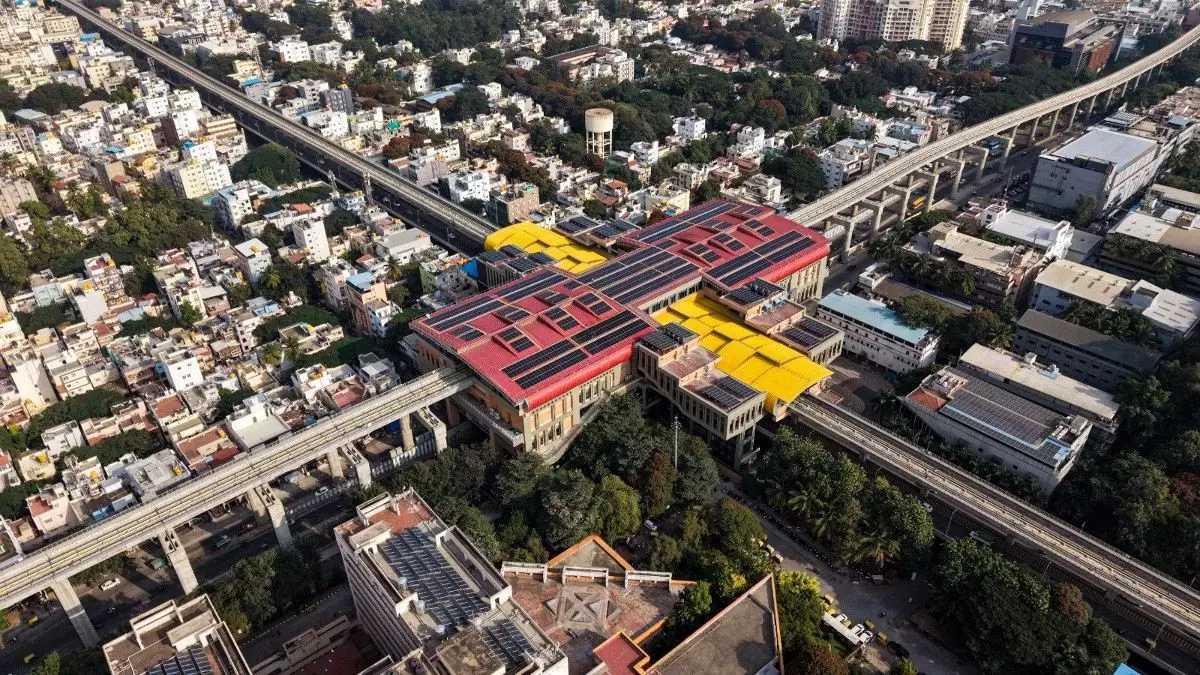
In this image shared on November 12 by Prime Minister Narendra Modi shows an aerial view of a Bengaluru Metro line. (@narendramodi/X via PTI Photo)
Bengaluru Metro Pink Line launch: Karnataka govt vs Centre over funds
Karnataka Chief Minister DK Shivakumar and Bengaluru Development Minister Krishna Byre Gowda have released a detailed account of the state government’s financial contribution

Bengaluru Metro, or Namma Metro, has now become a major battleground for political credit between the Centre and the Karnataka state government. With Prime Minister Narendra Modi scheduled to inaugurate a new elevated stretch of the Pink Line on Friday (November 13), the debate over who has contributed the most towards the project’s funding has intensified.
While the Karnataka government maintains that the state is bearing 84 per cent of the total project cost, BJP leaders have countered that this claim overlooks the Centre's sovereign guarantees for foreign loans. The credit war has moved beyond claims over the inauguration and has become a broader debate over who is responsible for financing Bengaluru’s infrastructure development.
Karnataka bears 84 per cent of financial burden
Karnataka Chief Minister DK Shivakumar and Bengaluru Development Minister Krishna Byre Gowda have released a detailed account of the state government’s financial contribution. According to their calculations, the combined project cost of Metro Phases 1, 2, 2A, 2B and the proposed Phase 3 stands at Rs 77,891 crore. Of this, the Karnataka government is bearing a whopping Rs 65,291 crore, or 83.8 per cent of the total expenditure. The Centre’s contribution, they maintain, is just Rs 12,600 crore (16.2 per cent).
Also read: Karnataka misrepresenting Metro funding share; Centre contributes 54 pc: Tejasvi Surya
Congress leaders argue that the state government is not merely providing grants for Metro construction but is also shouldering the entire burden of land acquisition, rehabilitation, state taxes, interest during construction, loan repayment, and operational and maintenance losses.
According to Gowda, the state government's share has increased significantly with each successive phase of the Metro project. Its contribution stood at 79.2 per cent in Phase 1, rose to 83.7 per cent in Phase 2 and further increased to 86.9 per cent in Phases 2A and 2B. He also pointed out that the state has already borne Rs 1,046 crore towards operational losses, with another Rs 52 crore yet to be reimbursed. The minister's contention is that there is a substantial difference between the 50:50 funding model often cited for Metro projects and the actual expenditure being borne by the state.
MP Tejasvi Surya hits back
Rejecting the state government's figures outright, Bengaluru South BJP MP Tejasvi Surya has presented a different perspective on the funding calculations. He has accused the state government of projecting Rs 28,958 crore borrowed from foreign financial institutions for the Metro project as its own contribution.
According to him, the Centre's sovereign guarantee played a crucial role in securing these massive foreign loans. Without this guarantee, obtaining loans of such a large magnitude would have been impossible. Therefore, he argues that the Centre's financial commitment should be calculated at Rs 41,558 crore (53.35 per cent), while the state's share should be pegged at Rs 36,333 crore (46.65 per cent).
Also read: Bengaluru Metro funding: Karnataka seeks bigger Centre share, says state bears 84 pc of costs
He maintains that the Metro project follows a 20:20:60 funding model, under which 20 per cent of the project cost comes from the Centre, 20 per cent from the state and the remaining 60 per cent is raised through loans. He also pointed out that Bangalore Metro Rail Corporation Limited (BMRCL) is a joint venture equally owned by the Centre and the state, with both governments contributing Rs 9,164 crore each as equity capital.
Who is responsible for Rs 28,958 crore loan?
The crux of the entire controversy lies in how the Rs 28,958 crore foreign loan is being accounted for. The state government includes this amount in its contribution because it bears the ultimate responsibility for repaying the principal and interest. The Centre, however, argues that the loans would not have been possible without its guarantee and that the amount should therefore be treated as part of its financial commitment based on the approved funding structure.
Former Karnataka Chief Minister Basavaraj Bommai has weighed in on the issue, stating that the loan is not being repaid directly from the treasury of either government. Instead, the repayment is being made through the ticket revenue collected from Metro passengers. He therefore maintains that the Centre's sovereign guarantee has played a crucial role in making the borrowing possible.
Ticket fares and financial sustainability
Surya has also accused the state government of delaying construction work. He alleged that the state government itself caused delays in Phase 3 projects, including the Orange Line, by introducing several technical changes, such as the double-decker system and modifications to pillar designs.
He pointed out that although the Centre had approved the Pink Line project, which is now ready for inauguration, as early as 2014, the civil construction contract was awarded only in 2017. He further cited figures showing that 72 per cent of the tunnelling work was completed during the BJP government's tenure between 2019 and 2023.
He also drew attention to Metro ticket fares. While the fare per kilometre is Rs 3 in Mumbai, Rs 2.72 in Delhi and Re 1 in Kolkata, Bengaluru's average fare stands at Rs 3.97 per kilometre. Despite the higher fares, BMRCL's share of non-fare revenue is only between 1.39 per cent and 8.62 per cent. In comparison, non-fare revenue accounts for more than 20 per cent of Delhi Metro's earnings. Surya has suggested that BMRCL should focus on increasing revenue through Transit-Oriented Development (TOD) and additional Floor Area Ratio (FAR).
Minister alleges he is being side-lined
As the controversy unfolds ahead of the inauguration of the 7.5-km Pink Line stretch between Kalena Agrahara and Tavarekere, attention has also shifted to upcoming Metro projects.
The state government has alleged that the Centre is deliberately delaying approval for the 37.8-km Red Line project connecting Sarjapur and Hebbal. In December 2024, the state Cabinet approved the project at an estimated cost of Rs 28,405 crore. Subsequently, following the Centre's directions, the project cost was revised downwards to Rs 25,999 crore, and the revised report was submitted to the Centre in January 2025. However, the state remains unhappy that approval has still not been granted as of November 2026.
Meanwhile, the last-minute removal of Minister Gowda's speech from the programme schedule for the inauguration ceremony to be attended by the Prime Minister has sparked outrage among Congress leaders. The minister has alleged that he was sidelined for raising his voice in support of the state's rightful share.
Challenges ahead for Namma Metro
Bengaluru's Metro network had expanded to 96.1 km by March 2026 and is set to reach 103.6 km with the addition of the new stretch. On October 16, the network recorded a single-day ridership of 11.92 lakh passengers.
During 2025-26, BMRCL earned Rs 1,625 crore in total revenue, including Rs 1,126 crore from ticket sales. However, after accounting for depreciation and interest expenses, the corporation reported an accounting loss of Rs 1,710 crore.
(This article was originally published in The Federal Karnataka)