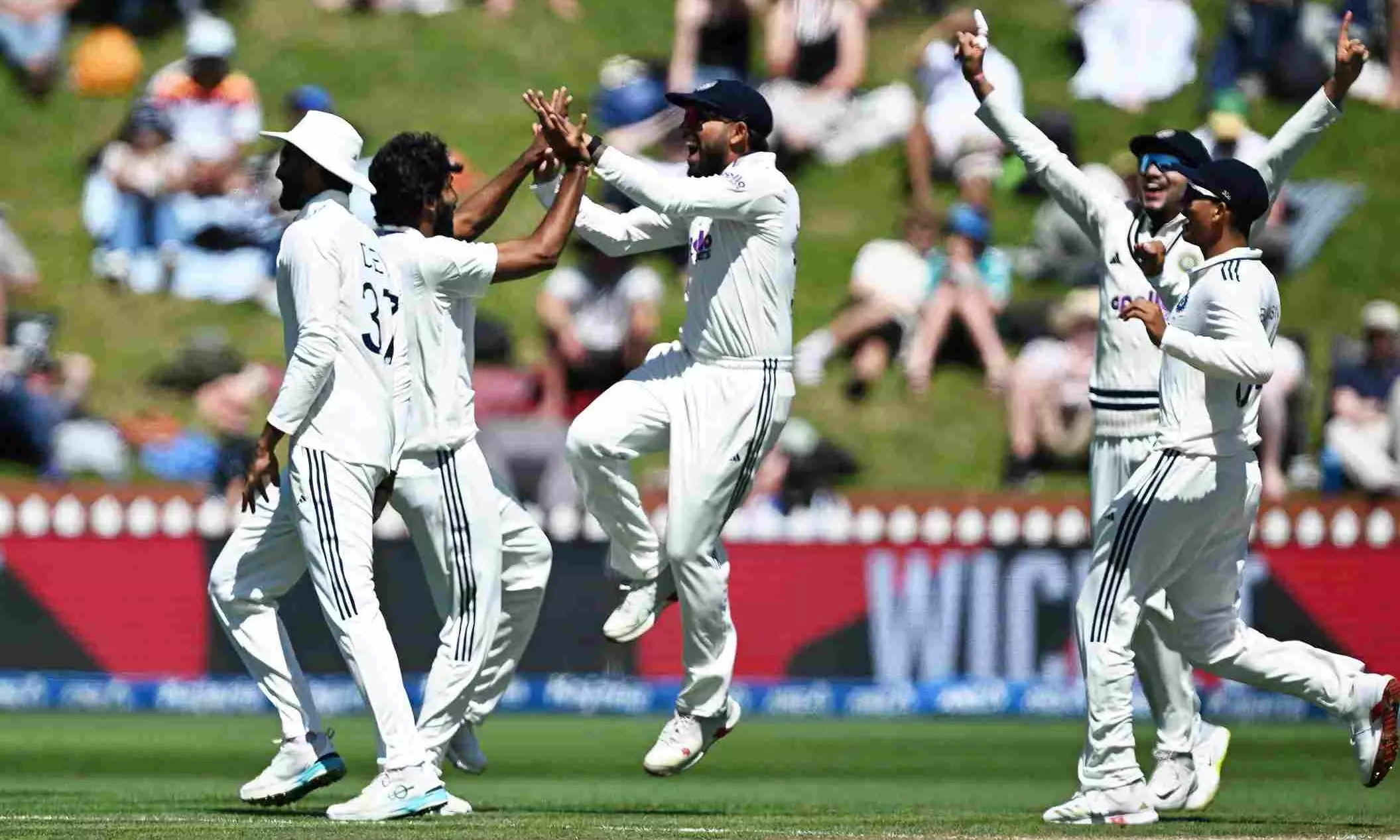
Wellington draw: Lost WTC points and selection doubts for India
India's batting depth and the returns of Pant and Bumrah offer positives, but questions over the omissions of Siraj and Jadeja and lost WTC points linger ahead of Christchurch

India will look back at the Wellington Test and rue the eight valuable World Test Championship points that got away. But they can also derive a modicum of consolation from the fact that they gave it their all in the quest for their first victory on New Zealand soil since 2009, only to be thwarted by a most benign playing surface and an unhelpful ball that offered little movement in the air or off the deck once it was more than 30 overs old.
Having looked on course for the full complement of 12 WTC points for the first half of Monday’s final day at the Basin Reserve, Shubman Gill’s side had to settle for only four points after Daryl Mitchell and Glenn Phillips ground out a resolute draw through dead-bat defence which was dictated by the slowness of the track.
Batting brilliance, missed opportunities
Gill was tersely emphatic in ruling out a potential change in outcome had India gone in with the experience of Mohammed Siraj and Ravindra Jadeja, insisting that he felt the think-tank had put out the ‘best XI’ to win the game; how much of it was conviction and how much of it had to do with being politically correct was hard to figure out.
Also read | Ind vs NZ | Selection blunders or strategic masterstrokes? Gambhir under scanner
Despite the disappointment of a stalemate when victory looked very much on the cards at various stages of the first Test, India had plenty to take away from the five days of run-soaked action. There are bound to be concerns over the inability to close out games, no matter how much the odds were stacked against them.
India also failed to drive home the advantage in the second Test in Colombo in August when they were thwarted by the broad willow of Sonal Dinusha after Sri Lanka were forced to follow on, though Gill was quick to point out that there wasn’t a lot more his bowlers could have done under the circumstances and one couldn’t disagree with him a great deal.
India’s batting muscle expressed itself in no uncertain terms with everyone in the top order getting substantial game time while amassing the highest Test total ever on Kiwi soil. India’s 720 for nine declared was their third highest Test tally and comfortably their best overseas; some of it had to do with the nature of the 22-yard strip, dead as a dodo and a bowler’s nightmare, but it was also reflective of the depth and the quality of the Indian batting, with KL Rahul as the vanguard and the irrepressible Rishabh Pant providing the dash and the chutzpah with characteristic nonchalance.
Pant and Bumrah shine on return
Experts watched closely as Pant and Bumrah returned to competitive cricket, and they must have been impressed with what they saw. Gifted with the best bowling conditions of the match on the first morning after Gill won the toss, Bumrah showed no signs of rust as he worked his way through the Kiwi top order. Like Pant, Bumrah hadn’t played an international match since October 3 and the Asian Games final against Pakistan, though a fortnight back, he did send down six overs in a rain-affected outing for India ‘A’ against their Kiwi counterparts.
India have been managing Bumrah’s workload with care, wanting his services for crunch games and tournaments; he responded to this unusually empathetic treatment by cranking it up on day one, though as the game wore on, even his genius was nullified by the conditions.
Pant is a fierce, untameable force of nature who sets his own rules. There was a cloud over his head after he missed seven weeks of cricket with a side strain, but it was as if he was never away. In a Test characterised by tall scores – Henry Nicholls, Phillips and KL Rahul made centuries, while there were big hands from Yashasvi Jaiswal, Devdutt Padikkal, Gill himself and Dhruv Jurel – Pant stood out for the incandescence of his stroke-production and the ease with which he shifted gears.
Rahul and Pant became only the fifth and sixth Indians respectively, after Mohammed Azharuddin, Sachin Tendulkar, Rahul Dravid and Virat Kohli, to score a Test hundred in South Africa, England, New Zealand and Australia (the feared SENA countries). Rahul was the first Indian opener to do so and Pant the first Asian stumper to achieve the feat. Rahul, who replaced Pant as vice-captain this June, is enjoying the role clarity that has him pencilled in at the top of the tree as Jaiswal’s long-term opening partner, while Pant merely did Pant things, cocking a snook at those who questioned his preparedness and match-readiness.
Siraj and Jadeja omissions under scrutiny
For all of Gill’s vehement denial, though, the jury is still out on the omissions of Siraj and Jadeja. Siraj has been one of India’s tireless workhorses since his Test debut in Melbourne in December 2020, in the same game as Gill.
His propensity to send down over after unflagging over in heat and dust, on surfaces placid and unhelpful, have often overshadowed his immense skillset. He ought to have been an automatic choice, and not just because he has close to 150 Test wickets, once India decided to field a four-pronged pace attack for the first time since January 2024.
But in their collective wisdom, Gill and head coach Gautam Gambhir arrived at the conclusion that India would be better served with Siraj warming the bench, plumping instead for Anshul Kamboj, terrible on debut in Manchester last July, and Akash Deep, who hasn’t played a Test for 15 months. There is no guarantee that India would have been able to seal the deal in Siraj’s presence, but his experience and ability, not to mention perseverance and never-say-die attitude, isn’t something that can be easily replaced or replicated.
Also read | Pant joins Indian greats, becomes first Asian keeper to conquer SENA
Jadeja’s omission was equally baffling. Overseas, he has been a wonderful batter at No. 5 or No. 6, and he boasts 358 wickets from 91 Tests. He too ought to have been an obvious selection but the leadership group went with Washington instead because the New Zealand XI included four left-handers. That they all constituted the top four didn’t seem to be a factor; Washington was tidy and parsimonious in the third innings and didn’t let himself or the team down, but one can’t shake off the feeling that with his street smarts and guile, Jadeja could have contributed to an altered script in Wellington.
India’s WTC race gets tougher
The teams have a very short turnaround time before the next Test, in Christchurch from Friday. Despite the reasonable workload – India’s pacers sent down 189 overs across the two innings – it is difficult to see any changes in the playing XI.
What the Wellington draw has done is amplify India’s challenges in the race to a top-two finish in the WTC standings. With just six games remaining, they need a minimum of five wins to stay in the hunt. The attempt to scale that mountain will start at the Hagley Oval in three days’ time, with the hope that Christchurch will offer bowlers from both sides plenty more than what unforgiving Wellington did.