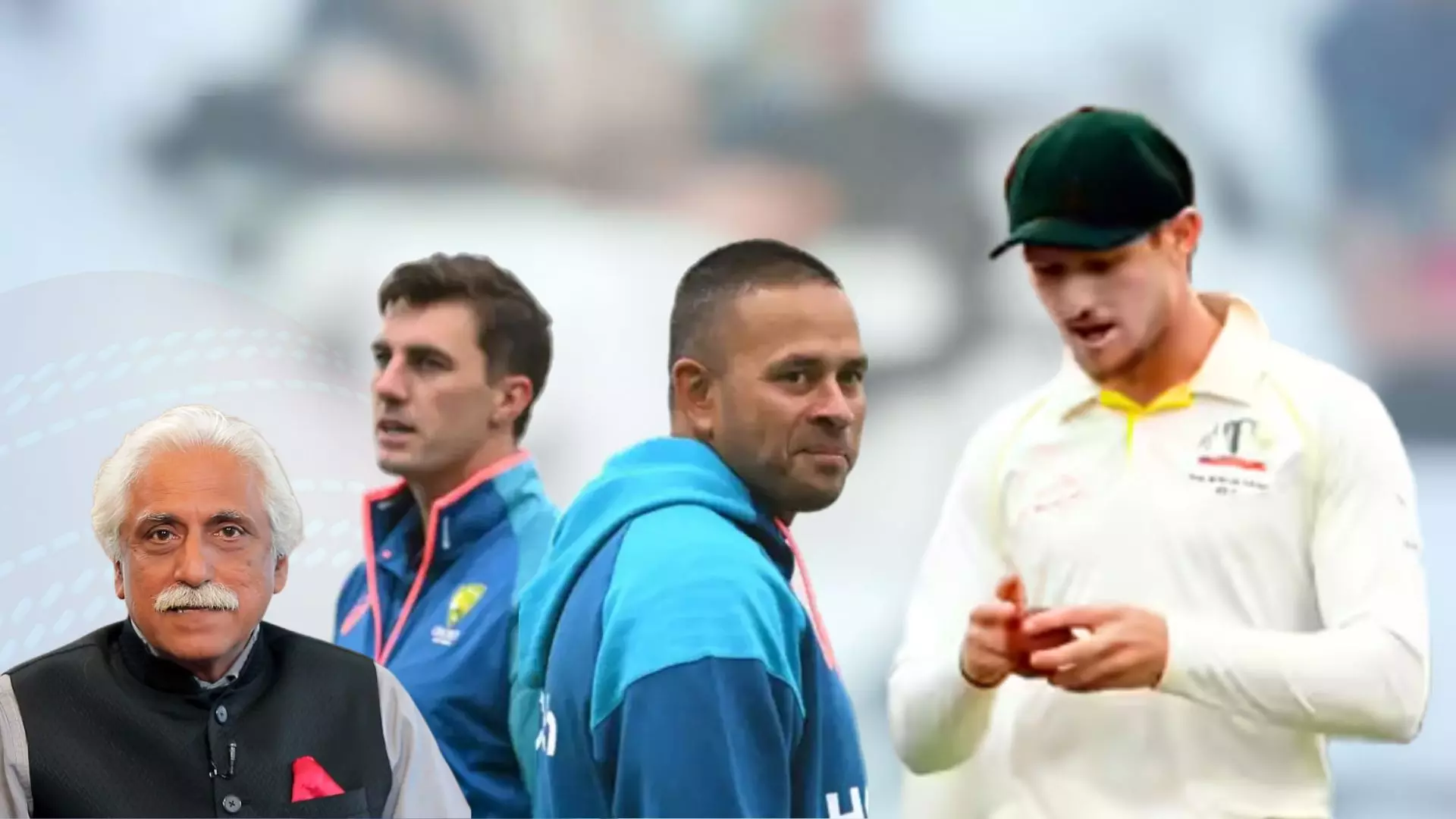
'Sandpapergate is one of the biggest controversies in cricket' | Ayaz Memon interview
Usman Khawaja's autobiography has reopened the ball-tampering row, exposing divisions among ex-Australian teammates and raising questions about Cricket Australia's handling of the scandal. Ayaz Memon has called for the ICC to step in

Eight years after the infamous 2018 Cape Town ball-tampering scandal, fresh claims by Australian opener Usman Khawaja have reignited one of cricket's biggest controversies. With two former teammates backing his account and current captain Pat Cummins rejecting it, the controversy has exposed deep divisions within Australian cricket.
Veteran cricket writer Ayaz Memon spoke to The Federal about accountability, Cricket Australia's response, the role of the International Cricket Council (ICC), and the damage the scandal could inflict on the sport's reputation.
Edited excerpts
Eight years after the 'Sandpapergate' scandal, how do you rank this controversy among the biggest incidents in cricket?
I think it is among the biggest controversies to have hit the sport. We have seen the Bodyline controversy, the match-fixing scandal that erupted in 2000, and other incidents.
The simple reason is that it has completely dismantled the almost invincible image of Australian cricket.
Following Khawaja's revelations in his book, the support he has received from David Warner and Cameron Bancroft, and the responses from Pat Cummins, Mitchell Starc and others, there is almost a civil war raging within Australian cricket. This was unthinkable. In that sense, I would rank it among the biggest controversies the sport has witnessed.
It is not as though ball-tampering has never happened before. There have been incidents involving bottle openers, nails and other objects, which have come under the scrutiny of the ICC and its experts.
We have also seen other controversies, including the case involving Pakistan's Mohammad Amir, who bowled deliberate no-balls under the instructions of his captain, Salman Butt. That was more in the realm of match-fixing.
But this Australian episode is different. Players from the same team are now ranged against one another. These are not players from 30 years ago making allegations against the current generation. They are contemporaries who, until very recently, and perhaps even now, have shared dressing rooms while playing for Australia, in the Big Bash League or elsewhere.
Also read: 'Sandpapergate': When winning matters more than the Spirit of Cricket
Pat Cummins recently held an almost 68-minute press conference, during which he called Khawaja's remarks casual and flippant and said he was 100 per cent wrong. Whose version should we believe, and how can we establish the truth? Should Cricket Australia reinvestigate the matter?
I think the issue was put most pertinently by former Indian captain Nasser Hussain, who said that the controversy is not really about sandpapering or ball-tampering. It is about who failed to take accountability and why.
Khawaja has said in his book and subsequent interviews that his intention was to ensure accountability was not restricted to just three players: Steve Smith, David Warner and Cameron Bancroft. According to him, the entire team was responsible because they were all part of the team and the matter had been discussed.
Pat Cummins, however, says he does not know about any such discussion. He also says he did not even know that sandpaper had been taken onto the field. That is the fundamental conflict between members of the same team.
Who is ultimately speaking the gospel truth is now a matter of conjecture.
However, increasingly, it seems to me that David Warner and Cameron Bancroft's support for Khawaja's version puts Cummins and the group of bowlers who have denied knowing anything about the incident on the back foot.
Remember, Warner and Bancroft were among those who received bans. Warner was banned for one year, while Bancroft received a nine-month ban.
Now that they have supported Khawaja's statements or his version of events, it puts the opposing group in a difficult position. But we will have to wait and see where the controversy goes from here. I do not think we have heard the last of this matter.
Also read: Bancroft opens up on 'Sandpapergate': It wasn't just three of us, it was the whole team
You mentioned that the bowlers have not supported Khawaja's claims. Do you think it is possible that bowlers would not know if the condition of the ball had been altered? Wouldn't someone like Pat Cummins or Mitchell Starc notice it when the ball was handed to them?
It seems very far-fetched to believe that the bowlers would not know that some tampering had taken place.
There have been several former bowlers who have said that it is simply not possible. Someone like Wasim Akram has pointed out that the first thing a bowler would notice is whether the ball had been tampered with.
The defence put forward by Cummins and the other bowlers is that, after Cameron Bancroft was found to have sandpapered the ball, the umpires checked its condition. The umpires officiating in that match found nothing objectionable. That is their point of view.
Their argument is that if the ball had been tampered with significantly, the umpires would have asked for it to be replaced with another ball.
That is where the controversy has been seesawing. It is becoming a massive blame game, with direct accusations and insinuations about who said what, who did what, who knew and who did not.
But what is becoming increasingly evident to me, and to the rest of the world, is how divided the Australian dressing room looks.
Australian cricket has always had this sense of comradeship or mateship. Wearing the Baggy Green has traditionally meant that everyone is in it together: all for one and one for all. That glorious tradition appears to have been divided down the middle in this episode.
The damage this could cause Australian cricket is going to be humongous. It is not just about the players themselves but also about the fans, who have such strong faith in their cricketers.
There will also be ramifications beyond Australia. Former Australian captain Greg Chappell recently wrote an article in Cricinfo arguing that it was time for the ICC to address ball-tampering very seriously and clearly.
There has been too much of a lackadaisical approach to the issue. Everybody knows that ball-tampering has been happening for donkey's years, involving players and teams across the world, but not enough has been done about it.
Significantly, Chappell has now raised this issue, particularly because he himself was once criticised for mocking the spirit of cricket.
As I said, accusations and counter-accusations are flying everywhere. Some accountability must rest with Cricket Australia, which I believe has done considerable damage. But the ICC, players and captains also have their share of responsibility.
Greg Chappell has called on the ICC to step in. Can the International Cricket Council independently intervene in this controversy, or will it wait for Cricket Australia's response before taking a decision?
I think this will have to be addressed in combination or in conjunction with Cricket Australia and the other cricket boards.
The issue has now gone beyond Cricket Australia. It is common sense that there will be plenty of bowlers and captains across the world who are probably thanking their stars that they were never caught on camera tampering with a ball or being part of a team that did so.
The ugliness of what has happened to Australian cricket is now firmly in the public domain. Nobody wants to find themselves in a similar situation.
The ICC has to step in. It needs to hold discussions with all the cricket boards. There is a technical committee within the ICC that deals with these matters, and it must address the issue in consultation with the relevant boards.
Perhaps the ICC should also bring together a group of very experienced and respected former cricketers who can help it navigate this deep crisis.
In my opinion, this may not be corruption in the sense of fixing matches or throwing matches for money, as we have seen in match-fixing and spot-fixing cases. But when you tamper with the ball, you are still manipulating the rules and trying to get away with it.
The national cricket association of Australia was also involved in the cover-up, as we are now coming to know. This is a rolling-ball situation. We do not know exactly where or how it will eventually stop.
But so much damage has already been done that everyone responsible for managing cricket, whether at the ICC, national cricket associations, boards or among the players, needs to grow up, wise up and address this issue with the seriousness it deserves.
Cricket has traditionally been described as a gentleman's game. But with repeated controversies involving spot-fixing, match-fixing, ball-tampering and on-field behaviour, can we still call it a gentleman's game? Players such as Sachin Tendulkar, VVS Laxman, Rahul Dravid and Anil Kumble have been role models through their conduct. How does cricket recover from these controversies?
I think the image of cricket as a gentleman's sport has certainly been sullied.
This is not the first time we have seen something like this. When the match-fixing controversy took place, the image of the sport was damaged. Go further back in history and there is the Bodyline controversy, which remains an evergreen subject of discussion. We have also witnessed racism on the field and several other incidents.
Consider Hansie Cronje. He had an impeccable reputation until he was exposed and admitted to fixing matches.
In the present controversy, Pat Cummins has been the poster boy of Australian cricket. He is a fantastic player and one of the greats of the game. He has also been the face of Australian cricket. Now, he finds himself in the dock, so to speak.
So, I would certainly say that cricket's image has been dented.
The issue has already become extremely polarising in Australia. People may support one individual and reject another, or agree with one version of events over another. But the belief that cricket is sacrosanct, unlike other sports, and that players do not manipulate rules because it is a gentleman's game, is simply not true. I do not think it has ever been entirely true.
Increasingly, we are also getting an insight into how volatile dressing rooms can be. Even without knowing the exact conversations that take place, we can understand that there are differences and tensions among players.
From the outside, we may assume that they are all gentlemen playing a gentleman's sport. But that may not always be the case.
There are many dynamics inside a dressing room that we are unaware of. They come to light when something like this controversy erupts.
The Marylebone Cricket Club (MCC) has long organised its Spirit of Cricket lecture, with the ICC and cricket boards supporting the idea that the spirit of the game must be maintained and sustained at all costs.
Even in competitions such as the IPL and in T20 cricket, which are open to considerable outside influences, the spirit of cricket is supposed to remain paramount.
There is clearly a need to address this issue because the spirit of cricket has been flouted repeatedly in the past and continues to be flouted.
What is your final assessment of the controversy? Will we ever get to the bottom of it and discover the absolute truth, given that everyone involved is presenting a different version of events?
In matters like these, the truth can be a little subjective.
I understand the points of view expressed by both Khawaja and Cummins. Khawaja has repeatedly said that this is his truth and the way he saw things.
Somebody else may see it differently. Another person may have a variation of the same truth and arrive at a different conclusion. I really do not know.
The new forum announced by Cricket Australia to find out more about the episode has already made it clear that it is not going to reinvestigate the incident or reopen the investigation. So, I do not know what conclusion will eventually be reached.
I think the biggest challenge for Cricket Australia, more than for any other cricket board or even the ICC, is how it moves forward without causing such enormous damage that Australian cricket is left in ruins, with no structure remaining.
That is something they will certainly want to avoid. Their attempt will be to find a way to move forward.
We are now closer to understanding what may have happened, but we still do not know with complete certainty exactly how it happened. Both what happened and how it happened are equally important to understand.
Only after that can we assess what conclusion has been reached, or will be reached, and why it has been arrived at in that particular manner.
As they say, there is still a little more masala remaining in this controversy. We will have to wait and see how it unfolds from here.
India is also expected to play Australia in the coming months. Could this controversy affect the Australian team's reputation whenever its players take the field? Could opposition players and crowds bring up the sandpaper incident, mock them or question their integrity until the issue is resolved?
I think so. There are two aspects to this.
One is that we will see a lot of memes, satire and jokes about the controversy on social media. There will obviously be plenty of allegations as well.
But the more serious issue is what happens on the field when these players take the field, particularly as more details of the controversy emerge.
Remember, during the 2019 World Cup, just a year after the sandpapergate scandal, India and Australia played a match in England. Steve Smith was booed by the English crowd, who were taking a dig at the Australian players.
Virat Kohli had to step in and ask the crowd to respect a great player rather than run him down.
I suspect the Australian players, irrespective of how they emerge from this crisis, will have to face the music wherever they go. That could happen even in India when the Australian team visits.
I think that is inevitable. How much, how intense and how serious the reaction will be is difficult to predict.
But it is sad because when we talk about players such as Steve Smith, David Warner, Usman Khawaja, Pat Cummins, Mitchell Starc, Josh Hazlewood and Nathan Lyon, we are talking about some of the greatest names in the history of the game, not just Australian cricket.
It will not be a good sight to see these players facing allegations and ridicule.
As a cricket lover, that would sadden me. But, at the end of the day, I would also be very happy to see this matter resolved in a way that leaves everybody satisfied.
By that, I do not mean that everyone has to be happy in the conventional sense. Rather, the players must be convinced that the right decisions have been reached.
The fans and critics must also feel that the decisions are fair. Most importantly, the outcome must be right for the sport itself.