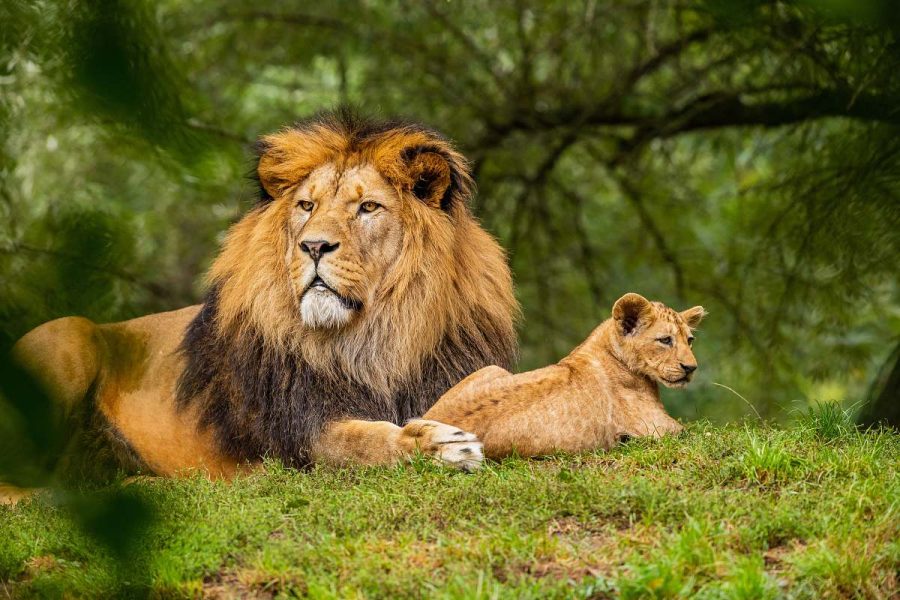
World Lion Day: Low genetic diversity makes big cat vulnerable to extinction

Every year, on August 10, the world celebrates ‘World Lion Day’ to raise awareness on the necessity to protect the royal beast.
The majestic species is listed as endangered by the International Union for Conservation of Nature (IUCN).
“Lion populations have dropped by more than 40 per cent in the last two decades,” the United Nations said in a tweet on Tuesday.
Lions supposedly wandered through Africa, Asia, Europe, and the Middle East some three million years ago. But a lot has changed in terms of their concentration and the number. Their population is now mostly limited to Africa and western India.
In India, the only free-roaming population of Asiatic lions in the world have been found in Gujarat for the last 130 years. Most of them are found in the Gir National Park and outside the protected areas in Gujarat.
As per the latest survey, there are 674 lions in the state.
Also Read: International Tiger Day 2022: World has more tigers in captivity than in wild
Experts believe that the concentration of lions in a single reserve is not good in the long run.
History
The first World Lion Day was observed in 2013 when Dereck and Beverly Joubert, from the Big Cat Initiative and National Geographic, founded it. The aim was to protect the lions in their natural habitat.
According to IUCN, the lowest number of wild cats was recorded in the 1880s when their number was reduced to a dozen.
As a result of hunting, poaching and encroachment of forest land, India was left with just 20 lions by 1913.
With the government’s intervention, the lion population has been now restored to 674 as per the latest 2020 census.
As per reports, in 2018, nearly 24 lions died in Gir due to the spread of the canine distemper virus (CDV).
As per Gujarat Government, around 184 lions died between 2016 and 2017, 32 out of which died due to unnatural causes.
Present scenario
As per experts, it is not natural for lions to adapt to a coastal habitat but the animals have no choice in times of scarcity of land which has increased the territorial wars among the big cats.
Due to low genetic diversity, lions are more vulnerable to extinction.
In 2013, the Supreme Court ordered Gujarat to translocate its lion population to neighbouring Madhya Pradesh to save them from the possible threat of extinction due to epidemic or natural calamity.
The Gujarat government which is showing resistance to the order has, however, insisted on completing nearly 30 studies before translocating the lions.