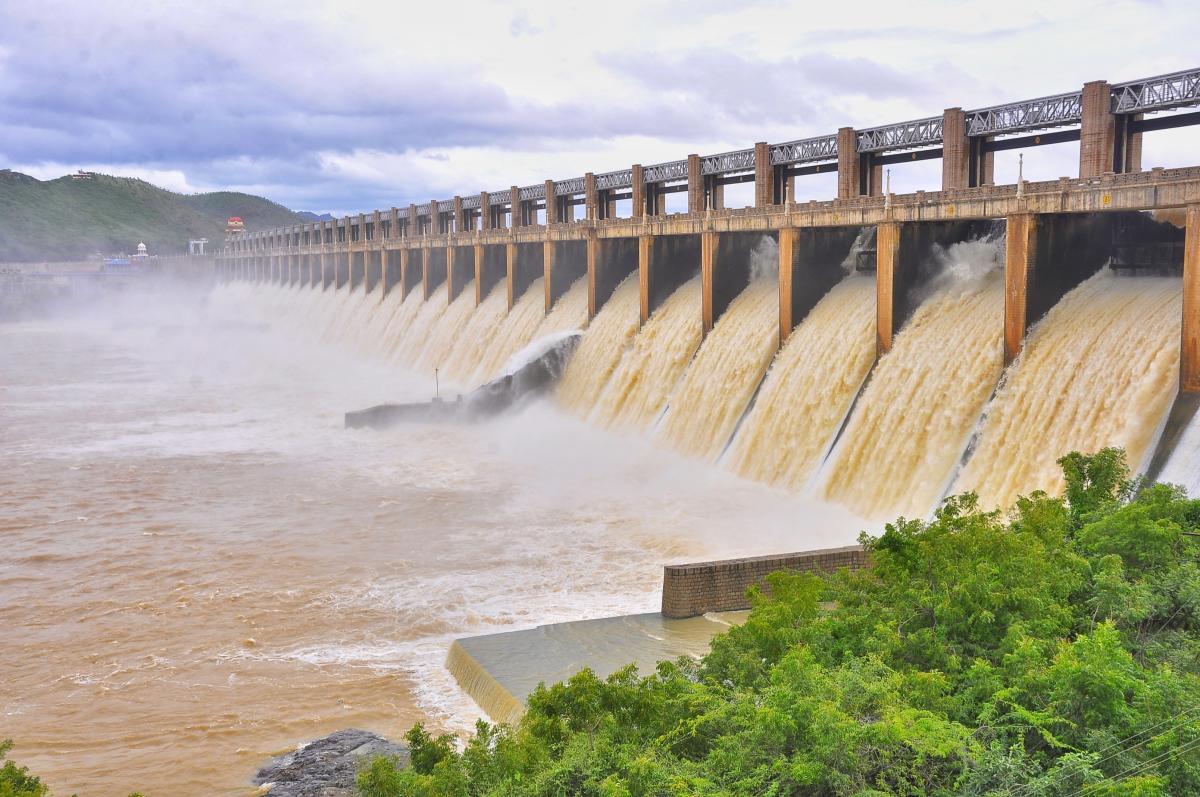
Poor August rains drop storage levels in reservoirs below 10-year average

Less than normal rainfall in the month of August means less storage in major reservoirs across the country and an indication that Rabi crop may not get sufficient irrigation this time.
This is bad news for the agriculture sector and for the economy since less rains adversely affect rural incomes directly and urban inflation indirectly.
Data released by the Central Water Commission (CWC) shows that the overall volume of water in India’s major reservoirs from August 26-September 2, 2021, was less than the corresponding period last year and the 10-year average.
The Central Water Commission monitors live storage status of 130 reservoirs of the country on a weekly basis. Out of these reservoirs, 44 have hydropower benefit with installed capacity of more than 60MW. As on September 2, the total live storage capacity of these 130 reservoirs is 111.691 billion cubic metres (BCM), which is about 65% of the live storage capacity.
Last year, the live storage available in these reservoirs for the corresponding period was 140.051 BCM and the average of last 10 years live storage was 119.026 BCM. Thus, the live storage available in 130 reservoirs as on September 2, 2021, is 80% of the live storage of corresponding period of last year and 94% of storage of average of last 10 years.
In the northern region (Himachal Pradesh, Punjab and Rajasthan), the total live storage available in 8 reservoirs is 10.36 BCM which is 54% of total live storage capacity of these reservoirs. The storage during corresponding period of last year was 76% and average storage of last 10 years during corresponding period was 81% of live storage capacity of these reservoirs.
Also read: Want to save water? Know your water footprint first
In the eastern region (Jharkhand, Odisha, West Bengal, Tripura and Nagaland), the total live storage in 20 reservoirs is 10.54 BCM which is 53% of total live storage capacity of these reservoirs. The storage during corresponding period of last year was 73% and average storage of last 10 years during corresponding period was 63% of live storage capacity of these reservoirs.
In the western region (Gujarat and Maharashtra), the total live storage in 42 reservoirs is 20.20 BCM which is 57% of total live storage capacity of these reservoirs. The storage during corresponding period of last year was 85% and average storage of last 10 years during corresponding period was 66% of live storage capacity of these reservoirs.
In the central region (Uttar Pradesh, Uttarakhand, Madhya Pradesh and Chhattisgarh), the total live storage in 23 reservoirs is 28.06 BCM which is 62% of total live storage capacity of these reservoirs. The storage during corresponding period of last year was 86% and average storage of last 10 years during corresponding period was 75% of live storage capacity of these reservoirs.
In the southern region (Andhra Pradesh, Telangana, Karnataka, Kerala and Tamil Nadu), the total live storage in 37 reservoirs is 42.54 BCM which is 81% of total live storage capacity of these reservoirs. The storage during corresponding period of last year was 80.05% and average storage of last 10 years during corresponding period was 64% of live storage capacity of these reservoirs.
Thus, storage during current year in the southern region is better than the storage of corresponding period of last year and also is better than the average storage of last ten years during the corresponding period.
Only five states had better storage than last year for the corresponding period: Jharkhand, Andhra Pradesh, Telangana, Karnataka and Kerala.
At present, 27.47 per cent of the country is facing drought-like conditions, according to Drought Early Warning System, a real-time drought monitoring platform.
Monsoon may revive in September, but will that suffice?
The India Meteorological Department’s (IMD) forecast of a normal monsoon in August fell flat as the country ended the month with a 24% rainfall deficit.
With this, the overall performance of the southwest monsoon has dipped further, with season’s monsoon rainfall deficit standing at 10% until August 29.
While the weather department has now suggested that September rains will be above normal, it is unlikely to compensate for the shortfall in August – the second highest rainfall month after July. Thus, India may end this monsoon with “below normal” rainfall, which is characterised by rainfall being 90-96% of the long period average of 88 cm.