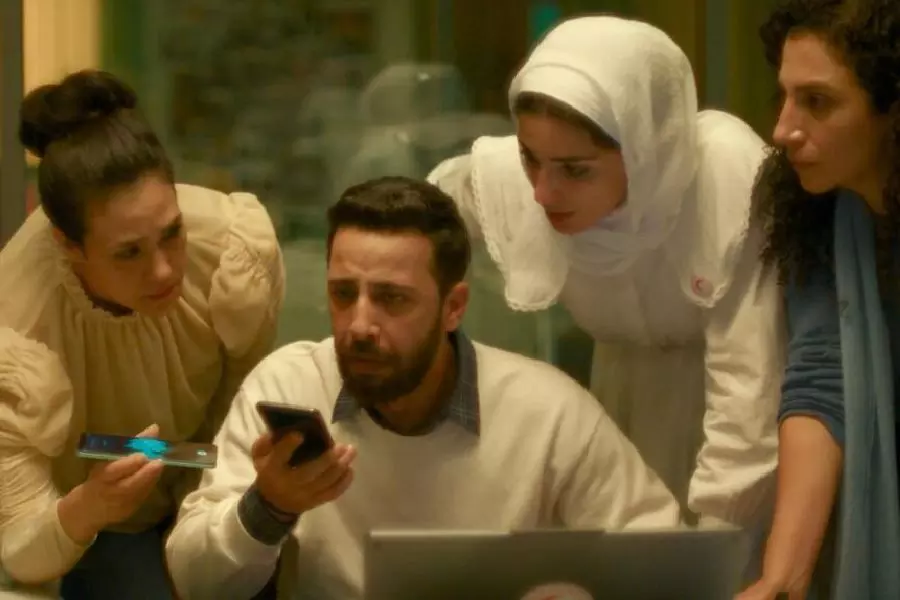
At just 89 minutes, The Voice of Hind Rajab premiered at the Venice Film Festival last year to a record-shattering 23-minute standing ovation, the longest in the festival’s modern history, and won the Grand Jury Prize.
The Voice of Hind Rajab: India has blocked this film on Gaza, but here's why you must watch it
The theatrical release of Tunisian filmmaker Kaouther Ben Hania’s docudrama, The Voice of Hind Rajab, which was nominated for the Oscar but lost to Sentimental Value, has been banned by the CBFC.

You do not so much watch this film as hear it. “They’re shooting at me. Please come get me. I’m scared,” you can feel the fear in her voice; small, trembling, but impossibly alive. That pleading voice belongs to Hind Rajab, a six-year-old Palestinian girl, who’s cornered in a car riddled with bullets, surrounded by the bodies of some of her family members. Her desperate phone call, made on January 29, 2024, lodged itself in the conscience of Tunisian filmmaker Kaouther Ben Hania like a shard of glass that would not be removed. Out of that single, harrowing recording — 70 minutes of terror and hope — came The Voice of Hind Rajab, the Oscar-nominated docudrama which the Central Board of Film Certification (CBFC) has banned in India, terming it as “very sensitive.”
On March 19, Ben Hania took to Instagram to confront India's decision to block the film's theatrical release. “I grew up loving India. Bollywood was part of my childhood. At some point I even imagined I had Indian roots just to feel special. Is the honeymoon between the ‘world’s largest democracy’ and the ‘only democracy in the Middle East’ so fragile that a film could break it?” she wrote.
Mumbai-based distributor Manoj Nandwana has revealed to Variety that the CBFC withheld clearance over fears it might fracture the India-Israel relationship. “I told them the India-Israel relationship is so strong that it's idiotic to think this movie will break it,” he said.
The docudrama records the Red Crescent’s response during the killing of Hind Rajab by the Israel Defence Forces during the Israeli invasion of the Gaza Strip. Starring Saja Kilani, Motaz Malhees, Amer Hlehel, and Clara Khoury, the film, a co-production between Tunisia and France, was nominated for Best International Feature Film at the 98th Academy Awards, but lost to Norway’s Sentimental Value. Ben Hania’s previous directorials, Man Who Sold His Skin and Four Daughters, earned Oscar nominations, too.
At just 89 minutes, The Voice of Hind Rajab premiered at the Venice Film Festival last year to a record-shattering 23-minute standing ovation, the longest in the festival’s modern history, and won the Grand Jury Prize. It has variously been described as “harrowing”, “unforgettable” and “a powerful appeal to humanity”. But those words feel inadequate. To watch this film is to come up close with Hind herself, even though we never see her face, with her voice enveloping the screen like a waveform of pure urgency, demanding that we, the citizens of the world, bear witness.
The account of the rescuers
The real events that inspired the film took place in Gaza City’s Tel Al-Hawa neighbourhood amid the helter-skelter that ensued in the wake of the conflict. Hind’s family, fleeing violence, found themselves trapped in their car under heavy fire. A 15-year-old cousin, Layan, made the first frantic call to the Palestine Red Crescent Society. She did not survive. Hind, alone now except for the dead, picked up the phone. For hours, she spoke to dispatchers who became, in those terrible minutes, her only thread of connection to the living world. She described her surroundings with the heartbreaking specificity of a child: the colour of the car, the fear in her voice rising and falling like a tide. She asked for her mother. She asked for help. She asked to be saved.
Those recordings, uploaded by the Red Crescent and shared across the globe, went viral because they were heartbreaking. A little girl’s voice, unfiltered, pleading across static and gunfire. Ben Hania first heard it during a layover at Los Angeles International Airport, deep in the Oscar campaign for Four Daughters (2023), which captured the grief of a mother named Olfa after two of her four daughters disappear one day, slipping away from home to join Daesh fighters in Libya. She had been mentally preparing to shoot a different film, a period piece she had laboured over for a decade. “Her voice was so alive,” the director later recalled in interviews, “I thought she was asking me to save her.”
Everything else stopped. She contacted the Red Crescent, obtained the full audio, spoke at length with Hind’s mother and the real dispatchers who had tried, and failed, to reach the child. “I had to drop everything,” Ben Hania said in an interview. “I knew, without a doubt, that I had to make this film. We started working on it to not feel helpless, to not accept, to bear witness.”
Kaouther Ben Hania first heard the recording of Hind Rajab's voice during a layover at Los Angeles International Airport. “Her voice was so alive,” the director later recalled in interviews, “I thought she was asking me to save her.” Photo: Wikipedia
What emerged from that impulse teaches us a lot about empathy. Rather than dramatise the violence directly, an approach that could tip into exploitation, Ben Hania confines the camera almost entirely to the cramped offices of the Palestine Red Crescent Society. The film becomes a chamber piece, a tense ensemble drama played out across desks, phones, and computer screens.
We never see the car, the bullets, or the final moments. Instead, we see the faces of the workers: their eyes widening, their voices steadying, their hands trembling as they navigate a labyrinth of protocols, coordinates, and permissions. Hind’s voice is the constant, piped through speakers, visualised sometimes as an audio waveform that fills the entire screen, her words pulsing like a heartbeat under siege.
The little girl who loved the sea
This structural choice is the film’s real achievement. By staying with the rescuers, Ben Hania forces us to experience the horror through their helplessness. We feel the Kafkaesque frustration of three-hour delays while an ambulance sits idle just minutes away. We hear the gunfire crackling through the phone line and watch the workers flinch as if the shots are aimed at them. The bureaucracy itself becomes a form of violence; paperwork and permissions standing between a dying child and the help she needs. The film does not show bloodshed, but it does show the cost of trying to stop it.
Saja Kilani, as dispatcher Rana Hassan Faqih, brings a gentle touch that borders on maternal instinct. Her voice stays calm for Hind even as her eyes betray the terror. Motaz Malhees as Omar A. Alqam lends spirited urgency, a man racing against impossible clocks. Amer Hlehel’s Mahdi M. Aljamal is the straight-laced anchor, while Clara Khoury’s Nisreen Jeries Qawas, a psychologist, offers compassion. Together they form a portrait of ordinary heroism under extraordinary pressure, of people who chose to answer phones and offered Hope to a girl hours before she was killed, when the world looked away.
Ben Hania shot the film in Tunisia over three intense weeks in late 2024; the film boasts an astonishing list of executive producers that reads like a who’s who of what you can call conscience-driven cinema: Brad Pitt, Joaquin Phoenix, Rooney Mara, Jonathan Glazer, Alfonso Cuarón, Spike Lee, and Michael Moore, among them. The production used real audio into scripted scenes, sometimes overlapping the actors’ voices with the actual dispatchers’ recordings to blur the line between reenactment and reality. Digital file names appear on screen. At key moments, the film cuts to black and lets Hind’s unaltered voice speak alone.
The ethical tightrope Ben Hania walked is palpable. She consulted Hind’s mother extensively and secured permission for the audio. She refused to sensationalise. In interviews, the director has spoken of transcribing the recordings herself in French to create emotional distance, of wrestling with the question of whether art can ever truly honour such a loss.
“It was like the very voice of Gaza asking to be saved,” she told Vogue. But the film never claims to save Hind. It only asks that we remember her, not as a mere statistic, but as a little girl who loved the sea, who smiled like sunshine, who treated waves like friends. In the closing moments, we hear Hind’s mother speak directly to the camera about that love of the ocean.
The voice of Gaza
Hind Rajab was a child who, in her final hours, displayed courage most adults could not summon. She kept talking, hoping and describing what her little eyes saw of the world, even as her own collapsed around her. Ben Hania has said she made the film so that “the world will sit up and listen.” The Voice of Hind Rajab places us in the room with the workers whose job was to save her and whose failure was not theirs but the system’s. It honours the Red Crescent volunteers who risked everything: two of whom, Youssef Zeino and Ahmed Madhoun, died trying to reach her. It also honours the mother left behind. And above all, it honours Hind by letting her speak.
As the genocide and ethnic cleansing of Palestinians flash across screens and vanish, as numbers replace names and tragedies become background noise, Ben Hania has turned a phone call into a film that will tug at your heartstrings and also leave you enraged at the sheer brutality and heartlessness with which the Israeli army keeps targeting hundreds of thousands of civilians, including countless women and children. The film only asks one thing: listen. Listen to the fear. Listen to the bravery. Listen to the child who should be playing by the sea instead of pleading into a dying phone. Listen to the voice of Gaza.
Hind Rajab’s voice does not fade with the final frame, but stays with you forever. The film accomplishes what years of headlines could not: it makes one small life feel infinite. It makes one small voice impossible to ignore. It also shows us why we tell stories at all: to keep the dead alive in memory, to keep the living accountable in conscience, and to ensure that no child’s final plea ever goes unheard again. Anywhere in the world. Hind Rajab loved the sea. She treated it like a friend. Through this film, her voice has become something like the tide: persistent, powerful, pulling us back toward humanity. Listen. The water is calling. The CBFC wouldn’t let it be released in theatres here. But watch you must!