Tu Hai Meri Kiran review: Sonakshi Sinha's sci-fi thriller is lifeless despite a fun premise
Karan Rawal's film, also starring Zaheer Iqbal, could have easily been an episode from an old anthology TV crime show

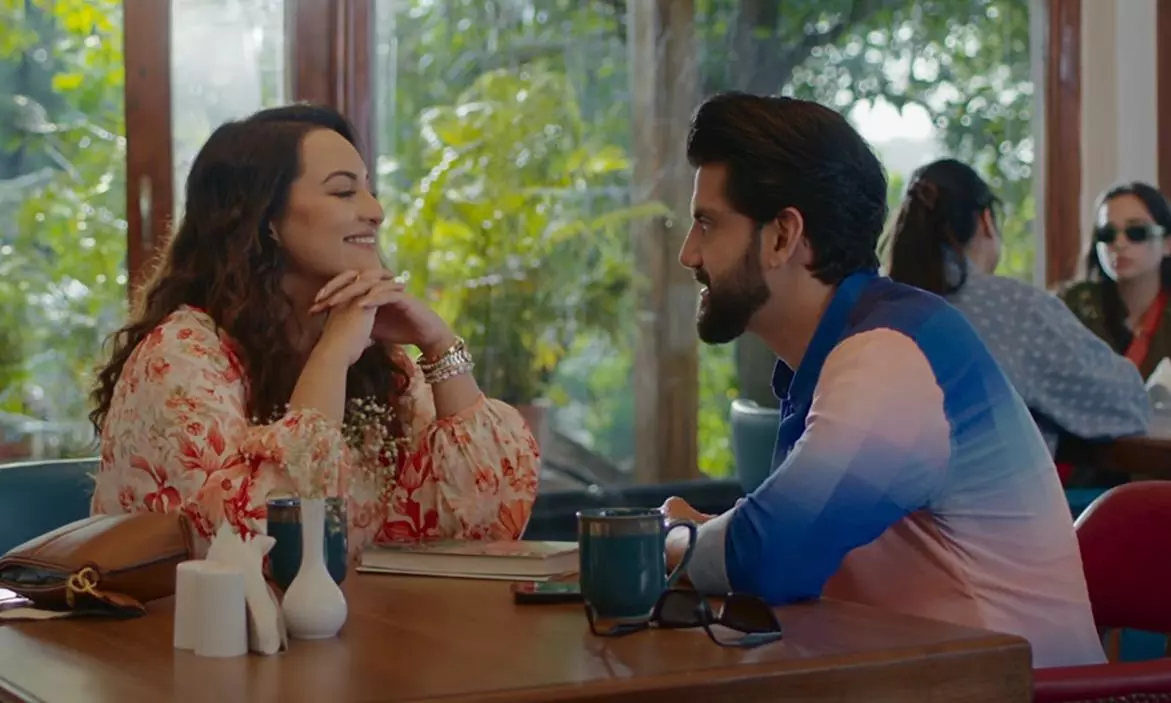
The term ‘loop’ becomes operative in the case of Karan Rawal’s Tu Hai Meri Kiran. On the one hand, the film’s derivative, loopy, timeline-bridging thriller plot connects two strangers from the past (2016) and the present (2026). On the other hand, the film has glaring logical loopholes that underline the narrative so prominently that they simultaneously make your eyes roll back in disbelief and add unintentional fun to the experience. This is one of those films where something intriguing seems at play at all times, but the hilarity of the story's unfolding adds its own layer of whimsy.
Crossed signals across a decade
When Kiran (Sonakshi Sinha) unassumingly finds an old flip phone in her snazzy Uttarakhand bungalow, little does she know that it’s a portal to a decade back, when Samar (Zaheer Iqbal) finds a version of the same nearly-broken device at a random tea stall. It doesn’t take much to realise that this is a rather well-known, abundantly used conceit, but writer-director Rawal runs with the notion that no one’s potentially encountered it before. Convenience, thereby, comes in very handy for him throughout the film. Kiran is a bestselling author currently facing writer’s block, so she is sure to be enamoured by the idea of interacting with a stranger from the past. Samar is an unemployed, designated loser who also happens to be a sociopathic stalker, so he finds his own motives to use the opportunity.
While Samar sensibly expresses absolute doubt and wariness about this chance meeting, Kiran has no qualms in either readily deducing the sci-fi premise between them or treating it with such casualness and lack of scepticism that no amount of scoffing feels sufficient. Writers, apparently, are such trustful creatures, according to Tu Hai Meri Kiran.
Still, you feel drawn to this exchange because the characters, even if superficially, come across as well-defined. Kiran's almost picture-perfect life includes her loving husband Riyaan, a snazzy bungalow somewhere in Uttarakhand (could be Bandra, for all you know), and a tricky relationship with her father, which feels strained only in description. Samar, in complete contrast, leads a life of shame and movie-like poverty that comprises a perpetually nagging mother (a nameless Zareena Wahab), “friends” who deride him all the time, and a sense of insecurity that makes him unpredictable and dangerous. One has everything to lose and the other, nothing. So Samar can perhaps (re)claim his future by acting from the past, all the while holding Kiran (of the present) ransom.
Nuanced characters, defective logic
Even with shoddy execution, Tu Hai Meri Kiran's plot has something to pique curiosity. It does a fairly decent job of lending some nuance to Samar, as one sees him transition from well-meaning to dark and obsessive within a short amount of time. Iqbal, too, is believable, despite the lack of expectations. Sinha’s Kiran, in parallel, doesn’t get much to her name in terms of a character arc, but her archetypal role of the plighted woman somehow manages to keep the story going. The plot twists occur now and then, although the rule-less world-building comes to be at odds with the proceedings.
Indeed, the film operates without much self-governance. The plot hinges on the fact that the present-day Kiran can acknowledge the butterfly effect caused by Samar, but the film abruptly removes this detail at the most crucial moment. Some of the other important elements — dates, landmarks, etc. — too are used in a manner that’s most unconvincing; even the most innocuous event is stored away in a laptop and the silliest of contrivances are treated as epiphanies. Yet, it’s the way the characters are made to behave or respond to the situation at hand that becomes the most nerve-grating aspect. Kiran, especially, goes about life as though she has little interest in the bizarre timeline mechanics around her.
Outdated aesthetics
That said, Tu Hai Meri Kiran, ultimately, isn’t defeated by incoherent plotting, but more so by the inauthentic storytelling. It feels dated, by at least a decade or two, and its personality is that of a film that could have easily been an episode from an old anthology TV crime show. You know, the ones where the rich live in the most stereotypical bungalows and make vapid small talk like “company kaise chal rahi hai” (How is the company doing?), while the poor inhabit a generic, cookie-cutter set, whose walls are smeared with soot to signal poverty.
More importantly, it doesn’t function fully as a movie or a visual document, and is rather better experienced as an oral account. It’s got some kicks and thrills scattered throughout and is tightly wound at a 125-minute runtime, but it still falls short of being rewarding or enjoyable.