The Legend of Karna review: SonyLiv animated series fights a losing battle
A retelling of the Mahabharata from the warrior Karna’s perspective, the series has been created by Sharad Devarajan and Jeevan J. Kang, but the characters are two-dimensional, and the philosophical rumination integral to the text is dispensed in sound bites ready-made for reels.

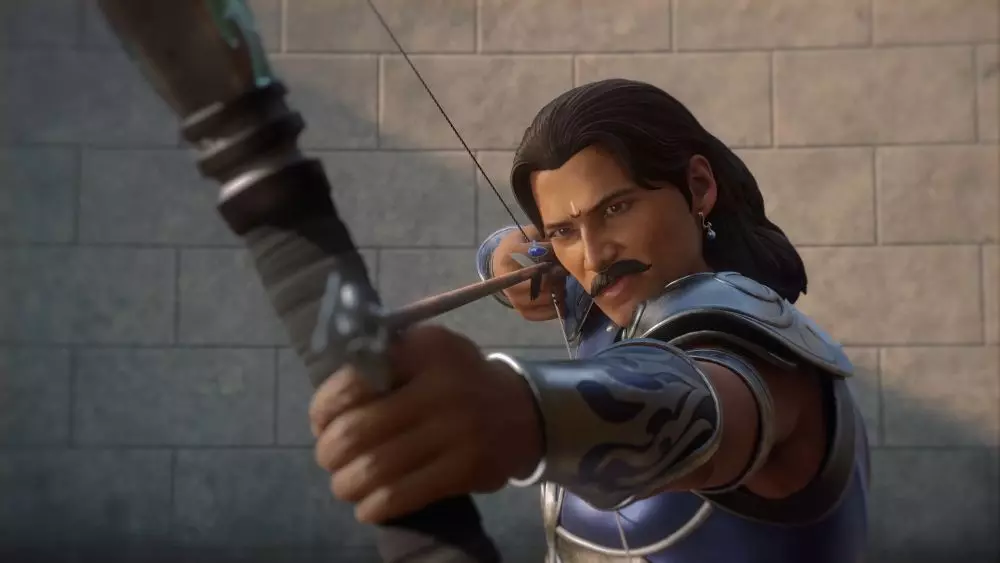
Within ten minutes of Karna being introduced in the first episode, he’s slaying a “rakshasa” with his bow and arrow.
The fundamental issue with adapting mythological epics in India is that there’s very little adaptation going on, avoiding straying too far from the source. But the issues with SonyLIV’s new animated series, The Legend of Karna, are twofold. Not only does the show struggle to find anything new to say about one of the greatest stories ever told, the Mahabharata, but it also can’t decide whom it is targeting. Too verbose for children and too simplistic for adults, The Legend of Karna ultimately finds itself in no man’s land, fighting a war that it was always going to lose. The irony.
A retelling of the Mahabharata from the warrior Karna’s perspective, the series has been created by Sharad Devarajan and Jeevan J. Kang, with none other than Anup Soni, of “Saavdhan Rahein, Satark Rahein” fame, voicing the titular character. The Legend of Karna, to its great misfortune, finds itself sandwiched between Christopher Nolan’s The Odyssey and the upcoming two-part Ramayana starring Ranbir Kapoor. Needless to say, it cannot compete with either of those projects in terms of production values or scope. There was, however, an opportunity to present a more internal take, especially since the writers were under no burden to flesh out the scores of characters in the Mahabharata.
Like watching a PlayStation game
It seems that the goal here wasn’t to provoke thought, but to simply introduce younger generations to the epic. Fair enough, but for a show ostensibly aimed at kids, it relies far too heavily on old men having long conversations. It doesn’t help that the men look identical to each other, which is to say, they all look like versions of Rocking star Yash, all muscled up. This is probably a side-effect of cost-cutting. For proof, one needn’t look further than Karna’s attire. He wears the same outfit in every scene, regardless of whether he’s battling demons in the rain or taking a stroll with his younger brother. Creating even one more skin for him, or any other character for that matter, was clearly deemed unnecessary.
These are the pitfalls of contemporary visual effects, which often rely on video game engines to render entire scenes. Watching The Legend of Karna gives the distinct impression that you’re looking at someone else play a particularly plodding PlayStation 3-era game.
Also read: Spider-Man: Brand New Day review — Emotional drama among the best moments of this superhero film
The goal should have been to create an expressionistic world, full of magic and wonder.
Karna is a tragic figure. But this show fails to engage in the moral intricacies of his character.
The Legend of Karna theoretically had a competitive edge over its live-action counterparts simply by virtue of being entirely computer-generated. Animation offers incredible creative freedom, and to not take advantage of these freedoms, unfortunately, is akin to turning away “prasad” at a temple. There is a magic to the medium that creators Devarajan and Kang fail to acknowledge because they’re too preoccupied with creating “real” images. This could’ve been overlooked had the writing been imaginative. But there’s a tonal imbalance to the series that makes it seem as if it was written in English and translated by someone else.
For instance, when Karna is instructed not to hold back against Arjuna in combat and to attack him “khul kar (freely)”, he asks, “Khul kar, khul kar (Like, freely, freely)?” On another occasion, a different character snarks at Shakuni Mama, “Dharm angvastra pehne aapke saamne nritya kare, aap tab bhi usse pehchan nahi payenge (You wouldn’t be able to identify dharma even if it danced in front of you).”
Translated, both these remarks are decidedly American. This checks out; the show owes about as much to the Marvel Cinematic Universe as it does to Mani Ratnam’s Ponniyin Selvan films.
A Karna who doesn’t evolve
The narrative is both straightforward in its structure and overly complicated in terms of plot. The characters are two-dimensional, and the philosophical rumination integral to the text is dispensed in sound bites ready-made for reels.
Also read: Bhai Tera Star Hai review: Raghav Juyal's comedy promises a lot, delivers little
Karna is introduced, fully formed, in the opening episode. Within ten minutes, he’s slaying a “rakshasa” with his bow and arrow. In episode five, he single-handedly breaches a fortress by ramming its thick doors with his bare fists and then by hurling a tank-sized catapult at it. We don’t see him evolve. Nor do we see him push back against casteist slurs or engage his father in ideological debate. His powers and personality remain unchanged throughout the show's run.
Like Odysseus, Karna is a tragic figure. Far be it, however, of this show to engage in the moral intricacies of blind ambition, betrayal, and identity. The Legend of Karna is, instead, a cursory exploration of a complex story, an adaptation that doesn’t respect its audience—children or otherwise—enough to offer something worthy of their intelligence.