Ikka review: Netflix film returns Sunny Deol to the courtroom 33 yrs after legendary Damini outing
Siddharth P Malhotra’s Ikka is the story of an upright lawyer (Deol) who must choose between his morals and his daughter's life, when he is called upon to defend sexual assault accused Shauryaman Gaur (Akshaye Khanna). Tilottama Shome holds her ground as a junior lawyer fighting to put Khanna behind bars.

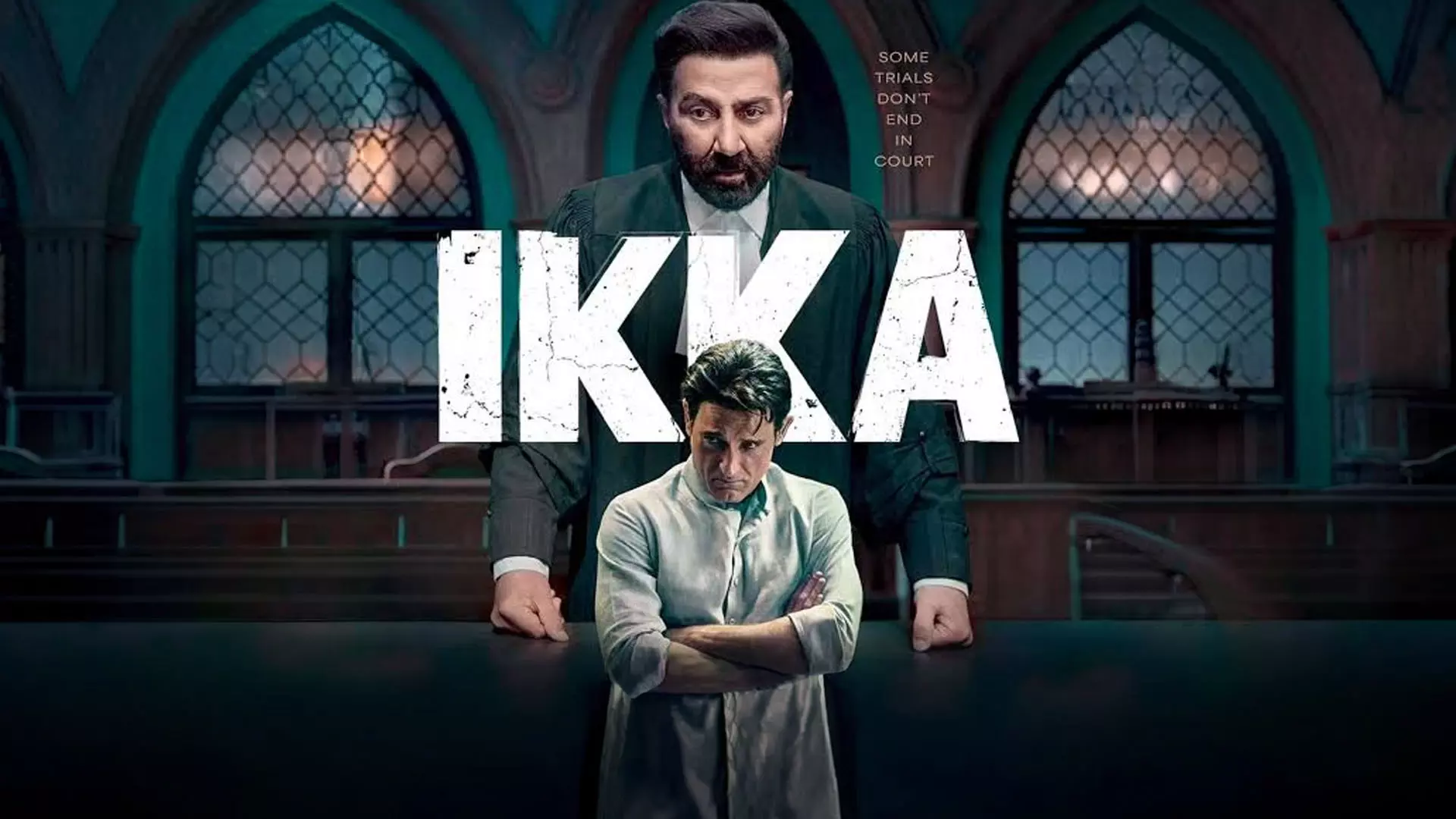
Siddharth P Malhotra is less interested in courtroom theatrics than in the moral questions that emerge from them.
Sunny Deol’s unabashedly unapologetic advocate Govind Srivastav, who had chastised the legal system that had left him disillusioned with the fiery “tareekh pe tareekh” monologue in the 1993 courtroom drama Damini, continues to remain etched in popular memory. Thirty-three years later, he returns to court as the uncompromising and morally upright defence lawyer Arjun Mehra — nicknamed “Ikka” (trump card) in legal circles — in Siddharth P Malhotra’s eponymously titled Netflix film, Ikka.
The courtroom genre has long been a favourite among filmmakers for questioning societal truths. Ikka opens at a nightclub, where Shauryaman Gaur (Akshaye Khanna), flashing the now-familiar Rahman Dakait (his character in the hit Dhurandhar) smirk, is cosying up to a young woman played by Akansha Ranjan. He escorts the inebriated girl out of the club and the very next moment we see her being thrown out of a moving car.
We are then introduced to the world of Arjun Mehra, a brilliant lawyer with an unblemished record, known for overturning the most complicated cases, even those considered open-and-shut, by pulling out an ace card, or Ikka. The author of a book considered the gold standard in law, Arjun enjoys an almost demi-god status in legal circles and is regarded as a guardian of justice in an otherwise compromised system.
The battle within
When Arjun is asked to defend Shauryaman, the son of a powerful business magnate and politician, he flatly refuses. It is evident the two men have history.
But Arjun is about to face his toughest challenge, one that will force him to compromise not only his ethics but everything he has stood for. His teenage daughter Samaira has been diagnosed with leukaemia and urgently needs a stem cell transplant. With time running out, a deeply personal revelation leaves Arjun with an impossible choice, forcing him to defend the very man he despises. For a lawyer who has built his career on never defending those he believes to be guilty, the proposition is not merely professional blackmail; it is a complete collapse of every principle he has lived by.
Also read: Evil Dead Burn review: A franchise vehicle that dares to hold its own
Shaurya coolly offers him a deal. Defend him and he will donate his marrow. He has no emotional attachment to the girl and couldn’t care less whether she lives or dies. But knowing that her life means everything to Arjun, he knows the lawyer has little choice.
Meanwhile, the victim is identified as Soma Mittal, who lies in a medically induced coma. Representing her is public prosecutor Madhura (Tilottama Shome), a junior lawyer. Though baffled by Arjun’s decision to defend someone as unscrupulous as Shaurya, Madhura is convinced there is more to the case than meets the eye. She understands that Arjun Mehra never steps into a courtroom without seeing moves others haven’t even imagined.
Ikka then settles into a courtroom duel.
The exchanges are crisp and never weighed down by excessive legal jargon, allowing the emotional stakes to remain front and centre. Every legal victory for Arjun chips away at his conscience. Wracked with guilt, he watches everything he has painstakingly built begin to crumble. While the courtroom turns don’t always surprise, a deeply personal revelation serves as the film’s emotional trump card, lending urgency and moral weight to what could otherwise have been a familiar legal drama.
A moral duel
Malhotra, whose previous legal drama Maharaj peeled back the layers of the infamous 1862 libel case involving journalist and social reformer Karsandas Mulji, spent over a decade bringing Ikka to the screen. Like his previous outing, Malhotra is less interested in courtroom theatrics than in the moral questions that emerge from them. While the story rests on allegations of sexual assault and violence against women, it is equally about a father’s dilemma. Though the plot is fairly straightforward, the film remains engaging, thanks largely to its performances.
Sunny Deol, whose evolution from the angry young man of the 1980s has played out over decades on screen, once again brings a commanding presence as a man still at loggerheads with the system he once believed in. Malhotra once again focuses on Deol’s expressive eyes, allowing the actor to convey Arjun’s simmering internal conflict with remarkable restraint. He underplays far more than the audience might expect, replacing chest-thumping heroics with guilt, helplessness and quiet anguish.
Also read: The Invite review: Olivia Wilde’s 3rd feature reaffirms her talent as filmmaker
Tilottama Shome, as the overworked junior lawyer juggling a demanding profession with the responsibilities of an exhausted wife supporting an unemployed husband, is effortlessly real and relatable. Never resorting to grandstanding, she gives Madhura a quiet determination that makes her an equal match for Arjun. Even surrounded by heavyweights, Shome commands the screen.
Akshaye Khanna, once again cast in anti-hero mode, leans heavily into grimaces and tightly delivered dialogue. Perhaps it is time for the actor to shed the Rahman Dakait persona because at times it feels as though he has simply transplanted that character into another film.
Dia Mirza is warm and understated as the quietly resilient Avantika, Arjun’s wife, lending emotional support to the story without demanding attention.
Though Ikka occasionally enters familiar territory, it keeps you invested, with its biggest emotional trump card reserved for a deeply personal revelation and a satisfying final act. It may not reinvent the courtroom genre, but it succeeds in reminding us that the most compelling legal battles are often fought within one’s conscience before they are argued in court.