Baththa review: Vijay Sethupathi stars in heart-warming tale of a ‘don’ daring to reject toxic masculinity
Balaji Tharaneetharan’s Baththa questions social reaction to ‘change’ and whether there is acceptance of men wanting to let go of toxic masculinity.

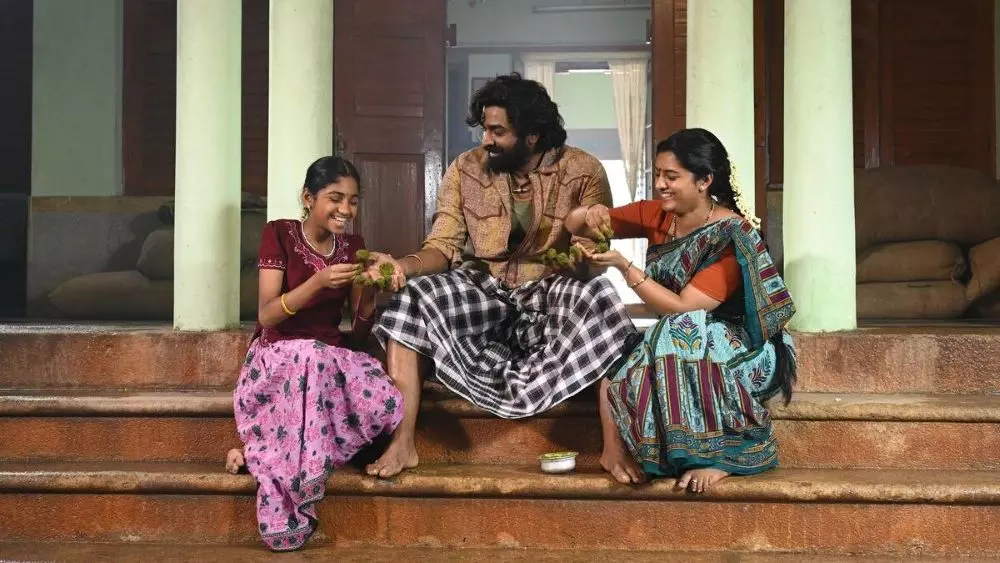
Vijay Sethupathi plays Baththa, a 'don' whose character undergoes a change.
The titular character of Balaji Tharaneetharan's film Baththa, played by Vijay Sethupathi, is a man trapped in an image. As a dreaded local don in 1980s Chennai, Baththa is feared by all. There is a scene in which students at a school share stories they’ve heard of him. One says Baththa kicked open a jail gate, another says he beat up a man for whistling on the street, another says he has caged a pet lion that he takes out on walks. It is almost like Baththa is a mythical character inspiring lores to be spun about him. Baththa enjoys the legend that he has become; in fact, he identifies himself only through the image that he has created and it is only when he is stripped of the narratives surrounding him that he attains true self-awareness, realising the person he truly is and all that he has taken for granted.
Reality check
As with most ‘dons’ in Tamil cinema, Baththa has a couple of henchmen who travel with him everywhere and a list of enemies like Jothi (Arjun Chidambaram), whose knives are forever aimed at his neck.
His domestic life is as chaotic as his ‘professional life,’ with a concerned wife (Lijomol Jose) and an empathetic daughter (Sahasra Shree). In parallel, the director introduces Sabari (Sai Prithviraj), a schoolboy whose life, coincidentally and almost unavoidably, circles Baththa.
Also read: Sigma review: Jason Sanjay’s debut directorial is a guidebook on rookie mistakes
Tharaneetharan, who continues to be an original and fresh voice of narration, proves his creativity by narrating the story from Sabari’s perspective rather than the protagonist’s or the director’s. Sabari is the one to give Baththa a reality check. It is after the encounter between the two that Baththa regrets his actions and sheds his machismo.
This is where the film triumphs. A safer bet would’ve been a survival thriller or a suspense thriller, but the director chooses a dark-comedy-ish tone to deliver a wholesome, kind, and heartwarming film that rejects toxic masculinity & masochism.
The cost of rebranding
The film’s biggest positives are the performances of Vijay Sethupathi and Sai Prithviraj and its moments where Baththa provides Sabari with all that he himself had lacked growing up, giving Sabari what his father cannot afford — buying the schoolboy a safari suit for a family function, taking him on a bike ride...
Also read: Drishyam: The Conclusion review: Ajay Devgn, Jaideep Ahlawat steer a promising final act
The film also captures the ‘80s backdrop well, with characters sporting thick moustaches, in flashy, colourful shirts and tea shops playing Ilaiyaraja & MSV’s music. Sai Abhyankkar’s background score adds to the nostalgia.
Baththa is essentially the story of a man who has confined himself to toxic norms that are a result of an uninformed, emotionally unintelligent decision that resembles Assault Sethu in the 2014 release Jigarthanda. But what does it take for a man to rebrand himself? What does it take for him to reflect on his life and rectify his mistakes? What does it take for him to not only realise that he has been an inadequate father to his daughter, but to change his attitude towards how he treats his wife? But the most important question that Baththa asks is whether we as a society are accepting of men who want to let go of toxic masculinity? Are we opening the door to change?