The End of Oak Street review: Anne Hathaway leads a delicious, utterly original dinosaur movie
The End of Oak Street dials back the clock to the early 1980s with quintessential, middle-class America in focus. Till the entire neighbourhood is bizarrely locked and surrounded by a Mesozoic landscape, forcing residents to go up in arms against invading dinosaurs and other deadly prehistoric creatures.

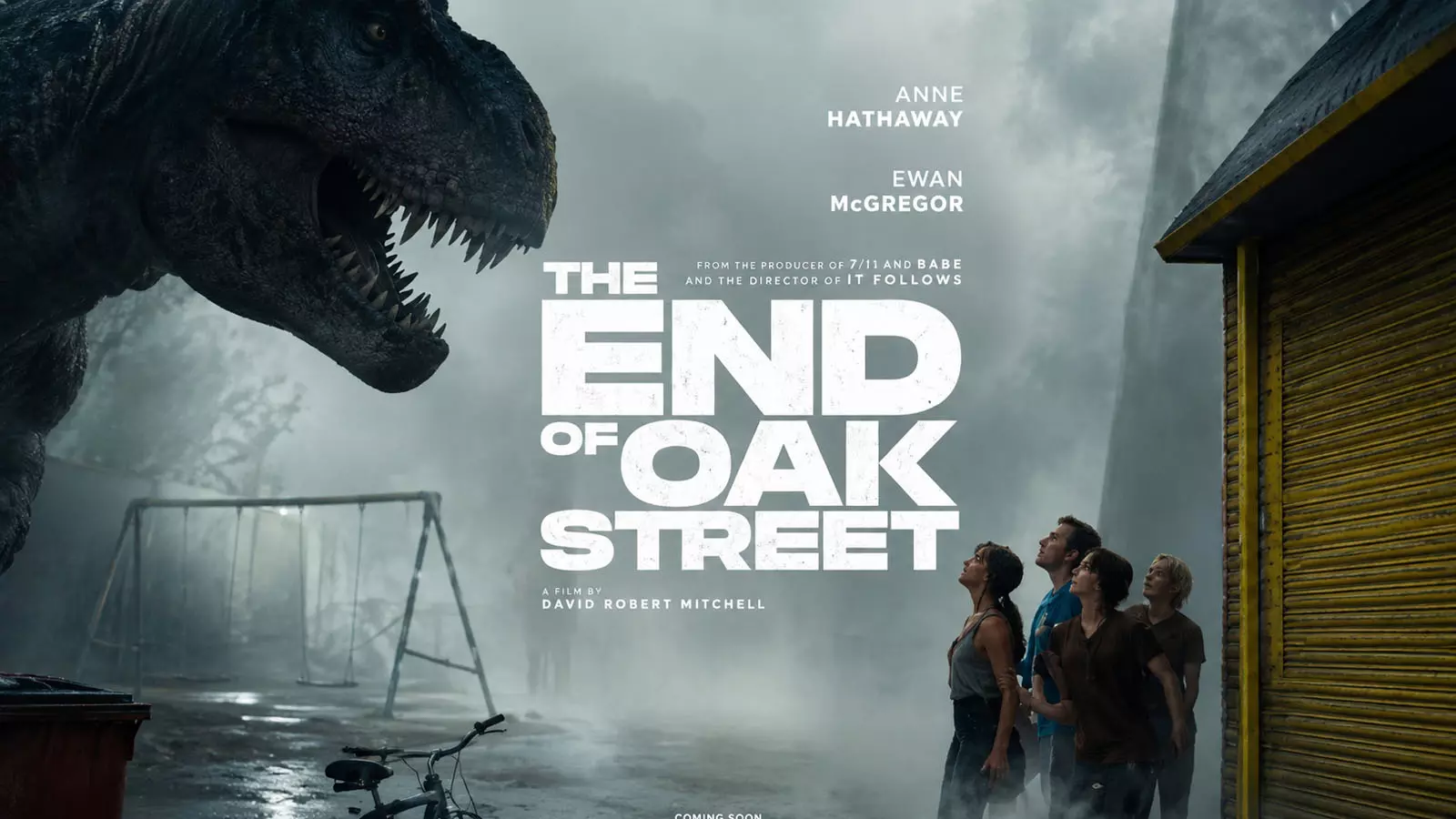
The End of Oak Street, running at a crisp 99-minute duration, is a delightful and accessible watch.
American suburbia has been filmmaker David Robert Mitchell’s thesis subject from the very beginning of his career. The filmmaker made a prominent debut sixteen years ago with The Myth of the American Sleepover (2010), where he cast a host of largely unknown teenage actors to take us through the isolation and unspoken awkwardness felt in a model suburban locality. Despite being made at a measly budget of $50,000, that film enunciated Mitchell’s unique vantage point that not only demystifies the setting that he himself, quite possibly, grew up in, but also appreciates for the strange beauty it offers. More importantly, the film is a conversation with the ideas of adolescence and coming-of-age propagated by cinema, suggesting that real life is far quieter and less vibrant than what one gathers from a classic teen film.
Since then, Mitchell has made three features that are starkly different from one another, both in terms of style and temperament. If his debut was a quiet, ethereal chronicle of a specific world, his second feature, It Follows (2014), revealed that the same place (quite literally) could simultaneously be dreadful and life-threatening. Under the Silver Lake (2018), then, took the famed noir traditions of Los Angeles and subverted them through a weird, shaggy dog narrative that is as amusing as it is bewildering. And now, yet again finding joy in countering as well as celebrating the mythology of cinema, he is back with the story of a quaint United States suburb that is suddenly tasked with fighting dinosaurs and other deadly prehistoric creatures.
And then there were the dinosaurs
The End of Oak Street dials back the clock to the early 1980s with quintessential, middle-class America in focus. The Platts, including Greg (Ewan McGregor), Denise (Anne Hathaway) and their two children — daughter Audrey (Maisy Stella) and son Brian (Christian Convery) — are the emblematic family of the neighbourhood, precisely Oak Street. Wide tarmac roads, lavish front yards laced with green grass and a life that generally looks and feels idyllic from the outside. This setting alone, along with the premise of dinosaurs (or Allosaurs, to be specific), gives away a strong whiff of Steven Spielberg influence and the presence of JJ Abrams (as the film’s main producer) and a John Williams-esque soundtrack do very little to hide those suspicions.
One knows that it is intentional on Mitchell’s part to draw our attention to these facets, and he doubles down on this homage-like treatment by making everything feel perfunctory or even superficial to the dot.
Also read: Batwara 1947: Sunny Deol film uses Partition to give message against mixing politics with religion
For instance, we get to learn early on that Greg and Denise are facing troubles in their marriage, but Mitchell doesn’t really get to the complexities of this relationship. She is an aspiring novelist who feels she cannot share her manuscript with her husband (on account of her ‘fictional’ story being about a married woman leaving her family). He has recently lost his job and is doing pizza deliveries, enduring second-hand embarrassment from his wife.
Pick up any American family comedy-drama from the 1980s and you shall find this thread running common in almost all of them. Mitchell, though, wants it to be exactly like that; important enough for us to care and just all-the-surface enough for us to not pick any sides. Even the way the couple argues is full of platitudes, never really getting ugly or unsavoury for anyone around.
But it is a family worth our affection, nevertheless, and the Platts are the dramatic centre of this story that soon introduces wild bursts of lightning and thunderstorms as cues for something really, really scary.
Brian, the youngest in the family, first notices it, and their pet dog Starbuck barks at this visual barrage too, but before the elders start to take any of this seriously, a cosmic event comes at all of them in full swing.
Travel back in time
The film’s trailer establishes the central idea elaborately, in that the entire neighbourhood is bizarrely locked and surrounded by a Mesozoic landscape and the full-length film adds barely anything to this to deepen or solidify it.
The pulpy paper-back conceit doesn’t want to bother itself, or us, about why those prehistoric killer animals have appeared out of nowhere, or why this specific neighbourhood was chosen for such outlandish activity in the first place; no kids are shooting weird lasers into the ether and no mad scientist is causing any time-spatial disruption here. Everything is simple, even simplistic and uncomplicated by design, and it is this level of familiarity that makes The End of Oak Street, running at a crisp 99-minute duration, delightful and accessible.
The action, too, is envisioned to go against the grain of a modern-day theatrical adventure. Mitchell sees his film as a disaster movie, no doubt, in which harmless bystanders get swallowed by velociraptors and children are left orphaned by its fellow creatures. But his tongue is firmly planted in his cheek and he conducts his narrative, particularly with respect to the tone and energy, by striking a great balance between sincerity and parody.
Also read: Awarapan 2: Emraan Hashmi sequel to 2007 film designed almost exclusively for actor’s cult fanbase
Although parody might seem like stretching it, nothing else really explains why the film suddenly wishes to show two dinosaurs in a mid-coital position, or why two frantic humans would stop to capture that moment with their camera. In another scene, staged at an especially sensitive moment, a massive reptile quietly slithers through the Platts’ home, while the family members carry on with their regular routines. A wormhole opts to disappear just as someone is mid-jump, causing them to break a bone or two after landing.
It is refreshing to watch a film that doesn’t wish to outwit its audience by trying to consistently dazzle them with a CGI onslaught (the visual effects, too, aren’t in your face but effective nevertheless). Instead, The End of Oak Street treads assuredly and stays tethered to its natural personality all along. It’s sentimental, but not cloyingly. It’s fun and adventurous, but not cacophonous. There are plenty of thrills and some bone-chilling violence too, and the ensemble cast is solid all along; for all we know, this least-expected outing might be Hathaway’s best thus far in her rather eventful 2026. My only quibble, though: Why the heck doesn’t McGregor run faster in the movie?!