The Last House review: Netflix’s new survival drama doesn’t reach its potential
Contrary to its stated purpose of instilling hope, the film, directed by Louis Leterrier and starring Greta Lee and Wagner Moura in lead roles, reveals itself as quite a distressing harbinger of the future.

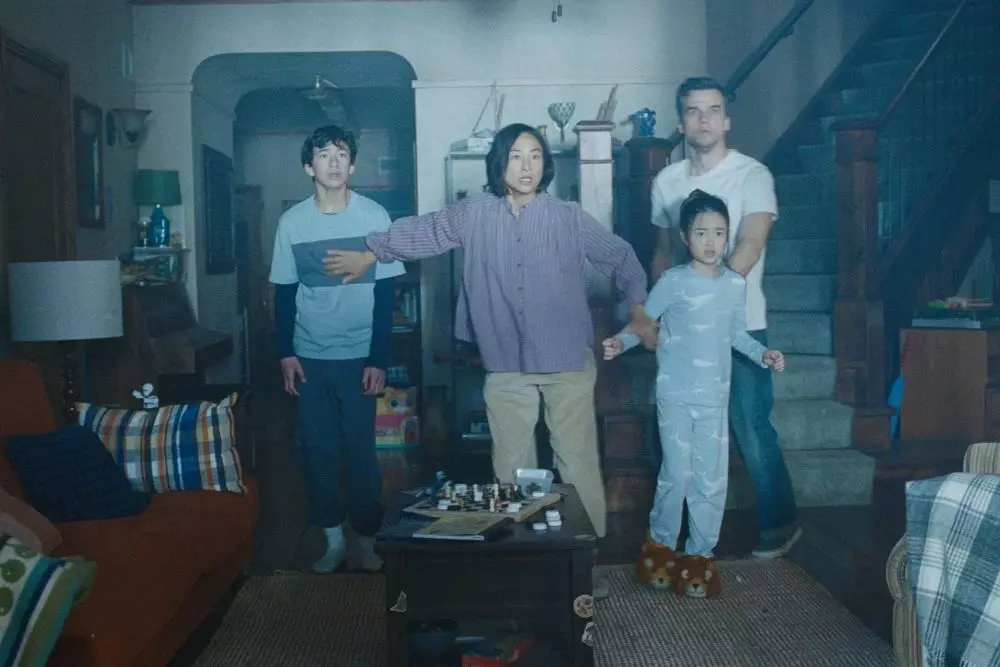
The film revolves around a family of four — a couple and their two children — who, on one rainy morning, find that they cannot leave their quiet suburban house.
What if the Covid-19 lockdown never ended? What if the world’s entire population was forever imprisoned in their homes, with family members as their cellmates? What would happen after three weeks, three months, or three years? Netflix’s new original movie, The Last House, doesn’t take this admittedly intriguing premise to its potential.
The film revolves around a family of four — a couple and their two children — who, on one rainy morning, find that they cannot leave their quiet suburban house. The doors won’t open, the internet and phone services are dead; there is no way of knowing what has happened. When the dad tries to hammer his way out, magical rainwater simply repairs any damage that he causes to the windows and the walls.
Very soon, the family realises that there is no escaping. Across the street from them, their neighbours appear to be in the same mess. They begin communicating with each other via large handwritten signs. Two houses down, a young man and woman sheepishly confess that they’d just woken up from a one-night stand when the rain came and locked them in with each other.
Dealing in archetypes
Having seen what director Louis Leterrier has done with The Last House, a part of you is convinced that following the one-night stand couple would've made for a more interesting movie.
Unfortunately, we are saddled with the most milquetoast couple imaginable; they're played by Past Lives breakout Greta Lee and the recently Oscar-nominated Wagner Moura — incredibly talented actors reduced to barking orders and delivering exposition. The script, by Matthew Robinson, deals purely in archetypes. Little effort is made to tell us who these people were before the sudden apocalypse, nor do we ever understand how they acquire important skills as time goes by.
For instance, how does Jason — that’s Moura’s character — suddenly become an inventor of gadgets and gizmos midway through the movie? Is it because the script ran out of ideas and couldn’t be bothered to come up with a smarter way for the family to fend for themselves?
Also read: Operation Safed Sagar review: Why new Netflix series on Kargil mission fails to touch the heart
Even The Martian, the 2015 blockbuster sci-fi survival movie starring Matt Damon, found ingenious ways to keep viewers invested in the protagonist's efforts to survive on Mars. There was a collective cheer in the crowd when he harvested his first batch of potatoes. There is a similar scene in The Last House, when Riley — Lee’s character — manages to grow tomatoes for the family. But because this happens entirely off-screen, there is no reason for us to celebrate. Instead, the movie frequently breaks its internal logic as it charges ahead, crippled by the idea of silence like a vampire confronted with some garlic bread.
Movies like this hinge on suspension of disbelief. Because it has been communicated to us loud and clear that there is no way out for the family, we believe it without question. But then, when the creaky house’s chimney hatch falls open and the magic rain doesn’t immediately seal it back up, you’re left wondering what the rules really are. As it turns out, the chimney is opened because the movie wouldn’t be able to proceed otherwise. It’s a plot contrivance of the laziest kind, but one that gives the family a means to gather food and water.
Spoon-feeding audience
Unlike A Quiet Place (2018 post-apocalyptic horror film), or even the cult classic Steven King adaptation The Mist (2007), The Last House isn’t daring enough to take its premise to its logically dour conclusion. It’s amazing that the first real interpersonal conflict between the characters happens months into the lockdown; there was such a terrific opportunity here to examine the dynamics of a crumbling unit, to raise questions about conventional familial bonds and use the rain as a metaphor for the cleansing of humanity’s collective sins. But The Last House runs in the opposite direction when poked even slightly to use its brain.
Contrary to its stated purpose of instilling hope, the movie, upon closer observation, reveals itself as quite a distressing harbinger of the future. Not because of anything in it, but because of how it has been made.
Also read: Ohh My Dog review: A heartfelt ode to empathy, adventure and man’s best friend
Much has been said about the spoon-feeding that streaming movies resort to via dialogue — because platforms assume that viewers are on their phones half the time, they insist that characters in films and shows exclaim important plot points verbally every few minutes.
The Last House does this quite often. It also does another thing that points to where moviemaking might be headed. The movie frames its characters at the dead centre of the screen, theoretically making itself viable for vertical formats in the future.
Streaming platforms are certain that this is where audiences will consume movies in a few years. The mere idea of a film, even one that is this forgettable, being watched in minute-long chapters on TikTok and Instagram is scarier than any of the derivative doom-mongering in The Last House.