The Uprising review: Paul Greengrass's spirited take on the Peasants' Revolt clicks in parts
There’s a certain defiance about The Uprising that feels both refreshing and futile at the same time.

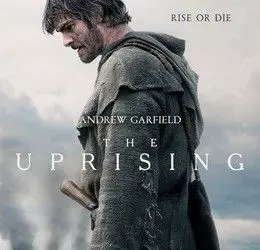
Ploughman, a forlorn farmer who has lost both his wife and daughter, picks up the sickle to galvanise a revolt already simmering across the country.
On the one hand, the film’s subject matter has been profusely marketed by various parties of interest, albeit largely in vain. What painstakingly details the events of the Peasants’ Revolt of the 14th century (1381, to be precise) in England, The Uprising was very recently, and falsely, rebranded as the story of ‘The Rise of Robin Hood’ by its US distributor, potentially in an attempt to crank up some interest in its theatrical release. Simultaneously, only a few days ago, leading man Andrew Garfield commented that the film’s core theme — of a mutiny against the rich, cruel and powerful — shall hopefully make the billionaires of the real world “scared sh*tless”, trying to draw a poignant parallel to the reel events. Both moves haven’t been successful in piquing the public’s curiosity, despite a story that concerns a massive turning point in English history.
On the other hand, there’s the stubborn attitude of writer-director Greengrass, who defiantly sticks to a storytelling grammar that he himself popularised a couple of decades ago. The 71-year-old veteran is best known for the Jason Bourne movies (parts 2, 3 and 5), whose frantic, pseudo-documentary temperament caused many great stirs in mainstream filmmaking in the 2000s. Given the amount of time that has passed since and the fact that the said style has become a self-referential or repetitive tool in his canon, one would have expected him to look at his latest epic through a different sensibility.
An old-school approach
Yet, Greengrass refuses to budge, and even though his intentions, as well as the incredible collective effort of the cast and crew, are in the best interest of the sprawling tale they are out to tell, the resulting experience feels overfamiliar and less moving. The telling is sincere and far from being a gimmick, but the very old-school approach that separates it from the newer crop of movies is also the reason why it doesn’t really strike a chord. The spectacle, enriched by handheld camerawork, intensely fast cuts and so much more, is certainly there to savour, but the substance at its core finds itself lacking.
Also read: Best of the Best review: Netflix dramedy channels Bollywood love, but misses the beat
The visuals, captured by Pål Ulvik Rokseth, are indeed the creative force guiding The Uprising. The desaturated, grey-heavy colour palette pronounces itself to make the setting feel sordid and unliveable, while the muck-covered faces of the large ensemble cast add to the overall dreariness. The time period and the context justify the aesthetic choices, and the film works best when it uses everything at its disposal — from the strong emotional undercurrent to the testing physical terrain — to make its material genuinely feel visceral.
This is a time during the aftermath of the plague or Black Death in England, and half the population has lost their lives, casting a giant shadow of grief on those alive. The country is in the thick of the Hundred Years' War with France and is presided over by a “gullible, nightmare-stricken”, 14-year-old king Richard II (played by Woody Norman). His councilmen are shown to be evil and manipulative and when they see there’s a dearth of funds to sustain the war, they decide that the general populace must pay higher taxes.
If the merchants are taxed, they’d want a seat at the table, professes the king’s high treasurer, Sir Robert Hales (Tom Hollander), but little does the kingdom know that the working class they plan to loot has had enough.
The two sides of a rebellion
Ploughman (Andrew Garfield), a forlorn farmer who has lost both his wife and daughter, picks up the sickle to galvanise a revolt already simmering across the country. And yet, he isn’t exactly the fulcrum of the story. In the large scheme of things, he is the voice of reason to more driven entities such as John Ball (Jamie Bell), the radical priest who seeks vengeance against the councilmen, and Wat Tyler (Cosmo Jarvis), the former soldier leader who transitions to become the rebellion’s leader.
The 128-minute narrative is stuffed with motivations of a vast range, and Greengrass, who has also written the film, interestingly treats them with a single-minded linearity. While that decision lends the film’s developments a strong dose of immediacy, the emotional connection doesn’t get fully established because of the writing’s crammed nature.
The shortcomings might feel like they outweigh the merits of the film, but The Uprising still crackles in many parts. It is ambitious, and endeavours greatly to show both sides of a rebellion, without shying away from showing that legitimate social issues could also degenerate into uncontrollable chaos. It offers ample room to its boy-king, whose conflicted persona assumes many moods and shapes over the course, and similarly, the King's mother, also Joan of Kent (played by Katherine Waterston), is allowed to respond to the grave situation with a quiet gravitas that would generally get drowned in a story such as this.
Also read: Lust Stories 3 review: New Netflix anthology season offers pleasures, but not quite the satisfaction
But the film is also matter-of-fact to a fault, and it is here, in the pursuit to reflect a time with nuance, that it ends up being distant and a tad too unrelenting. The passion is palpable throughout, and the staging is incredible in parts, but not everything works as expected here.