



Paradise review: Nani’s charm, martial arts-inspired action fails to rescue film
Nani joins hands with director Srikanth Odela for the second time after Dasara, but Paradise is an incoherent, sloppy mess with over-the-top action and scenes that fail to trigger emotion.

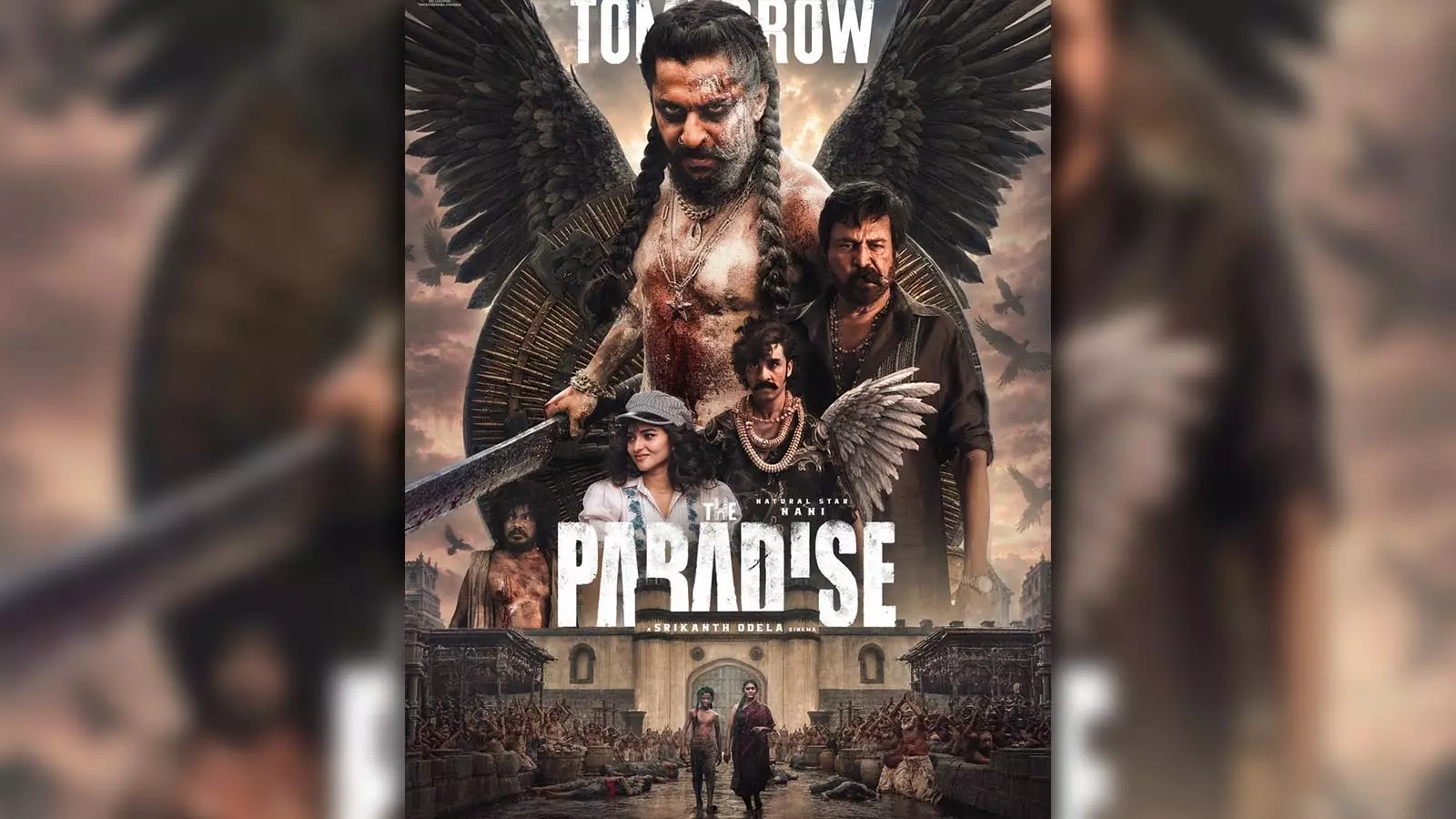
Nani is known to bring something new to each film and continues to do so in Paradise — sporting a full beard, braids and unleashing martial arts-inspired stunts. But the film’s exhausted plot downplays the actor’s efforts.
In post-independence Secunderabad, a tribal community is forced to live with no food, livelihood, dignity, freedom, or means to escape to a better life. Oppressed by the affluent, upper-caste family of Malik (Mohan Babu), the tribe struggles to gain legal recognition, and when a child — Jadal (Nani) — is born amidst this struggle, he is regarded as their ‘would be’ emancipator, in keeping with the storylines of most films with a ‘saviour’ trope.
A worn-out plot
This seems to be the problem with Paradise; the film comes off as too lazy to step out of a tried-and-tested template: a hero questions his birth, discovers his purpose, owns his identity, and eventually fights the system.
Nani, the natural star, known for his family-friendly rom-coms and dramas, made a genre shift in his filmography to prove himself as a ‘mass hero’ with films like Dasara (Paradise director Srikanth Odela’s 2023 debut with the star himself), Saripodha Sanivaram (2024) and HIT: The Third Case (2025). He is known to bring something new to each film and continues to do so in Paradise — sporting a full beard, braids and unleashing martial arts-inspired stunts. But the film’s exhausted plot downplays the actor’s efforts. There is only so much that Nani can do to save a sinking ship.
No film for women characters
Dasara, Odela’s previous venture, was not perfect, but it was rich in visuals and an intensely emotional presentation. Paradise, in comparison, fails to convey emotions despite the plot’s dramatic blend of oppression, heartbreak and personal sacrifice.
Jadal’s mother, Sumaka (Sonali Kulkarni), is stripped and forced to stand naked amidst a large crowd, but displays of exploitation are so repetitive that beyond a point they fail to trigger the audience. Odela places a pregnant woman near a negative character every time he wants to use her as bait to threaten the villagers into complying; repeated such scenes leave the audience feeling numb and exhausted.
Women in the Paradise universe are nothing more than symbols of martyrdom, most of whom are forced into sex work or acting in erotic films to support themselves. It is now left to the ‘hero’ to pull them out of their misery.
Ironically, a special dance number by Keerthy Suresh for Jadal and his ‘virtuous’ men is quite a skin-show.
Subbulakshmi (Kayadu Lohar), Jadal’s love interest, exists purely to support him and has no independent character arc of her own. Every time the hero has a momentary low, it falls upon her to push him to a comeback.
Beating up a hundred
Most ‘masala’ films, would have at least one action setup where the hero ‘fights a 100 men’. In Paradise, every fight sequence has Jadal engaging with and brutally killing a hundred; that’s how over-the-top the film is. Almost all action sequences are for the same cause, triggered over the same issues and result in the chopping, beheading, grinding, and pulping of men in a similar pattern.
Navin Nooli contributes in a big part to pulling a sinking ship further down with his choppy and incoherent editing. The film literally teleports itself to different parts of the story, shifting genres with no flow, order, or comprehension. Anirudh Ravichander, whose music is usually an asset, becomes a liability here, it feels alien to the film’s setting.
Also read: Shakuntalabai Nagarkar obit: Why death of award-winning Lavani artiste marks end of an era
In this universe of unrealistic and exaggerated characters, Nani becomes an artificial star whose general charm and emotional contagion fail to transport this film into the realm of success. Towards the climax, an entire village tries to save a newborn baby from getting killed by the antagonist’s gang — women run with the child in a swaddle, miraculously saving the baby from bullets and machetes; a dog grabs it from the clutches of the goons, a crow’s nest provides shelter, Jadal attempts gravity-defying jumps to save the baby — one can’t help but look at the child as a metaphor for the film itself. The baby is saved in the end, but the film is not.

Next Story