Bachelor Party D’eux Review: Amal Neerad film has neither style, nor substance
Despite boasting of some big names, the film remains a lifeless, lacklustre narrative that fails to use its actors’ potential and drags them down with its repetitive characterisation.

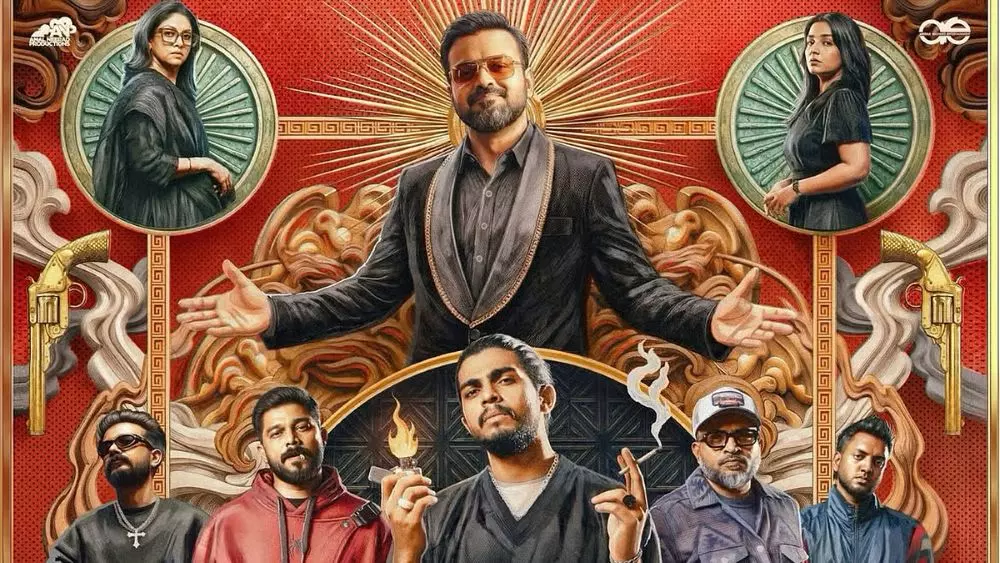
Bachelor Party D'eux, a spiritual successor to the 2012 Bachelor Party, follows a gang of orphans who become hitmen.
Indian Cinema is not new to multi-starrers. In the Malayalam film industry, which takes great pride in flaunting the fraternity between its artists, it’s common for actors to appear in cameos in each other’s films, which also gives filmmakers the scope to spring a franchise by following up on the cameo narrative, or to come up with a spin-off. However, such ambitions can be nurtured only when the supporting characters have an arc of their own, a hook that wants the audience to engage with them in more detail. And that is what Amal Neerad’s Bachelor Party D’eux fails to create.
Also read: Why for singer Susha, Grammy-nominated Varuvaaiy, based on Bhartiyar poem, has a personal connect
The film boasts of an interesting star cast — Naslen, who was phenomenal in his last release, the thriller Scene; Soubin Shahir and Sreenath Bhasi, who can be the perfect complement to each other; Sharafudeen, who created a lasting impression as the cunning and creepy college professor in Padakkalam; and Tovino Thomas, who, although (in)famous for his cameos, has consistently brought something new to each of these appearances. But it is Neerad’s failure as director that he fails to use them to their potential here, giving all five actors similar characters, tone and style; none stand out.
An underworld universe that fails to draw the audience in
The entire first half of the film is devoted to establishing the plot set-up — the Kochi underworld network.
The film, a spiritual successor to the 2012 Bachelor Party, follows a gang of orphans who become hitmen. But ideological and ethical differences cause a rift and the gang splits into two. Anna Mathews, played by Nadia Moidu, hires one of the two factions to kill the man responsible for her son’s death. But Neerad tries so earnestly to ‘humanise’ his hitmen protagonists that the mission is almost a lost cause. The audience definitely has little to remember it as the film follows their family lives.
The characters all dress in sepia tones, walk towards cars in slow-motion, look on from behind a cloud of cigarette smoke and strike up a dapper appearance. But Neerad’s gangster universe has little originality.
There’s no dearth of bloodshed; machetes, guns, and grenades are all pulled out; but none of the gangsters faces any consequences for their actions. The police remain conveniently missing from the Bachelor Party D’eux universe, even when high-profile policemen and celebrities get killed.
A standalone comic act
The dialogues with liberal use of double entendre, repeated shots of lifeless sacrifices and the clockwork-like violence do little to help the audience connect emotionally with the film.
Also read: Beyoncé, Olivia Dean and a Tamil Song — The Grammys’s ‘Year of Women’
The music is so repetitive that psychologist Ivan Pavlov could have used it to illustrate his theory of classical conditioning — play it and one immediately imagines a group of men walking in slow motion.
Kunchacko Boban, however, provides some much-needed comic relief with his imitation of a group of philanthropists whose charity works are all for the social media display. But in a film as exhausting as Bachelor Party D’eux it is but like a one-minute reel, a standalone act that doesn’t even fit into the narrative, and on its own might be enough to draw the audience to the theatres, but not quite enough to sustain their interest in the film.