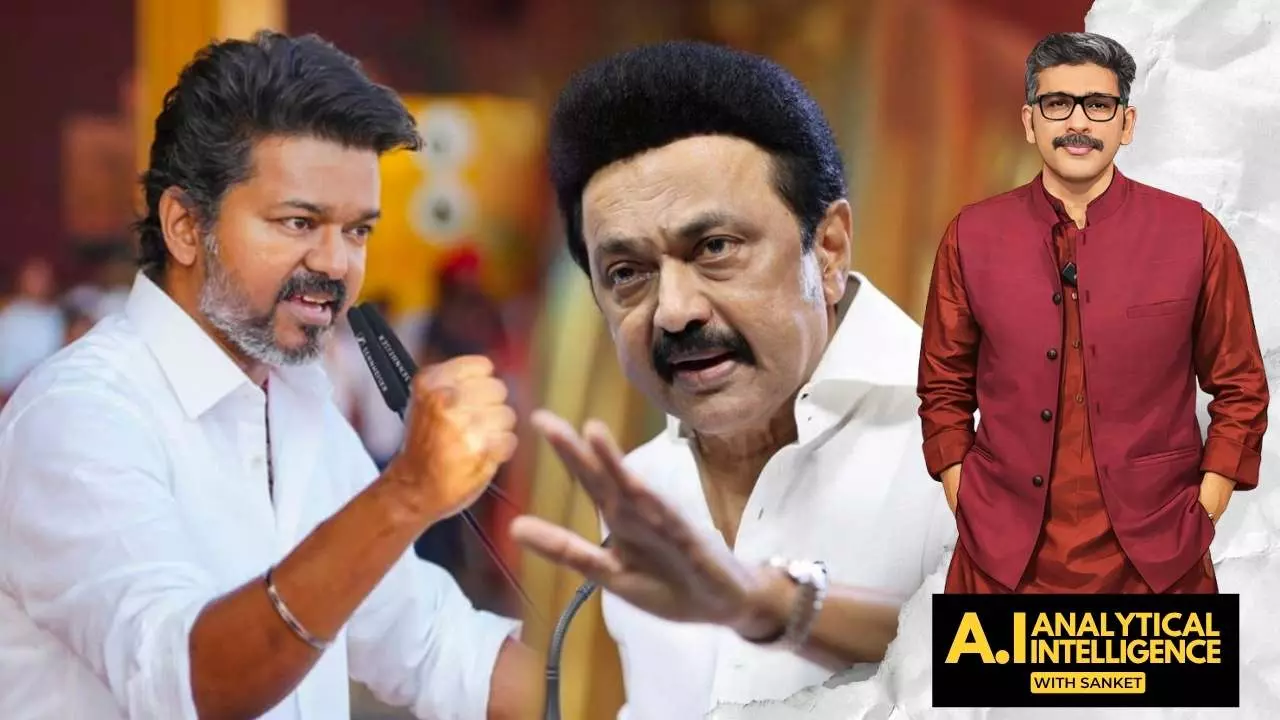
Exit polls in Tamil Nadu: Media spectacle or real signal? | AI With Sanket
Debate over exit poll credibility grows as Tamil Nadu projections largely favour DMK, with a rare outlier suggesting a possible political disruption

Exit polls have “very limited shelf value” and are largely a “media spectacle,” yet continue to influence political chatter, says S Srinivasan, Editor-in-Chief, The Federal. Even as most projections point to a return of the DMK in Tamil Nadu, an outlier forecasting actor Vijay’s TVK victory has triggered debate. In this episode of AI with Sanket, Sanket Upadhyay speaks to Srinivasan on how seriously exit polls should be taken, the mood on the ground, and whether a disruptive mandate is plausible.
Do exit polls still hold credibility, or are they just a media spectacle?
It’s a very interesting question. Over the years, we’ve watched so many exit polls that we’ve become slightly cynical. Yet, every time there’s one, you still sit in front of the television and watch it—that’s the beauty of it.
Also read | Poll strategist explains the 8 pc 'anti-incumbency’ threat for DMK | Interview
This whole exercise is largely devised for the news media. It gives television channels an opportunity to compete, analyse, and dissect trends. But its shelf value is very limited. We’ll talk about it for a day or two, and once the results come, everyone forgets—until the next election.
There are also methodological issues. Sample sizes, framing of questions, and the fact that people don’t always tell the truth all affect outcomes. India’s population is diverse, not homogeneous, and opinions often change at the last minute. So accuracy remains a challenge. Still, it’s fun for the media and analysts.
How seriously should people read these exit polls, especially with conflicting predictions?
The outcomes are varied, but broadly they suggest the DMK alliance returning to power. Some say there’s a possibility for the AIADMK, and one particular poll claims that TVK could form the government.
Let’s break this down. There is some anti-incumbency against the current government, as it has completed one term. Historically, the DMK has rarely returned to power consecutively, except once under Karunanidhi.
At the same time, the government has managed governance reasonably well. On the other hand, the AIADMK has faced internal churn—splits, leadership struggles, and alliance complications with the BJP. Eventually, alliances were stitched together, but not without friction.
Both DMK and AIADMK are established, cadre-based parties with long political legacies. Then comes TVK as the outlier. The question is: can a new party disrupt this entire system in one go? That would be extraordinary.
Can Vijay’s TVK replicate the kind of surprise seen with AAP in Delhi?
There are precedents—like NTR’s Telugu Desam Party and the Aam Aadmi Party—but both had strong groundwork.
NTR ran an intense campaign, travelled extensively, and had strong messaging and media backing. AAP, too, emerged from a grassroots movement led by Arvind Kejriwal, who was already active in public life.
Also read | Major exit polls predict DMK return in Tamil Nadu; One predicts TVK win
In contrast, Vijay launched his party about a year ago. He hasn’t spoken extensively about policy, except identifying his political and ideological opponents. His campaign was limited—mostly roadshows in select cities like Chennai, Tirunelveli, Thoothukudi, Coimbatore, Tiruchirappalli, and a few others.
Even his rallies faced organisational issues, including a tragic incident in Karur. While he draws massive crowds, translating that into votes—and then into a governing majority—is a completely different challenge.
Is there an undercurrent of public dissatisfaction that could drive such a shift?
It’s possible, but there’s no clear evidence yet. Tamil Nadu is a relatively developed state in terms of education, health, and industrialisation. But there are still issues—urban infrastructure, traffic, water supply, and quality of life.
People may aspire for more—perhaps world-class standards. Some argue that voters are tired of alternating between DMK and AIADMK. If that sentiment is strong enough, it could create space for a new force.
However, from what journalists and reporters on the ground have observed, there hasn’t been a visible wave of that magnitude. If such a shift happens, it would indicate deep dissatisfaction with the existing political class.
Does Vijay have the potential to become a political disruptor like past film stars?
He is certainly different from recent examples like Kamal Haasan. Rajinikanth never fully entered politics, so it’s hard to compare.
Vijay has a massive fan following, especially among young people and women. But popularity in cinema doesn’t automatically translate into political trust.
Take MGR and Jayalalithaa—they had years of political involvement before reaching the top. Even Vijayakanth, who had some early success, built his presence over time.
Vijay is relatively new. While his popularity is undeniable, there’s little to show in terms of administrative experience or sustained political engagement. Whether voters are ready to entrust governance to him is something only results will reveal.
Could the delimitation issue have influenced voters in Tamil Nadu?
Yes, it certainly helped the DMK to some extent. The timing of the issue—during elections—worked in their favour. Tamil Nadu is very sensitive about federal rights and regional identity.
The DMK capitalised on this, with visible protests and campaigns. But this alone is not a decisive factor. Several other elements contributed.
Also read | Rise of a third force and what it means for TN’s political future | Exit polls 2026
There were welfare schemes, direct benefit transfers to women, and a visible leadership style. The chief minister remained in the public eye, attending events and engaging with people.
This election also had a unique dimension—it was almost ‘Instagramised.’ Politicians adapted to social media formats, created reels, and staged interactions designed for digital platforms.
At the same time, Tamil Nadu has a long tradition of welfare politics. Any government must deliver on that front to remain competitive. If the DMK returns to power, it will likely be due to a combination of welfare delivery, governance, and its stance on federal issues.
The content above has been transcribed from video using a fine-tuned AI model. To ensure accuracy, quality, and editorial integrity, we employ a Human-In-The-Loop (HITL) process. While AI assists in creating the initial draft, our experienced editorial team carefully reviews, edits, and refines the content before publication. At The Federal, we combine the efficiency of AI with the expertise of human editors to deliver reliable and insightful journalism.