



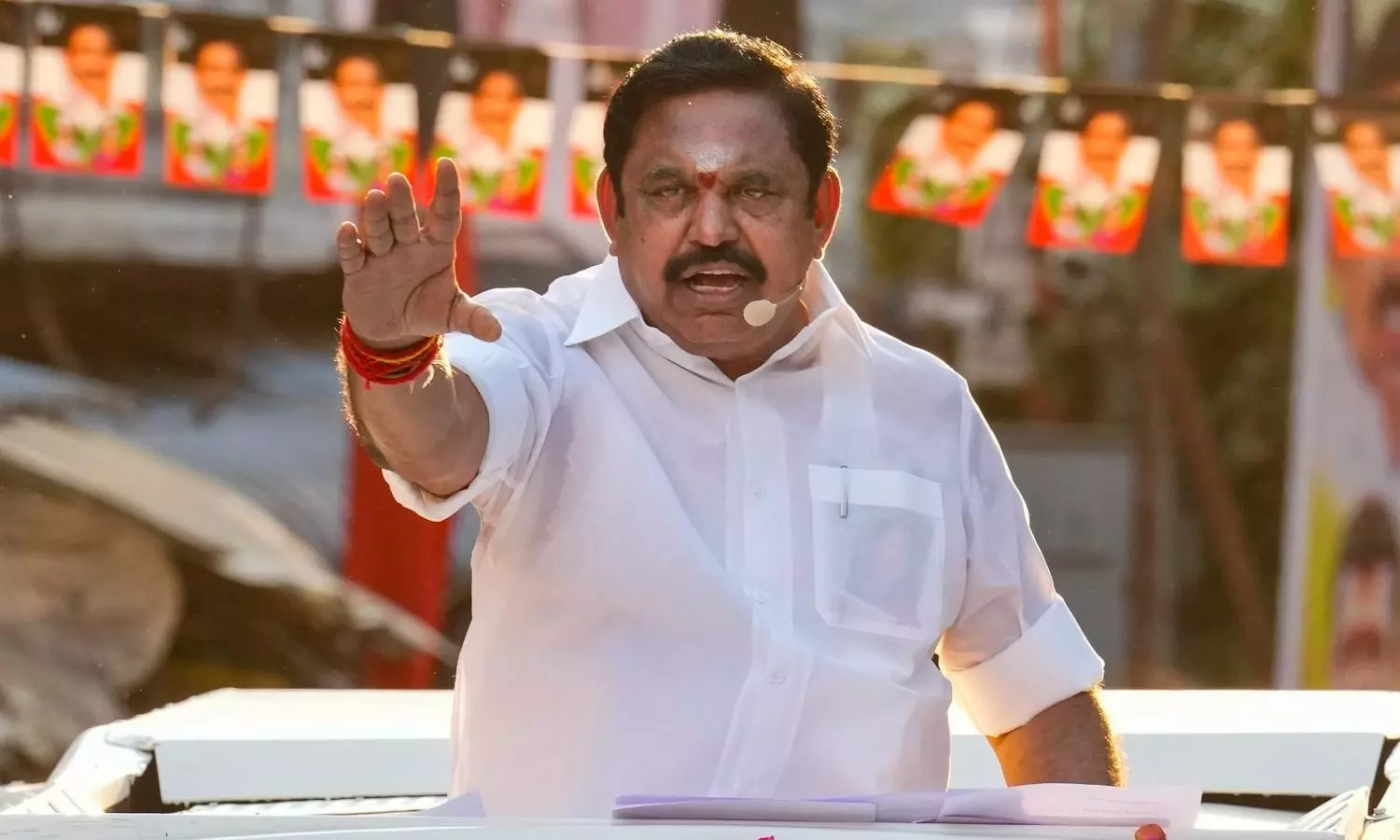
AIADMK chief Edappadi K Palaniswami greets supporters during an election roadshow at the Mylapore constituency, ahead of the state Assembly elections, in Chennai, Wednesday, March 25. PTI
With free LPG and fridges, AIADMK reignites debate on pre-poll freebie promises
While welfare schemes build human capacity via education and healthcare, freebies deliver short-term material relief without corresponding returns, say critics

The AIADMK has released a manifesto for the Tamil Nadu Assembly elections that brims with populist welfare promises. This has reignited concerns over the state’s mounting financial burden.
The Edappadi K Palaniswami-led party has pledged free refrigerators and three gas cylinders each annually to 2.22 crore rice ration card holders, a complete waiver of educational loans, and monthly supplies of 1 kg of dal and 1 litre of cooking oil, alongside a slew of other direct-benefit schemes.
Dravidian growth model
While the announcements are positioned as immediate relief for low-income families battling inflation, critics warn that the scale of these commitments could further strain Tamil Nadu’s already stressed finances. As is, debt servicing consumes a significant portion of the state budget.
Also read: As Vijay looks set to contest from Perambur, NDA hands the seat to PMK
They note that Tamil Nadu’s political culture has evolved from the Dravidian movement’s early emphasis on education, reservations, and the public distribution system to a more consumer-oriented model of direct handouts. What began with pioneering initiatives like the noon-meal scheme in the 1980s and free colour TVs in 2006 has steadily expanded to include mixers, grinders, gold for weddings, laptops, and now large-scale cash transfers and appliances.
While such schemes have undeniably improved access and dignity for millions, particularly women and marginalised groups, critics argue they risk fostering dependency and straining the state’s finances.
Development vs freebies
Manivannan, a leading political scientist, has drawn a clear distinction between the two approaches. Welfare, he contends, should build human capacity through education, health, skill development, and productive opportunities that enhance dignity and long-term self-reliance.
"Freebies, by contrast, often deliver short-term material relief without corresponding returns, potentially eroding work motivation and turning governance into a cycle of competitive populism. With the state’s debt already hovering around Rs 8 lakh crore and annual interest payments exceeding Rs 40,000 crore, unchecked expansion of such schemes could crowd out critical investments in infrastructure, industry, and sustainable growth," he warns.
Also read: TN elections: AIADMK releases first list of 23 candidates
While M Karunanidhi pioneered the consumer turn in Tamil Nadu’s welfare politics, it was J Jayalalithaa who perfected and supercharged the model into an electoral juggernaut. After storming back to power in 2011, she unleashed an unprecedented expansion of direct-benefit schemes, showering households with free mixers, grinders, fans, gold for mangalsutras, laptops for students, school uniforms and textbooks, goats and cows for rural families, and free electricity up to a specified consumption limit.
Huge spend
This blitz, matched by various DMK schemes, transformed the very grammar of Dravidian populism from structural reforms to instant, tangible consumer relief, point out observers.
Economists and analysts point out that welfare expenditure already consumes nearly Rs 45,000-50,000 crore annually. Adding fresh promises could push the burden further. At roughly 11 per cent of projected revenue, this could make the reversal politically almost impossible once expectations are set.
