



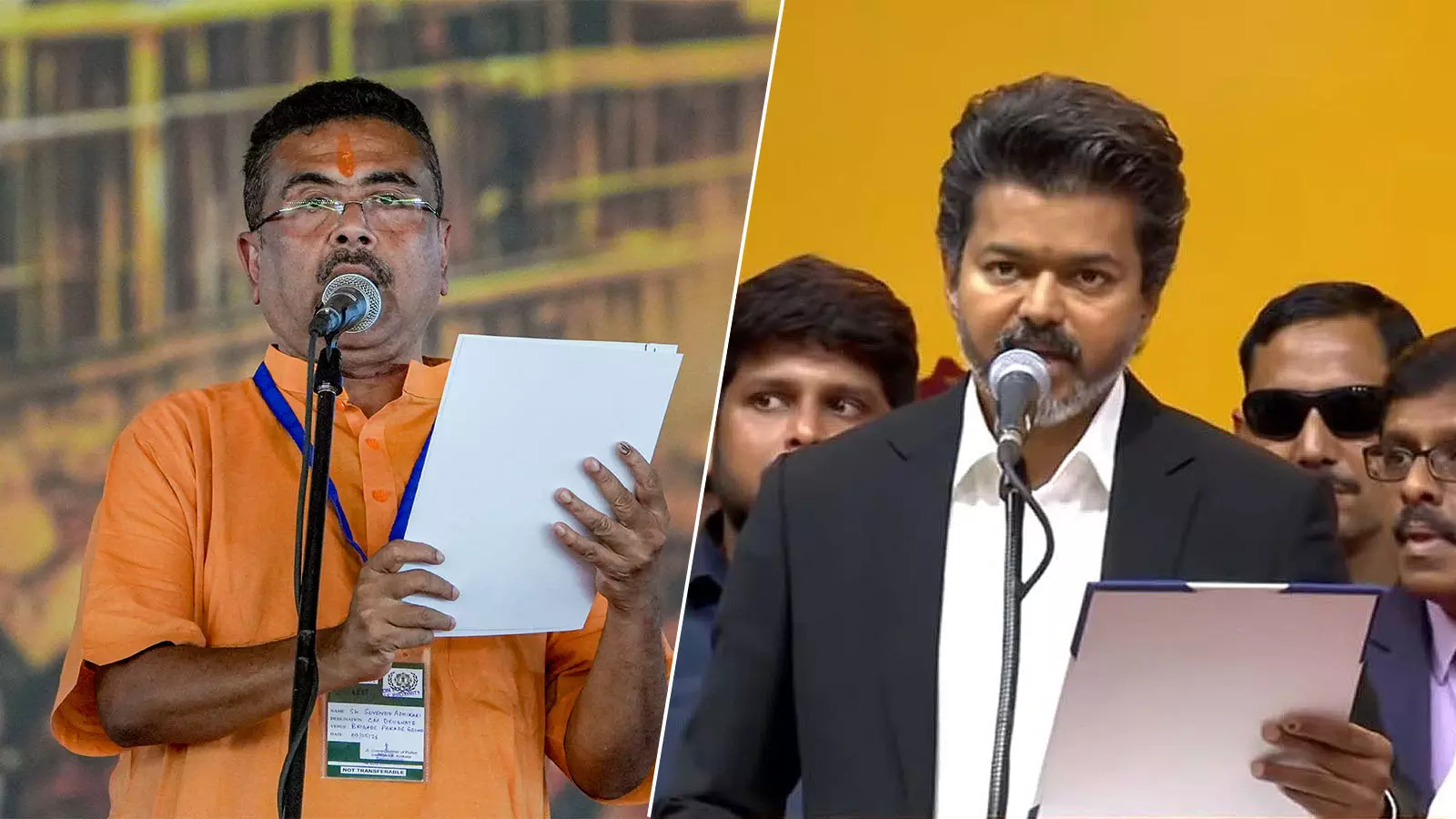
Suvendu vs Vijay: Two first-time CMs take oath, reflecting two Indias
In West Bengal and Tamil Nadu, two men debuted as CM in a span of 24 hours, and the contrast couldn't have been more stark

India concludes this week on a political spectacle in stereo — there was been a saffron sunrise in Kolkata and a star-studded dawn in Chennai. Two men took their oaths as Chief Ministers within hours of each other — both first-timers — and the contrast between them couldn't have been more vivid.
Suvendu Adhikari was sworn in as West Bengal Chief Minister in a solemn ceremony at 11 am yesterday in Kolkata, which was attended by Prime Minister Narendra Modi and other BJP dignitaries. The joy was palpable, but contained.
Also read | Free power, women’s safety, anti-drug push: Vijay's first orders as TN CM
In Chennai at 10 am today, C Joseph Vijay took oath as Chief Minister of Tamil Nadu in a ceremony that was just as solemn, but also more spontaneous. His parents, his film colleagues, his party members...the joy was frankly expressed, be it with wide grins, loud cheers or ear-splitting whistles.
The venues
Suvendu's swearing-in was held at the Brigade Parade Grounds in Kolkata, a sprawling open ground steeped in Bengal's political history, associated with mass rallies going back generations. The choice was unmistakably triumphalist: BJP had just pulled off something that many thought impossible, ending 15 years of Mamata Banerjee's TMC rule.
In Chennai, Governor Rajendra Vishwanath Arlekar administered the oath to Vijay at the Jawaharlal Nehru Indoor Stadium, an enclosed arena that traded the raw spectacle of an open ground for something more theatrical, befitting a man who spent decades commanding film sets.
The language
Bengal's ceremony carried the BJP's trademark nationalist cadence, conducted in Hindi and Bengali. Tamil Nadu's swearing-in was conducted in Tamil — pointedly so. Vijay's entire political brand rests on Tamil identity and pride, and the oath reflected that. He opted for colloquial Tamil, as against the Dravidian parties' typically formal language, and peppered it with English phrases and sentences.
While Suvendu's ceremony was framed in the language of a national party reclaiming a state, Vijay's was conducted in the language of the soil.
The dress code
Suvendu wore the BJP's typical formal attire — saffron, crisp, sober, projecting statesman-like gravity befitting the party's first CM of West Bengal.
Vijay appeared in, keeping with the image he has carefully cultivated since entering politics: his trademark white shirt and stubbled look, the same aesthetic he brought to party meetings and rallies. However, he dropped his standard blue jeans and beige trousers for a formal black suit. This was in immediate contrast to the DMK and AIADMK's decades-old dress code of white dhoti and white shirt.
The audience
Prime Minister Narendra Modi, Home Minister Amit Shah, Rajnath Singh, and Chief Ministers of NDA-ruled states were present at Suvendu's swearing-in — a parade of the BJP's national brass, turning the occasion into a demonstration of central power arriving triumphantly in Bengal.
Also read | Despite her call for a mega anti-BJP platform, why Mamata seems to be a lonely warrior
Chennai told a starkly different story. Leader of the Opposition Rahul Gandhi, whose Congress party had been in alliance with the DMK but extended support to TVK, also attended Vijay's swearing-in ceremony. While Modi took centre-stage in Kolkata with his speech and a dramatic prostration before the audience, Rahul made no attempt for the limelight.
Vijay's event also invited a sizeable film crowd — from actors Jai, Sangeetha Krish and Trisha Krishnan to filmmaker Archana Kalpathi to college friend Sanjay and his actor-wife Preetha.
The historic weight
BJP won 207 seats in the 2026 West Bengal Assembly elections, while the Trinamool Congress was reduced to 80 seats after ruling the state for 15 years — a comprehensive rout. Most of Adhikari's colleagues have been politicians for years together, well-versed in the rules of the game.
In Tamil Nadu, the swearing-in marked the rise of the first non-DMK, non-AIADMK government in the state in nearly 70 years. Both were seismic shifts, but of entirely different kinds — one, a national party steamrolling a regional one; the other, a brand-new regional party breaking a duopoly that had held for generations.
The TVK being just two years old, there was a freshness to the swearing in of Vijay and nine other ministers. Vijay had learnt his lines by heart, and addressed the audience directly without looking at the paper. His ministers, breaking the Dravidian tradition, skipped dhotis for pants, with the lone woman MLA in a stylish saree, her hair let loose. None of them fell at Vijay's feet, hugging him instead — hopefully a trendsetting practice.
Modi vs Rahul: The subtext
The two ceremonies also served as a proxy for the larger national contest. Modi attended in Bengal as a conquering general, legitimising BJP's most significant state acquisition in years.
Rahul's presence in Chennai was more complex — a pragmatic gesture toward a government his party didn't lead but chose to sustain. Modi was the architect of victory; Rahul was the shrewd survivor, keeping Congress relevant in a state where it had next to no independent standing.
Two political styles, two ceremonies, one extraordinary weekend that India will not forget in a hurry.