



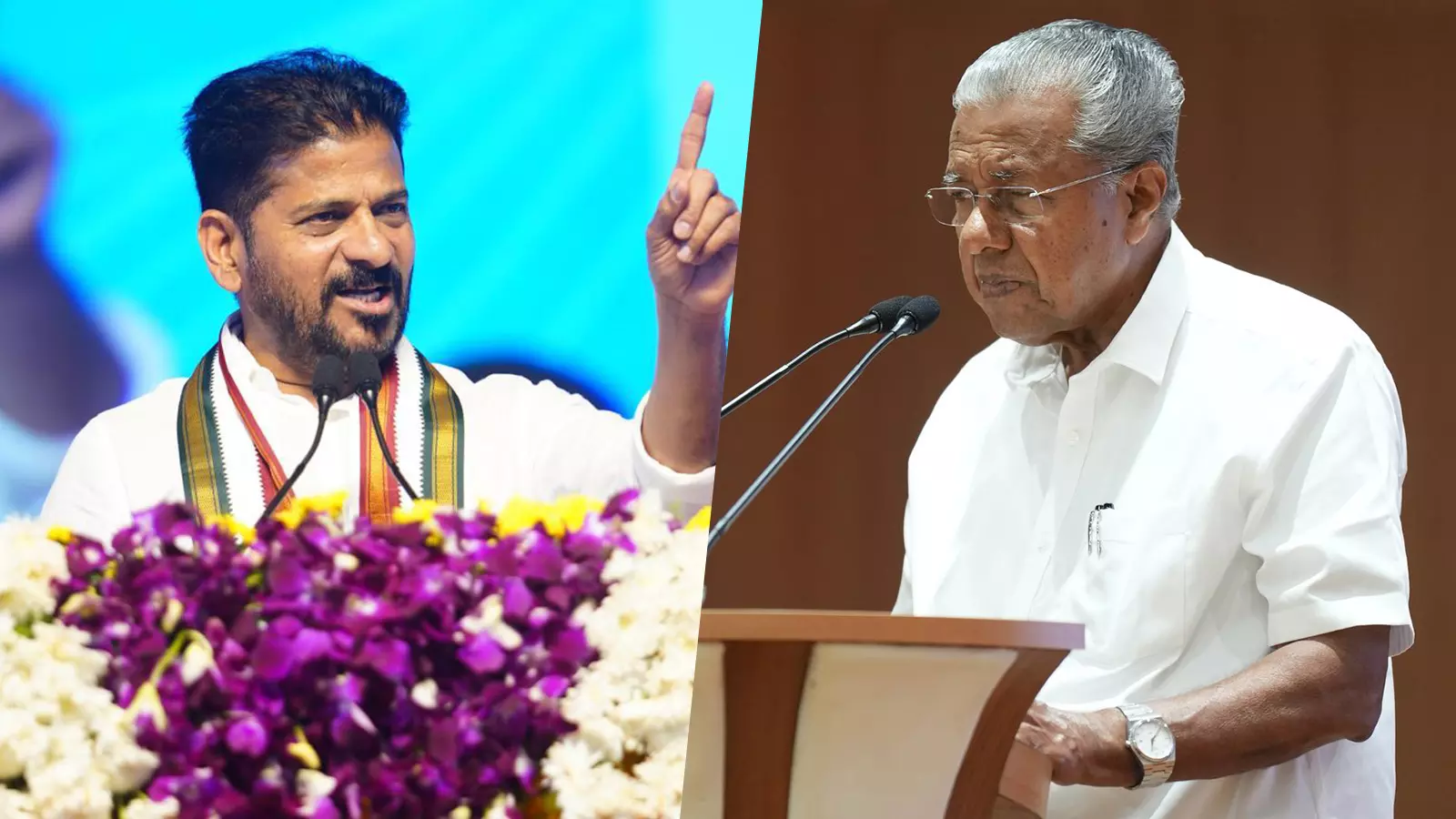
Revanth vs Pinarayi in ‘letter war’ over Mohanlal punchline
What began as a campaign intervention by Reddy in Kerala quickly snowballed into a formal exchange of letters between the two Chief Ministers

The political exchange between Telangana Chief Minister A Revanth Reddy and his Kerala counterpart Pinarayi Vijayan has escalated into a full-blown “letter war”, blending a sharp debate over governance models with an equally intense controversy over political language and decorum.
What began as a campaign intervention by Reddy in Kerala quickly snowballed into a formal exchange of letters between the two Chief Ministers. Reddy’s remarks, critical of the Left Democratic Front (LDF) government’s claims on development, set the stage. But it was his choice of words, particularly the use and later repetition of the phrase “Nee po mone Dinesha” (you go, my boy, Dinesha), that pushed the confrontation into a larger political and cultural flashpoint.
Vijayan’s sharp response, in which he used the word “dash” as an angry form of address while referring to Reddy, also stood out as somewhat out of character, even if it came in reaction to the latter’s inappropriate use of a punchline in an official letter.
Reddy’s letter faces criticism
The phrase, a well-known dialogue from the Malayalam film Narasimham starring Mohanlal, carries a distinctly dismissive and mocking tone. In popular usage, it is often deployed to belittle or ridicule the person being addressed. Its appearance not just in campaign speeches but in an official six-page letter from a sitting Chief Minister has drawn widespread criticism in Kerala’s political circles.
Also read: Kerala polls: Revanth Reddy takes on Pinarayi, with a Mohanlal punchline
Reddy’s letter was the opening document in this exchange. Running into six pages, it mounted a detailed critique of Kerala’s development narrative under Vijayan. At its core was the accusation that the Kerala Chief Minister was relying on “outdated data” and selective citations to project a favourable image of governance.
Reddy pointed specifically to the use of the NITI Aayog Sustainable Development Goals Index 2023-24, where Kerala ranks first with 79 points while Telangana stands sixth. According to him, these figures largely reflect a period before his government assumed office in Telangana and therefore fail to capture the state’s recent progress. “You are measuring our recovery by data that predates our government,” he argued, framing the issue as one of both accuracy and fairness.
Telangana vs Kerala
He also questioned what he described as selective appropriation of credit in Kerala’s development story. Social indicators in the state, he noted, have evolved over decades through contributions from multiple governments, including those led by the Congress. To attribute these gains primarily to the current LDF regime, he suggested, was an oversimplification.
Also read: Pinarayi hits back at Revanth Reddy’s ‘misinformed’ viral jibe
More broadly, Reddy positioned Telangana’s governance model as one focused on speed, efficiency, and contemporary delivery. His argument implicitly contrasted this with Kerala’s emphasis on long-term social development, suggesting that present-day performance and rapid outcomes should be the primary benchmarks for evaluation.
However, the letter’s tone drew as much attention as its content. By repeating the phrase “Nee po mone Dinesha” even in formal correspondence, Reddy blurred the line between campaign rhetoric and official communication, triggering criticism about the dignity of constitutional offices.
Kerala CM’s response
Vijayan responded with a detailed rebuttal that addressed both the substance of Reddy’s claims and the issue of tone. At the outset, he made it clear that he strongly disagreed with the use of personally insulting language. “He is a Chief Minister of a state and should keep some decorum,” Vijayan said, underscoring that political disagreements should not descend into personal remarks.
Also read: How Kerala is rewriting India's higher education playbook
On the substantive issues, Vijayan firmly defended Kerala’s development model. He rejected the charge of relying on outdated data, arguing that indicators like the SDG Index reflect sustained policy choices and governance continuity rather than short-term fluctuations. Kerala’s top ranking, he said, is the result of decades of structural interventions in health, education, and social welfare.
Vijayan’s letter places Kerala’s achievements within a long historical arc. He references land reforms, decentralised governance, and literacy movements as foundational to the state’s current standing in human development indicators. Initiatives such as the People’s Planning Campaign are cited as examples of early innovation in democratic decentralisation.
Pinarayi counters Revanth
The Chief Minister also outlined the LDF government’s recent initiatives to counter the narrative that Kerala relies solely on legacy gains. He pointed to the Ardram Mission in healthcare, which has transformed primary health centres into family health centres, and the Public Education Rejuvenation Mission, which upgraded thousands of schools and classrooms with improved infrastructure and digital facilities.
On the economic front, Vijayan rejected allegations of industrial stagnation, highlighting Kerala’s push into emerging sectors such as deep-tech, artificial intelligence, and maritime logistics. He cited major infrastructure projects like the Vizhinjam International Seaport and the state’s growing startup ecosystem as evidence of a forward-looking development strategy.
The rebuttal also carried clear political undertones. Vijayan countered Reddy’s references to Congress-era contributions by asserting that the Left movement has played a central role in Kerala’s social transformation. He invoked historical episodes such as the dismissal of the first Communist government to underline what he described as a long-standing pattern of political contestation.
Crossing a line
At a broader level, he framed Kerala’s governance within the context of federal politics, accusing the BJP-led Union government of adopting an anti-federal approach and emphasising Kerala’s role in resisting central encroachment through legal and political means.
The exchange between the two leaders thus goes beyond a simple disagreement over statistics. It reflects two distinct frameworks for evaluating governance. Reddy’s argument foregrounds immediacy, speed, and recent performance, suggesting that current outcomes should carry greater weight. Vijayan, in contrast, emphasises continuity, institutional depth, and cumulative social development.
The controversy over the “Nee po mone Dinesha” remark adds a parallel layer to this debate. It raises questions about the evolving nature of political communication, where popular culture references and colloquial expressions increasingly find their way into formal discourse. While such language may resonate with sections of the public, its use in official correspondence between Chief Ministers has been widely seen as crossing a line.
In the context of Kerala’s Assembly election campaign, the "letter war" has added a new dimension to the political narrative. The LDF has consistently projected governance, welfare delivery, and administrative continuity as its core strengths, and Vijayan’s letter reinforces this positioning. At the same time, Reddy’s intervention amplifies the Opposition’s critique that Kerala’s development story is overstated or selectively presented.
What started as a campaign remark has thus evolved into a layered political confrontation, combining policy arguments, historical claims, and questions of personal conduct. As the debate continues, it underscores how, in contemporary politics, both data and dialogue, statistics and symbolism, can shape the narrative just as powerfully.