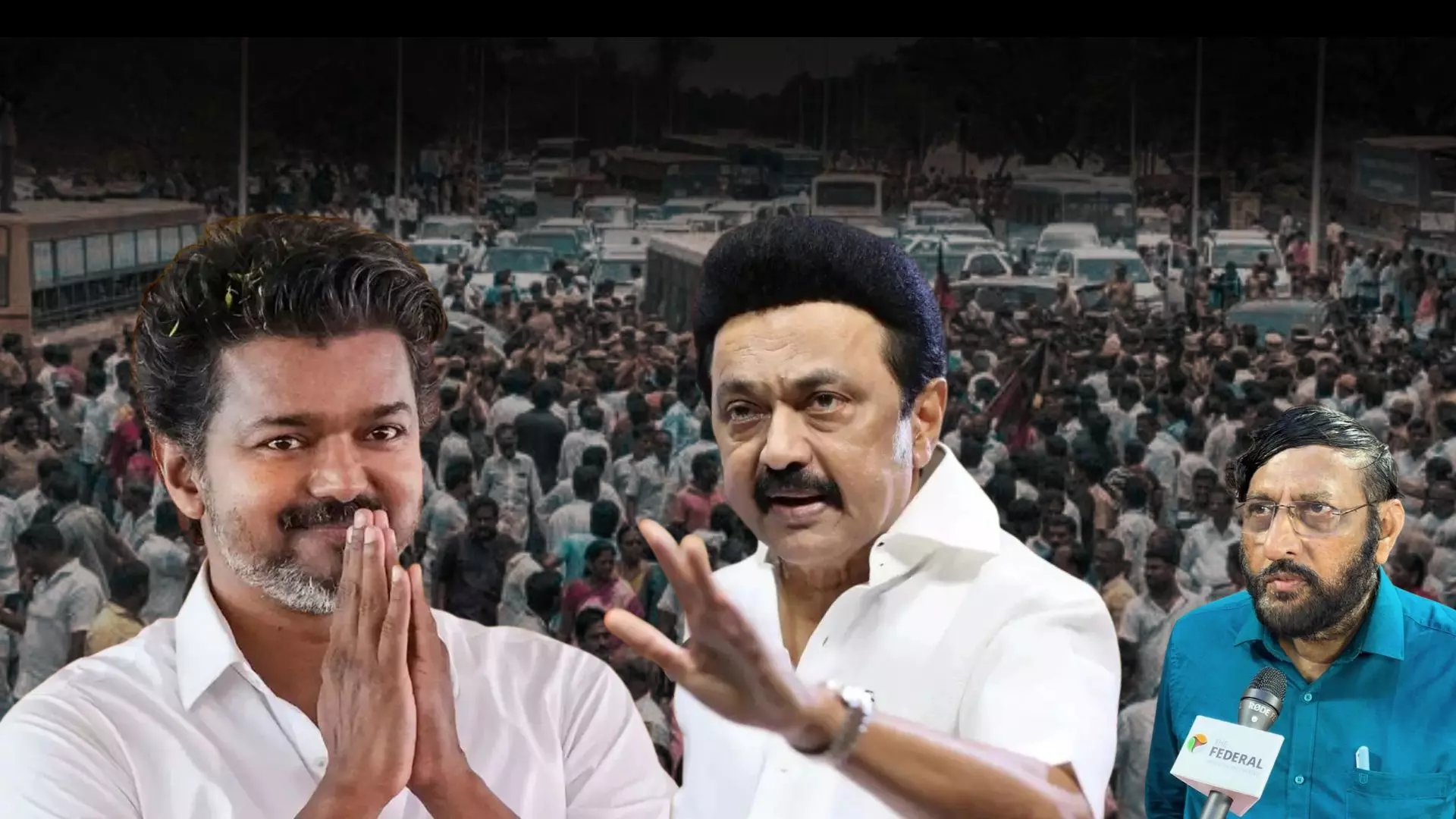
Media repeatedly got it wrong on Vijay's TVK: Political analyst Rangaraj
Rangaraj says Vijay may not win this eleciton, but he has made his presence felt and turned the contest triangular; 2031 is likely to be DMK vs TVK, he suggests

“The media swung from one extreme to another — from writing Vijay off completely to imagining a massive wave that doesn’t exist,” said political analyst R Rangaraj, cautioning against overreading exit poll trends.
With most surveys giving the DMK an edge in the 2026 Tamil Nadu Assembly elections and downplaying the so-called ‘Vijay wave’, the debate has shifted to the actor-politician’s real impact. The Federal spoke to Rangaraj to unpack what the numbers and narratives actually mean.
Why do many exit polls suggest there is no ‘Vijay wave’? What led to this perception?
Firstly, people swung from one extreme to another. Initially, Vijay was written off completely — people said there was no infrastructure for his party, no committees across Tamil Nadu, and that it wasn’t functioning like an established political party. It was said that his party was not visible, that he wasn’t campaigning actively, and that he had cancelled many rallies. He had not even visited one-sixth of the constituencies.
So, a narrative was created that Vijay was non-existent. Then on polling day, people saw a large turnout of youngsters and women, many openly saying they voted for him. There was visible public support.
From there, the media swung to the other extreme and assumed a massive wave. But that’s not accurate. The increase in voters was only about 20–25 lakh, with around 15 lakh being new voters.
So, on both counts, the media miscalculated. There is definitely some voting in his favour, but not enough to upset the DMK or the AIADMK. However, he has created a significant impact — more than many third-front players in Tamil Nadu. He has made his presence felt and turned the contest triangular.
Even if he doesn’t win many seats, the vote share could be fairly decent for a new party. That means he may have reduced margins for both DMK and AIADMK.
Why do exit polls show a gap between projected vote share and actual seats for Vijay?
I wouldn’t say Vijay has dropped. If you compare him with others like Kamal Haasan, Bhagyaraj, or Ramarajan, Vijaykanth had the highest vote share among such entrants — around 8 to 11 percent.
But Vijaykanth won only one seat in his debut. Only after aligning with AIADMK in 2011 did his party win over 40 seats. So, if Vijay gets even a few more seats than that, he has done better than many others.
You cannot compare him with MGR. In 1977, MGR benefited from unique conditions — the Congress had lost power at the Centre, and there was strong anti-Congress sentiment post-Emergency. He was able to draw votes from Congress, DMK, and floating voters. It was also a four-cornered contest without alliances.
Vijay, on the other hand, is facing two strong parties — DMK and AIADMK. So, if you look at it positively, he has done reasonably well. If he gets above 5 percent vote share, many parties may want to ally with him in the future.
If he reaches 10–15 percent, he could become a major player. There could be a realignment of political forces, and some parties from both DMK and AIADMK camps might shift towards him. He could lead a new front in the future.
Despite visible crowds and social media buzz, why do exit polls suggest Vijay may not be a major disruptor?
This election is essentially Stalin versus the rest. Stalin has a personal image advantage that adds about 3–4 percent to the DMK’s vote share. He is the tallest leader in the current race for Chief Minister.
But that doesn’t mean voters will always support the DMK. If Stalin is not around in the future, that extra cushion may disappear. If Udayanidhi is projected next time, the contest could become Udayanidhi versus Vijay — and that would be a different ballgame.
For now, the Dravidian parties are leading. But Vijay could emerge as the main challenger in the next election.
Did the lack of alliances hurt Vijay’s chances in this election?
Yes, alliances matter a lot. There were reports that Thol Thirumavalavan’s party and even the Congress might align with Vijay. There were talks and feelers.
If those alliances had materialised, it could have significantly altered the equation. The DMK might have lost some partners, and Vijay’s alliance could have approached the 30 percent vote share needed to win seats.
In India’s first-past-the-post system, you need around 30–35 percent vote share to win. Even if you get 15–20 percent, you may not win seats — Vijaykanth experienced that.
So, Vijay needed 2–3 more parties to boost his vote share. In that sense, he may have missed an opportunity. But this could also send a signal to other parties that alternatives to the DMK exist.
There could be churn within alliances. Some parties may feel they would have done better aligning with Vijay. That’s a concern for the DMK, even if it wins.
What are the long-term political implications of Vijay’s debut?
TVK has likely taken some votes from the DMK, which would be a concern for them. In the long run, Vijay represents a growing force.
If more allies join him, he could become a major player. On the other hand, if AIADMK loses this election, it risks slipping to third place in the long term. The next election could potentially be between DMK and TVK. That is a real danger for AIADMK.
There are many lessons here. But we must wait for the actual results. Exit polls are not always reliable, especially in a large and diverse state like Tamil Nadu where regional variations are strong.
Statewide predictions can go wrong. It’s better to analyse results constituency by constituency. So, these exit polls should be taken with a pinch of salt.
The content above has been transcribed from video using a fine-tuned AI model. To ensure accuracy, quality, and editorial integrity, we employ a Human-In-The-Loop (HITL) process. While AI assists in creating the initial draft, our experienced editorial team carefully reviews, edits, and refines the content before publication. At The Federal, we combine the efficiency of AI with the expertise of human editors to deliver reliable and insightful journalism.