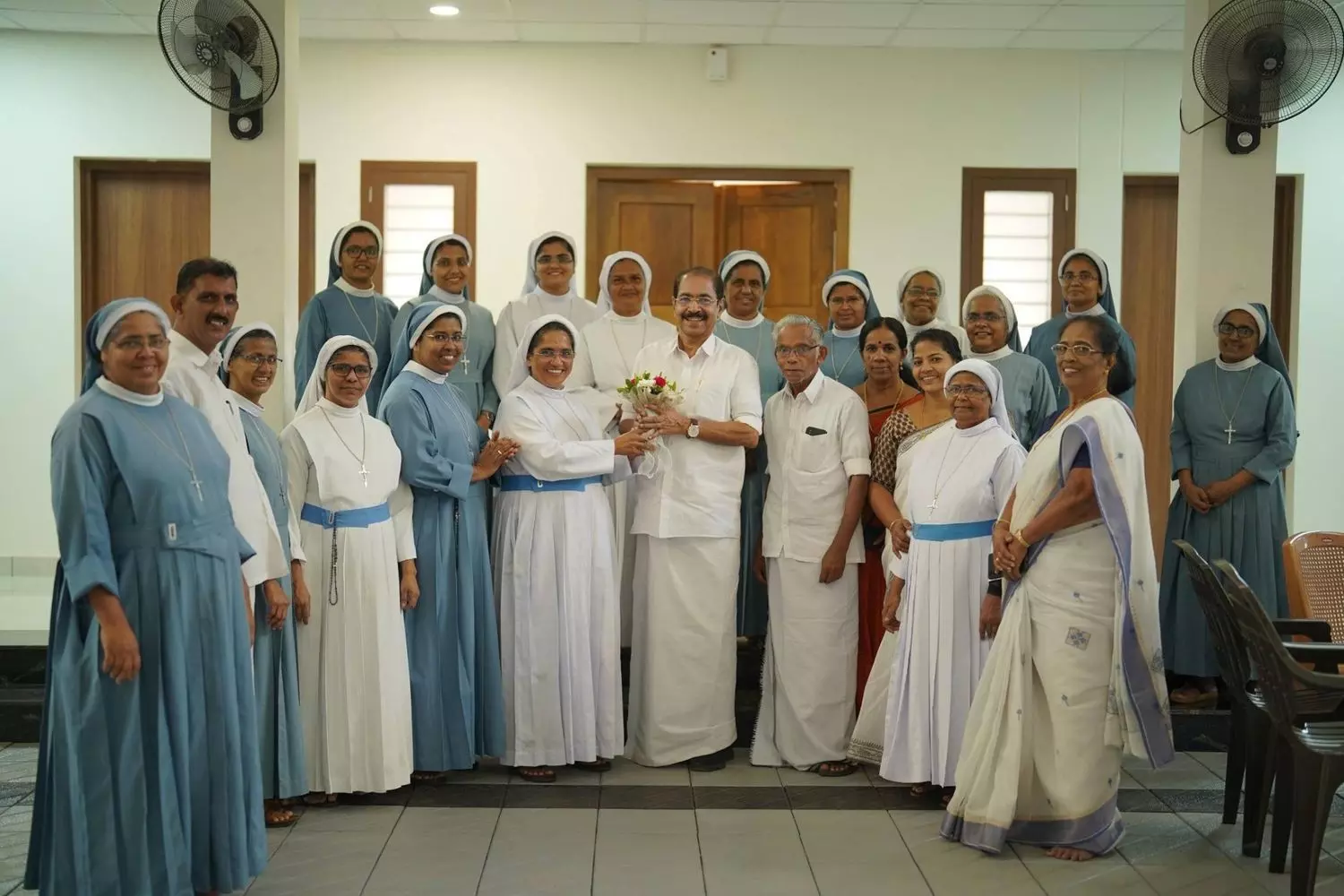
Sunny Joseph, Congress candidate in Peravoor (Kannur district), with a group of nuns during poll campaigning.
Kerala’s Christian vote in flux as UDF, LDF and BJP battle for votes
A larger churn is happening across Kerala’s Christian belt, a region that has long shaped electoral outcomes in the state

Raphael Chttilappilly, 75, sits behind the counter of his small shop in East Fort, Thrissur, weighing his words as carefully as he weighs his goods. A lifelong Congress voter since 1977, he made an unusual choice in the 2024 Lok Sabha election. He voted for Union Minister Suresh Gopi.
A shift, with doubts
“What I wanted was a change,” he says. “I had been voting for Congress from the seventies, but Suresh Gopi sounded genuine, and he was addressing the issues we needed to focus on. I tried him. But I don’t know whether it was right. There are apprehensions about the BJP now. The news of nuns and priests being attacked is not good to hear. I won’t say I am fed up, but this was not what we expected.”
When asked about his choice in the coming election, Raphael pauses. “I won’t say. We have good candidates from the Left and the Congress. One is a minister and a very good person. The Congress candidate is also known to us. So, we have choices. Let us see.” Interestingly, he does not seem to be aware of the BJP candidate in his constituency, Ollur.
Revenue Minister K Rajan is in the fray against Congress candidate Shaji Kodankandath, while the BJP has fielded Bijoy Thomas.
In the 2024 Lok Sabha election, Suresh Gopi had polled 59,997 votes in Ollur.
A changing political map
Raphael’s hesitation captures a larger churn across Kerala’s Christian belt, a region that has long shaped electoral outcomes in the state. Stretching from constituencies like Irikkur, Peravoor and Thamarassery in the north to the decisive central districts of Thrissur, Ernakulam, Idukki, Kottayam and Pathanamthitta, this belt has historically leaned towards the Congress-led United Democratic Front. Yet, over the last decade, that certainty has weakened.
The shift started in 2006 and became visible in the 2016 Assembly election and sharpened in 2021, when the Left Democratic Front led by Pinarayi Vijayan broke Kerala’s electoral pattern by retaining power and expanding its reach. What stood out was not just the scale of the victory but where it came from. The LDF made steady inroads into central Kerala, where Christian voters, cutting across denominations, play a decisive role in dozens of constituencies.
From strongholds to swing seats
This was not a dramatic swing but a gradual seepage. Seats that were once considered safe for the UDF became competitive.
In districts like Thrissur, Idukki and Pathanamthitta, the Left found new openings. Even in parts of Ernakulam and Kottayam, the margins narrowed.
New players, new equations
A key factor in this transformation was the entry of the Kerala Congress faction led by Jose K. Mani into the LDF, at least in Kottayam and Pathanamthitta districts. For decades, the Kerala Congress in its various forms had been the political voice of large sections of the Syrian Christian community, especially the agrarian middle class in central Kerala. Its shift to the Left carried both symbolic and practical weight.
At the same time, a parallel effort was unfolding. The BJP began reaching out to Christian communities in Kerala with a new intensity. Engagement with church leaders, symbolic gestures during religious occasions and targeted messaging marked this phase. The rise of Suresh Gopi as a visible political figure in Thrissur added to this outreach.
“It was not just in Thrissur, but more broadly across the Christian community, especially among the more affluent sections linked to the church, that the BJP began to be seen as an option. To some extent, the alienation and othering of Muslims by the saffron camp also played a role, with campaigns like ‘love jihad’ finding some traction”, said Justin Xaviour, a teacher from Thiruvalla.
Opening and then unease
For voters like Raphael, this opened up a new possibility. The BJP was no longer entirely outside the conversation. It became, at least for some, an option worth testing. The 2024 Lok Sabha election reflected this shift in places like Thrissur, where the party managed to convert visibility into votes. Yet, this experiment has not been without complications. Reports of attacks on Christian communities in parts of North India have travelled quickly through social and church networks in Kerala. For many voters, this has created a sense of unease.
“After the Lok Sabha elections, and with back-to-back incidents of attacks against Christians in North India, the situation has changed. In the local body polls, the UDF made significant gains in the Christian belt. In terms of seats, the LDF was the main loser, and the inroads the BJP had begun to make were also checked,” opines Justin Xaviour
An unsettled electorate
The latest indications from the 2025 local self-government elections suggest that the LDF’s advances may have plateaued. In several parts of central Kerala, the UDF appears to have regained ground. Local leadership networks, which had weakened in the face of the LDF’s 2021 surge, have shown signs of revival. In some pockets, the BJP has emerged as a spoiler, complicating the arithmetic further.
The dynamics differ between north and central Kerala. In constituencies like Irikkur, Peravoor and Thamarassery, the Christian vote is part of a broader coalition and does not singularly determine outcomes. In contrast, in districts like Kottayam, Idukki, Pathanamthitta and parts of Thrissur and Ernakulam, even minor shifts within the Christian electorate can decisively swing results. That is where the LDF now faces its most serious test.
High stakes in Pathanamthitta
For instance, in Pathanamthitta district, the LDF had won all five seats in 2021, but it is facing a tough contest this time. The UDF is mounting a strong challenge, particularly in Aranmula, against Health Minister Veena George, the journalist-turned-politician, focusing on issues in the health department. The Sabarimala gold theft issue could also hurt the Left, given that the shrine falls within the district.
“On the surface, it may look tough, but we are confident of retaining the seats. Aranmula will require some extra effort, but overall, we believe we are on the right track,” said Alfin Dani, a prominent youth face of the CPIM in Thiruvalla.
UDF’s opening, internal strain
For the UDF, the moment offers an opportunity to reclaim lost ground. Its historical advantage within the Christian community remains intact, but it can no longer take that support for granted. The presence of a third player has ensured that loyalty is now negotiable.
However, the real test for the UDF lies with the Latin Catholic Church, which had backed it in the Lok Sabha and local body elections and remains influential along the coastal belt. The Church is now exerting pressure and is visibly unhappy over what it sees as under-representation in the UDF’s candidate lists. If reports and sources are to be believed, even the Leader of the Opposition’s meeting with the Latin Bishop in Kochi failed to break the deadlock, which could be a cause for concern for the front.
The Christian vote in Kerala is still in motion, and where it finally settles will play a huge part in shaping the state’s next political chapter.