- Home
- India
- World
- Premium
- THE FEDERAL SPECIAL
- States
- Perspective
- Videos
- Sports
- Education
- Entertainment
- Elections
- Features
- Health
- Business
- Series
- In memoriam: Sheikh Mujibur Rahman
- Bishnoi's Men
- NEET TANGLE
- Economy Series
- Earth Day
- Kashmir’s Frozen Turbulence
- India@75
- The legend of Ramjanmabhoomi
- Liberalisation@30
- How to tame a dragon
- Celebrating biodiversity
- Farm Matters
- 50 days of solitude
- Bringing Migrants Home
- Budget 2020
- Jharkhand Votes
- The Federal Investigates
- The Federal Impact
- Vanishing Sand
- Gandhi @ 150
- Andhra Today
- Field report
- Operation Gulmarg
- Pandemic @1 Mn in India
- The Federal Year-End
- The Zero Year
- Science
- Brand studio
- Newsletter

Jantar Mantar to South Mumbai, can Neha Bora's Gen Z campaign penetrate beyond Left liberal camps?
Earlier this week, the AISA national president was present at Mumbai's YB Chavan Auditorium, at an event attended by the likes of actor Shabana Azmi, comic and writer Varun Grover, activist Rhiya Ahir, actor Raghu Ram and filmmaker Dibakar Banerjee. But can the Left youth leader tap into the anxieties of the larger Gen Z population in Mumbai, where the Bal Thackeray-led Shiv Sena had turned unemployment into an identity issue, shaping the political narrative of Maharashtra?

On Monday (August 24), South Mumbai's YB Chavan auditorium was filled to the rafters, with those unable to fit inside the main room spilling onto the balcony. The Gen Z (those born between 1997 and 2012), who have reclaimed the space for dissent in the country with last month’s protest for reforms and accountability in education — the agitation had its epicentre in Delhi’s Jantar...
On Monday (August 24), South Mumbai's YB Chavan auditorium was filled to the rafters, with those unable to fit inside the main room spilling onto the balcony. The Gen Z (those born between 1997 and 2012), who have reclaimed the space for dissent in the country with last month’s protest for reforms and accountability in education — the agitation had its epicentre in Delhi’s Jantar Mantar, but its effects were felt across the country — were there, of course. But so were the Boomers (born between 1946-1964), the Gen X (1965-1980), the Millennials (1981-1996), and even the Gen Alpha (2010-2024); the last accompanied by their parents.
Emotions and expressions ranged from anger, joy, celebration and irreverence.
The event, ‘Dil Se Bole Mumbai with Gen Z’, organised by the Communist Party of India (Marxist-Leninist)-affiliated All India Students’ Association (AISA), was hosted by stand-up comedian Varun Grover and saw the likes of actor Shabana Azmi, filmmaker Dibakar Banerjee and television artiste Raghu Ram address the crowd. But the star spot was reserved for 29-year-old AISA national president Neha Bora, who has emerged from last month’s Jantar Mantar protest as one of the most recognisable faces of youth mobilisation in the country.
In end-June Bora, a PhD scholar at Delhi’s Jawaharlal Nehru University (JNU), joined educationist Sonam Wangchuk and fellow AISA activists on an indefinite hunger strike, demanding that the National Testing Agency (NTA) be scrapped and Dharmendra Pradhan resign as Union Education Minister (the Bharatiya Janata Party member of Parliament has since done so) over the National Eligibility Cum Entrance Test (NEET) paper leak scandal which broke out in May. For 23 days Bora ate nothing, as part of the protest spearheaded by the Cockroach Janata Party (CJP), which, on its part, had started as an online movement triggered by comments attributed to Chief Justice of India Surya Kant, terming the country’s unemployed youth as ‘cockroaches’ (the CJI has since said his statement was directed at fake law degree holders and not all youth).
The Jantar Mantar protest ended on July 25. But Bora has since kept the momentum of Gen Z dissent going, travelling to Jharkhand (where the youth were protesting against alleged irregularities in recruitment examination), to Chennai and Mumbai.
Also read: Why legal experts, activists are critical of PM Modi’s call to ‘identify and isolate Dimagi Naxals’
Political observer Mukund Kule describes her as “part activist, part political communicator and part representative of an emerging generation that refuses to accept that nationalism, democracy and patriotism belong exclusively to any one ideological camp”.
In an exclusive interview to The Federal earlier this month, Bora herself admitted that the “education system is only part of a larger system, all of which is crumbling”. “The protests were also because we have seen such naked violence on the streets of this country. We have seen how easy it has become for us to hate one another on the basis of caste, gender, religion — there was an anger against that… There was a hope that this movement would be able to consolidate unity and solidarity and do away with this politics of hate. There was a hope that this movement would highlight the crisis of unemployment,” she said.
Kule concurs. “The most interesting aspect of their political presence,” he says, is the attempt to connect “democracy, constitutional values, social justice and citizenship with a wider public anxiety.” Their appeal, he argues, is therefore not restricted to what is often dismissively called the “Left-liberal” constituency.
And so, while Left parties and civil society figures have certainly rallied around the campaign, other Opposition politicians too have amplified it.
Raghav Mohanty, the octogenarian political science expert and observer from Cuttack, makes a crucial distinction: “The difference between who provides the language and infrastructure of a protest and why millions of people recognise themselves in it.”
Activist-politician Yogendra Yadav, who knows something about the life cycle of mass movements, puts it even more starkly. “If sab changa si with the country and the economy, 20 million young people wouldn’t rally around something like this,” he says. Beneath the claims of political dominance, he sees “a latent but widespread disquiet cutting across the political spectrum”. His most useful formulation is perhaps this: “The Left didn’t create the anxiety. It recognised it.”
AISA can organise a march, Yadav says. People like him can interpret it. Congress leader Rahul Gandhi can amplify it. The Trinamool Congress’s Mahua Moitra can take it into Parliament. But none of them can manufacture the experience of a 19-year-old who has spent two years preparing for an entrance examination only to discover that the paper was leaked.
Nor can they manufacture the humiliation of a graduate who has collected degrees but cannot find a job, the anger of a family that borrowed money to pay coaching fees, or the despair of a young woman discovering that “merit” still has to negotiate caste, class, gender, money and connections.
File photo of students' protest in Mumbai.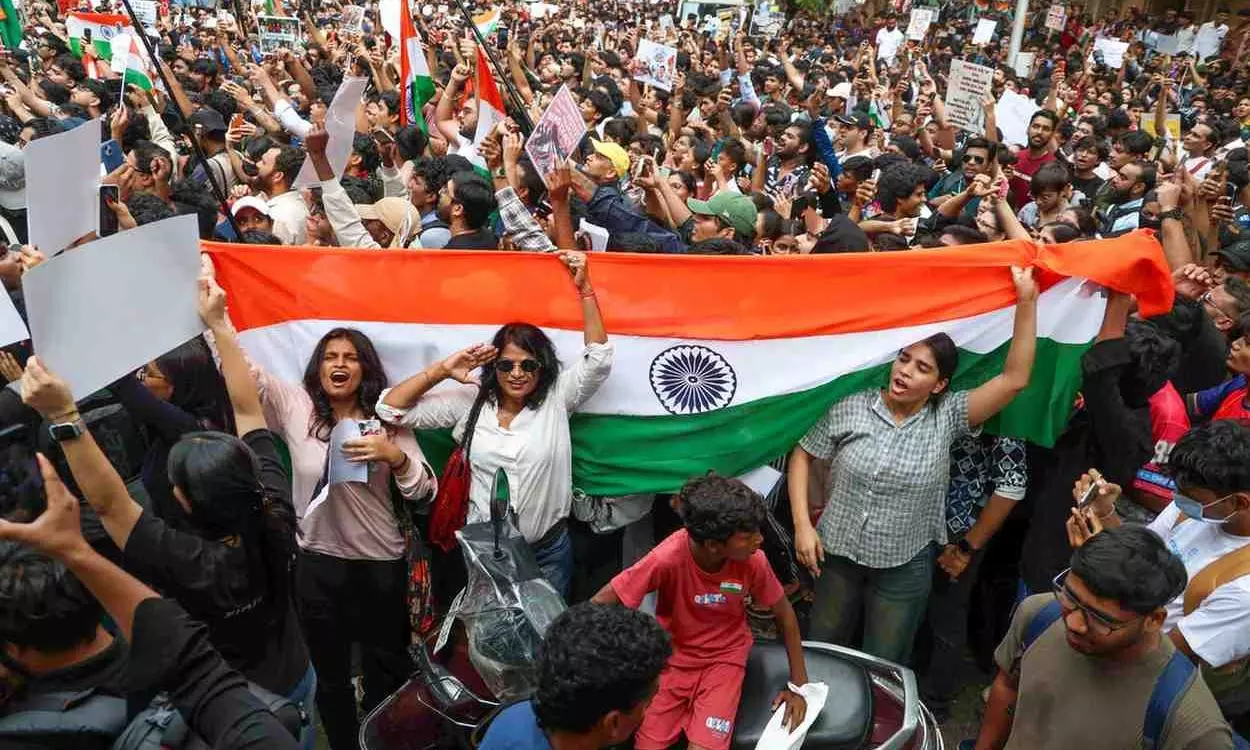
Perhaps the strongest argument that this phenomenon cannot simply be dismissed as a Left-liberal bubble is the BJP’s own behaviour.
“If the party believed that the Gen Z campaign represented only AISA, JNU, Congress sympathisers and the familiar metropolitan civil society circuit, it could have ignored it,” says Baroda-based political scientist Dr Megha Desai.
Instead, the BJP has begun building its own Gen Z outreach.
Mohanty believes the BJP’s response exposes the weakness of the easy Left-versus-Right formulation. “A young BJP supporter can be furious about a paper leak. A young Hindu can demand examination reform. A nationalist can resent unemployment. A Modi supporter can believe that the government has failed to protect the integrity of competitive examinations.”
The political categories that worked for an earlier generation, he says, do not necessarily map neatly onto this one.
Which brings us to Mumbai. The city is not merely the backdrop to this argument. It is where one of the most consequential political experiments in modern India was first perfected.
Bal Thackeray understood something before much of the political establishment did: unemployment is not automatically a class issue. It can be made into an identity issue.
When the Shiv Sena emerged in the late 1960s, it tapped into anxieties among Marathi-speaking youth who believed migrants were taking jobs and opportunities. Through Marmik, the publication founded by Thackeray’s socialist father Prabodhankar, the party helped construct a narrative in which the frustrated young Marathi man did not see himself primarily as a worker trapped in an unequal economic system. He saw himself as a “son of the soil” being dispossessed in his own city.
“The genius, and the tragedy, of the model was that a material grievance was given a cultural enemy,” Kule says, adding that the Marathi manoos did not need a complicated explanation of structural unemployment. “The shakha supplied the neighbourhood, the camaraderie, the political purpose and eventually even the infantry.”
The Sena’s rise, Kule argues, was not simply about ideology. “It was about giving alienation a face. Later, that face kept changing based on political and electoral compulsions or sheer opportunism.” As Marathi nationalism converged with Hindutva, the Shiv Sena-BJP alliance transformed Maharashtra’s politics and the BJP subsequently scaled much of that vocabulary nationally.
But compare that with the young person at the centre of today’s mobilisation. “The enemy is much harder to personalise,” Kule admits. “A paper leak has no religion. Unemployment has no caste. An unaffordable coaching class has no ideology. A degree that does not lead to work is indifferent to whether its holder voted BJP, Congress, AAP or NOTA.”
The unemployed mill worker of Thackeray’s Mumbai could be told that the outsider was taking his job. “Today’s unemployed graduate is increasingly asking a more uncomfortable question: What if nobody is coming to take my job because there aren't enough decent jobs in the first place?” asks Kule.
That question does not lend itself easily to Hindutva, Marathi nationalism or even the Left’s traditional class vocabulary.
“It is now firmly and squarely positioned as a question about the competence of the State,” Mohanty says. “Which is why education may be a lot more politically disruptive than identity.”
This makes Maharashtra Chief Minister and BJP leader Devendra Fadnavis’ position more complicated than a simple caste reading.
Maharashtra now has a BJP chief minister who is a Brahmin, leading a party whose historical project has been to construct a broad Hindu coalition extending beyond its earlier upper-caste social base. Fadnavis consistently argues that Marathi identity cannot be separated from Hindutva, a formulation that attempts to fuse the two great strands of the old Maharashtra political imagination: regional pride and Hindu identity.
But Kule asks whether those identities can absorb the anxieties of a younger Maharashtra.
The young Mumbaikar faces extraordinary living costs, housing insecurity, precarious work, competitive examinations, an increasingly automated labour market and a city in which social mobility is becoming harder for many first-generation graduates. “So the political language of the 1970s cannot simply be replayed on Instagram,” he says. “The question Gen Z is asking is increasingly less: Who are you? And more: What can you do?”
Kule’s observation finds validation in the voice of 22-year-old South Mumbai resident, Zoha Chaudhary. “The Shiv Sena was once so woven into the identity of Mumbai that politics felt very local, very street-level and very personal. The BJP feels different. It has brought a much more centralised, national political language into Maharashtra. The symbols and issues have changed, and so has the way politics is communicated, particularly to young people through social media. But I don’t think Gen Z necessarily sees this as a simple Shiv Sena versus BJP transition. We are looking at what each government actually does and asking whether it affects our lives,” she explains.
Far removed from Chaudhary’s upper-middle-class family life, but united by the same anxiety about her future, is 19-year-old Dolly Yadav. “For my family, politics is not something we discuss in terms of ideology all the time,” she explains. “My mother sells vegetables from a kiosk in Kandivali and my father drives an autorickshaw. They have gone hungry and struggled to give me an education. For us, the question is very simple: what kind of future are we going to have? Who is going to make sure that children like me get a good education and a fair chance?”
It is an understanding of this Gen Z outlook which leads Desai to conclude that the Gen Z voter may be less ideological than transactional. “Give me a job. Give me a fair examination. Give me an affordable education. Give me a safe city. Give me infrastructure that works. Give me a chance. And if you can’t, do not lecture me about patriotism, ideology or history.”
That is a profoundly different political contract, and one that older (wily) politicians are finding difficult to comprehend. The young person standing at the other end of the power continuum is asking a deceptively simple question: What good is identity if I cannot build a life?
File photo of students' protest in Mumbai. 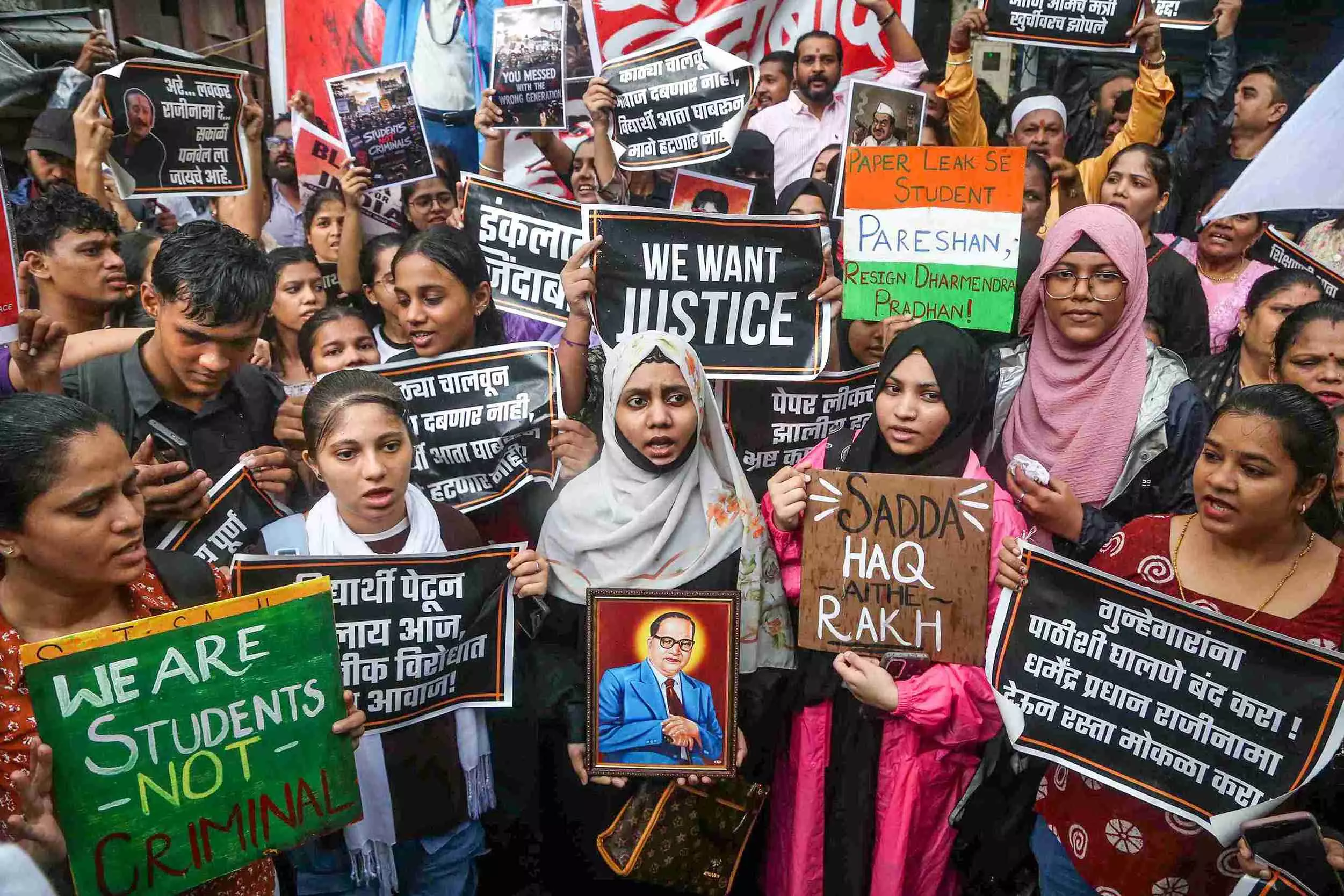
The other consequential development from the protest, according to Mohanty, is Gen Z’s emergence as a “constituency that refuses to be captured easily, as the old Left-versus-Right frame is proving increasingly inadequate”.
Young voters can be nationalist and angry with the BJP. They can be religious and demand institutional accountability. They can admire Modi and resent his education system. They can reject Rahul Gandhi and still attend a protest.
Present at both the protest at the city’s Shivaji Park last month, held in support of the Jantar Mantar agitation, and this week’s AISA event at the YB Chavan auditorium, Chaudhary agrees that for her, “the Shivaji Park protest was important precisely because it did not feel like a political rally in the traditional sense. I went there wondering what difference one person could make, but standing in that crowd, I realised that everyone there was simply one person who had decided to show up. That is where I would place the Gen Z movement in this new political ecosystem. We are politically aware, but not necessarily politically owned. We can disagree with the government without automatically becoming supporters of an opposition party. We can care about democracy, education, jobs or representation without wanting to join a political party. Maybe that is the uncomfortable thing for established politics: our participation does not necessarily come with a membership card.”
Concurs Shlok Batia, a 20-year-old engineering student from Malad, “I want to correct the assumption that Gen Z mobilisation automatically translates into party politics. It doesn’t. Not everything is about elections. It’s about governance. I can question the BJP, the Shiv Sena, Congress or anybody else without signing up to another party. That, to me, is where this movement sits within the ecosystem. It is outside the traditional political binary, at least for now. We are not necessarily trying to replace one party with another. We are saying that governments, whichever party is in power, have to be accountable to us. If political parties understand that, they will engage with us. If they assume we are just another vote bank, they will completely miss the point.”
Also read: How the language of political discourse in India has transformed with the years & why it's a matter
Of course, the visible leadership remains disproportionately rooted in political and civil society networks that have traditionally opposed the BJP. The participation of AISA, other Left organisations, opposition politicians and progressive intellectuals is real.
But that is not the same thing as saying the underlying constituency is Left.
As Bora herself pointed out at a recent interaction at the Mumbai Press Club, gig workers and other young workers have also protested, but often lack the social and cultural capital required to make their protests visible.
Mohanty calls this “the most important caveat in the entire debate.”
Young people who can spend hours making reels, posting memes, attending demonstrations and explaining politics to journalists are not necessarily representative of millions of Indians working 12-hour shifts, studying while working, preparing for examinations in small towns or simply trying to survive. The danger, he says, is that “Gen Z becomes another metropolitan category imposed upon a radically unequal generation.”
A 21-year-old in Delhi who can attend Jantar Mantar and a 21-year-old gig worker in Mumbai do not experience precarity in the same way. “The latter may have neither the time nor the vocabulary to join a movement,” Mohanty says. “But that does not mean s/he is any less angry. It only says s/he is less visible. If I were the system I’d fear that invisibility so much more…”
Bal Thackeray’s innovation was to take young men’s frustration and give it an organisation: the shakha. The organisation gave frustration discipline, discipline gave it street power, and street power eventually gave it political power.
The BJP’s subsequent achievement was to take that model of cultural mobilisation and make it national, technologically sophisticated and electorally formidable.
But Gen Z has grown up after the age of the shakha, reminds Kule. “Its political neighbourhood is the smartphone. Its shakha is Instagram. Its poster is a meme. Its political meeting may be a WhatsApp group. Its leader can be a person it has never met. Its first political act may be a repost rather than a march.”
And crucially, it may resist becoming anybody’s foot soldier.