What is ‘dark genome’ and why scientists may have been wrong in discarding it as evolutionary debris
A vast 98% of human DNA has long been dismissed as having little biological significance. However, in the new book Eclipsed Horizons: Unveiling the Dark Genome, Sudhakaran Prabakaran argues that the so-called 'dark genome', or 'junk DNA', may help explain rapid evolutionary innovation. In this first of a two-part series on the 'dark genome' and the answers it might hold, we look back at how the text of heredity is written.

For more than half a century, biologists have been puzzled by one of the greatest mysteries hidden within our own genome. Barely two per cent of human Deoxyribonucleic Acid (DNA) consists of genes that encode proteins; the remaining 98 per cent was long dismissed as ‘junk DNA’, evolutionary debris with little biological significance.But what if this neglected portion of the genome is not...
For more than half a century, biologists have been puzzled by one of the greatest mysteries hidden within our own genome. Barely two per cent of human Deoxyribonucleic Acid (DNA) consists of genes that encode proteins; the remaining 98 per cent was long dismissed as ‘junk DNA’, evolutionary debris with little biological significance.
But what if this neglected portion of the genome is not junk after all? What if it contains the hidden instructions that have shaped some of the most remarkable innovations in the history of life?
In the book Eclipsed Horizons: Unveiling the Dark Genome (World Scientific Publishing, 2026), Sudhakaran Prabakaran, associate teaching professor at Northeastern University and CEO of NonExomics (a scientists’ led company involved in biotechnology research), advances a bold and provocative hypothesis. He argues that the so-called ‘dark genome’ is not a graveyard of discarded DNA but a vast reservoir of regulatory information that may help explain rapid evolutionary innovation, adaptation to changing environments and perhaps even humanity's future beyond Earth, colonising outer space.
To appreciate why this idea is so intriguing, it helps to begin not with DNA but with one of the largest critical editing projects ever undertaken: the Mahābhārata.
Imagine that you are holding a copy of the Mahābhārata. It appears to be a single book, but it is the product of a remarkable history. For centuries, scribes across the Indian subcontinent copied the epic by hand. Each generation tried to preserve the story faithfully, yet no two manuscripts were exactly alike.
In the twentieth century, scholars at the Bhandarkar Oriental Research Institute (BORI) in Pune undertook one of the world's largest textual research projects. Between 1919 and 1966, they compared 1,259 handwritten manuscripts of the Mahabharata collected from across India and beyond to reconstruct the earliest attainable text of the epic.
The editors found something remarkable. Every manuscript preserved the same central story, the rivalry between the Kauravas and the Pandavas, the game of dice, the exile, and the Kurukṣetra war. Yet each manuscript also carried traces of its own history. Some contained additional verses like Harivaṃśa, devotional passages, or longer philosophical discussions; others omitted material or incorporated passages that had once existed only in the margins. Over centuries, the epic expanded, contracted, and diversified. The compilers found distinct 'versions' such as Sarada (Kashmiri), Nepali, and Tamil. Every manuscript was recognisably the Mahābhārata, yet no two regional schools were identical.
Biological evolution works in a surprisingly similar way.
Also read: Who was James Watson, Nobel Laureate known for seminal work on DNA structure, who died this month
Every generation inherits almost the same biological ‘manuscript’ from its parents. Most of the genetic text is copied with remarkable accuracy. Occasionally, small changes occur. Most of these disappear without a trace, but a few stick around and spread through populations. Over long periods, these accumulated changes can shift the biological manuscript so much that entirely new species appear.
This immediately raises a profound question. If life's manuscript is copied so faithfully from one generation to the next, how does nature ever write an entirely new chapter?
Biologists have been trying to answer this question for more than 160 years.
The story begins with Charles Darwin. In 1859, he proposed one of the most revolutionary ideas in science: species are not fixed. They evolve over time and entirely new species can emerge from older ones through the process of natural selection — something we learn in high school. Individuals within a population differ from one another. Some run a little faster, some tolerate cold better, some digest food more efficiently, or see more clearly. If one of these differences gives an individual even a slight advantage in surviving and producing offspring, that trait becomes a little more common in the next generation. Over thousands or millions of generations, countless small changes accumulate. Eventually, the descendants may become so different from their ancestors that they are recognised as a new species.
The evolution of whales provides one of the clearest examples of Darwin's idea. About 50 million years ago, the ancestors of modern whales were four-legged mammals that lived on land. Over countless generations, some populations became increasingly adapted to life in water. Natural selection favoured countless small variations that improved swimming and diving. No single generation created a whale. Instead, the forelimbs gradually changed into flippers, and the hind limbs shrank to small internal remnants. The nostrils moved to the top of the head, forming a blowhole. The body also became streamlined for living in water. Fossils clearly show many of these intermediate forms. An intermediate stage could walk and swim before later species became entirely aquatic. What started as a typical land mammal eventually became the largest animal ever to live on Earth.
About 50 million years ago, the ancestors of modern whales were four-legged mammals that lived on land. Over countless generations, some populations became increasingly adapted to life in water. Photo: iStock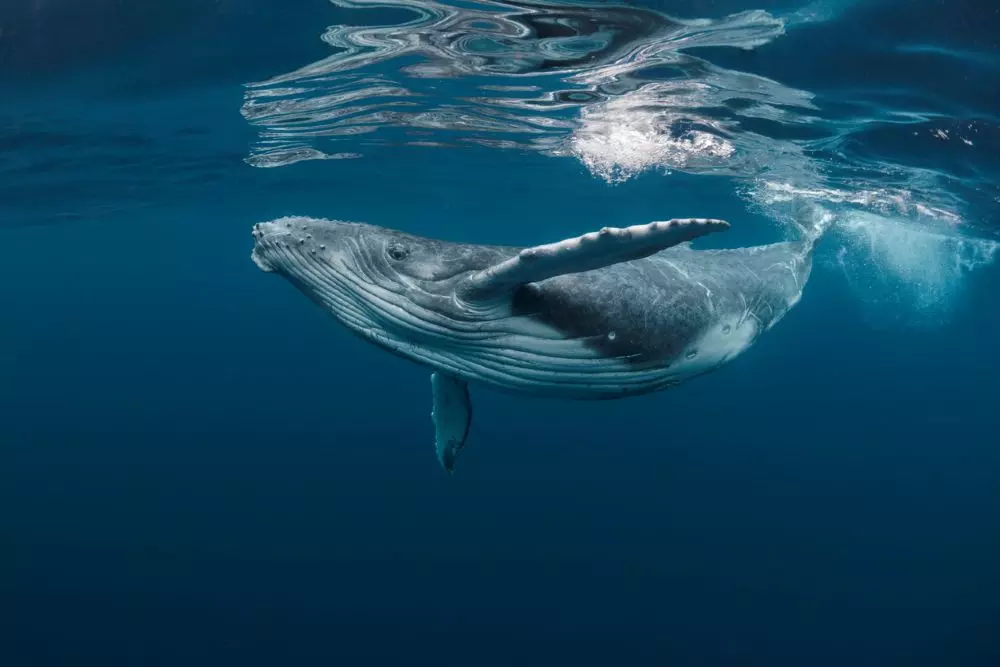
This was Darwin's great insight. Nature does not create entirely new organisms in a single leap. It produces astonishing novelty by preserving countless small improvements over immense spans of time. Yet Darwin himself recognised that his theory left one important question unanswered: if natural selection merely chooses among existing variations, where do those variations come from in the first place?
Even Darwin admitted that he did not know how traits were inherited from parents to offspring. A few years later, an Austrian monk named Gregor Mendel provided the missing piece. By breeding pea plants, Mendel discovered that biological traits do not blend together like paints mixed on an artist's palette. Instead, hereditary factors — today called genes — are passed on as discrete units, one from each parent.
A tall plant crossed with a short one does not produce offspring of medium height. Instead, the offspring are either tall or short, while the recessive trait may remain hidden for generations before reappearing. Mendel's experiments showed that hereditary information is transmitted with remarkable fidelity from one generation to the next.
But Mendel's discovery created a new puzzle. If genes are copied so faithfully, how can evolution produce creatures that never existed before? Where do feathers, flowers, whale flippers, or the dazzling colours of tropical fishes come from? If inheritance preserves the biological ‘manuscripts’, how are entirely new variations of ‘manuscripts’ ever written?
The answer was mutation. Occasionally, copying errors occur when genes are copied from one generation to the next. Most are harmless, some are harmful and very few are beneficial. Along with the reshuffling of genes during reproduction, these mutations create new variety. Natural selection acts as a filter. It preserves useful changes and eliminates harmful ones.
During the 1930s and 1940s, evolutionary biologists such as Ronald Fisher, JBS Haldane, Sewall Wright, Theodosius Dobzhansky and Ernst Mayr united Mendelian genetics with Darwinian natural selection by incorporating the notion of mutation. Evolution was viewed as changes in gene frequencies produced by mutation, recombination, genetic drift and natural selection.
Meanwhile, in the 1950s, James Watson and Francis Crick discovered DNA's double-helix structure (two intertwined, oppositely running strands forming a spiral, which clarified how DNA stores genetic information and enabled understanding of how accurately information is stored and retrieved during cellular processes) . Rosalind Franklin's critical X-ray diffraction work (notably Photo 51) was a key puzzle piece in determining the structure, though her contributions were often under credited.
In the 1960s, scientists found that DNA is written using just four chemical "letters": A (Adenine), T (Thymine), G (Guanine), and C (Cytosine). Like the 26 letters of the English alphabet, these four letters can be arranged in multiple ways to encode the instructions for building and maintaining every living organism. Soon, Marshall Nirenberg, Indian-origin scientist Har Gobind Khorana, and Robert Holley deciphered the genetic code. They found that triplets of DNA letters (codons) specify each amino acid, revealing how genes act as detailed instruction manuals for assembling proteins that power every aspect of life.
Also read: How India's nuclear energy journey has led to a new route for production of green hydrogen
By the early 1970s, molecular biologists realised that only a small fraction of DNA consisted of protein-coding genes. Vast portions of the genome appeared to do nothing at all. To explain this, the geneticist Susumu Ohno coined the term "junk DNA" in 1972, suggesting that much of the genome consisted of evolutionary leftovers with no obvious function.
Then came the Human Genome Project. When the first draft of the human genome was announced in 2001, it confirmed just how surprising this was.
After sequencing the human genome and identifying its genes, scientists found that only about 1–2 per cent of our 3.2 billion DNA letters encode proteins. The remaining 98–99 per cent lies in non-coding regions.
Much of this non-coding DNA consisted of repetitive sequences, mobile genetic elements, and the remnants of ancient viruses. To many scientists, it resembled a manuscript bundle in which only a few folios contained the main text while the rest appeared unrelated.
Palm-leaf manuscript bundles often contained much more than the text named on their cover. During centuries of recopying and rebinding, scribes frequently placed unrelated leaves together in the same bundle. A manuscript labelled "Mahābhārata" might therefore also contain a horoscope, a medical recipe, or leaves from another work. To scholars interested only in reconstructing the epic, these additional folios initially appeared to be little more than clutter. Molecular biology viewed much of the genome in a remarkably similar way.
In the past few decades, scientists have realised that much of what was once dismissed as 'junk DNA' is neither biological trash nor merely vestigial, evolutionary leftovers like the appendix.
A useful analogy comes from the textual history of the Mahābhārata. A popular Tamil saying observes, "Sita's beauty brought her sorrow; Draupadi's laughter brought hers." Yet this familiar image of Draupadi's laughter is itself the product of the epic's long textual evolution.
In different recensions and later retellings of the Mahābhārata, Draupadi's role in Duryodhana's humiliation (often regarded as the trigger for Draupadi’s latter abuse by the Kauravas, triggering the battle of Kurukshetra) gradually changes. In the earliest recoverable text reconstructed by the BORI, Duryodhana's humiliation stems chiefly from his own envy and from the laughter of the Pāṇḍavas and the attendants; the famous taunt associated with Draupadi is absent.
Different versions tell different stories of Draupadi's role in that episode. In some retellings, she simply smiles; in others, she laughs out loud. In the most well-known versions, she mocks Duryodhana with the sharp comment, "The son of a blind man is blind".
The main story stays the same, but each addition subtly changes the moral meaning of the epic. In one interpretation, the disaster at Kurukṣetra stems primarily from Duryodhana's jealousy and envy. In another, Draupadi's words serve as the immediate spark that starts one of the greatest wars in world literature.
By the early 1970s, molecular biologists realised that only a small fraction of DNA consisted of protein-coding genes. Vast portions of the genome appeared to do nothing at all. Photo: iStock
The genome may function in a surprisingly similar way. Protein-coding genes make up the main biological text, while much of the non-coding genome acts like the manuscript's marginal notes and interpolations. It includes regulatory elements that determine when, where, and how genes are turned on or off. These elements usually do not encode proteins, but they significantly affect how the genetic text is understood. Small changes in these regulatory sequences can lead to markedly different outcomes without altering the genes themselves. This is akin to minor changes in the telling of the Mahābhārata can alter how generations of readers perceive its characters, motivations, and even the causes of the great war.
This shift in perspective has changed modern genetics. The main question is no longer just, "What genes does an organism have?" Scientists are now asking a deeper question: "How and when is the information in those genes expressed?"
Which brings us back to the ‘missing folios’ of the biological manuscript and the lingering question, what if scientists were so long wrong in discarding the ‘dark genome’ as ‘junk DNA ’, and can it hold the answers to evolution’s greatest leaps, as Prabakaran suggests?