In Assam, recurring floods bring psychological trauma of displacement, rehabilitation fatigue
Last month, floods in Upper Assam wreaked havoc across 15 districts, affecting people in 863 villages. By Aug 6, the death toll reportedly reached 96. But with 'nearly 40% of the Brahmaputra valley being flood-prone ', the loss of family members and friends, ravaged homes, destroyed crops, the stench of dead livestock and lives that need to be rebuilt are a yearly reality for many in the state.

For Lokhima Baruah, 32, of Hesuli village in Assam’s Lakhimpur district, floods have become an annual ordeal. In May 2020, when the Jiadhal, a subtributary of the mighty Brahmaputra, flooded the village, it carried away her home in its fury. For the next six months, Lokhima lived with her family in a bamboo chang (structure built on stilts) beside the ruins of their house.“My heart aches...
For Lokhima Baruah, 32, of Hesuli village in Assam’s Lakhimpur district, floods have become an annual ordeal. In May 2020, when the Jiadhal, a subtributary of the mighty Brahmaputra, flooded the village, it carried away her home in its fury. For the next six months, Lokhima lived with her family in a bamboo chang (structure built on stilts) beside the ruins of their house.
“My heart aches to talk about it,” says Lokhima. The family owns a five-bigha farmland, but with repeated floods turning it into a barren patch, the 32-year-old, who lost her husband about six years back, now works as a daily wage labourer to support herself and her two young children. The recent floods in the state saw her back at a relief camp with her children. She was home when The Federal caught up with her last week, but with the monsoon far from over, there is a lingering fear in her. “What if I have to leave again?” she frets.
For many in Assam, floods are a recurring challenge that they must face annually. Last month, floods in Upper Assam wreaked havoc across 15 districts, including Golaghat, Sivasagar, Udalguri, Kamrup (Metro), Nagaon, Kamrup, Darrang, Sonitpur, Hojai, Biswanath, Jorhat, Charaideo, Karbi Anglong, Dhemaji and Lakhimpur, hitting people in 863 villages. Described as among the worst to be experienced in Assam in recent years, the floods affected an estimated 11 lakh people, among them Lokhima. According to the Assam State Disaster Management Authority (ASDMA) data, the death toll reached 96 last week, after two more deaths were reported on August 6.
As the flood water receded, it left in its wake ravaged homes, destroyed crops, the stench of dead livestock and lives that needed to be rebuilt all over again.
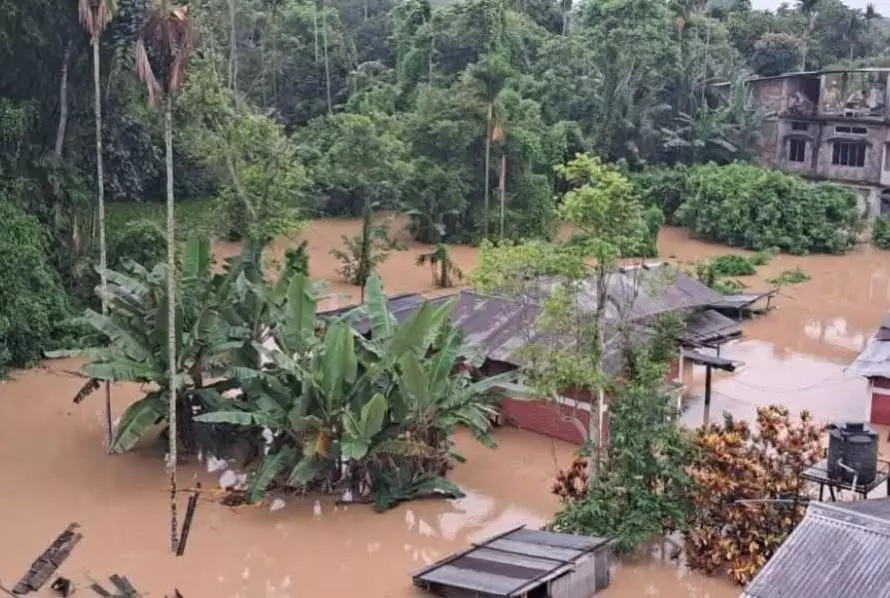
A flooded village in Assam. Photo: By special arrangement
According to reports, the state’s Himanta Biswa Sarma-led government has already released the first tranche of approximately Rs 160 crore interim relief to about 75000 worst-hit families.
What the government can’t give, however, is the will needed to repeatedly rebuild lives, well knowing that it may again be washed away in 12 months.
“Floods do not end psychologically when the water recedes. For people who experience recurring floods, the repeated cycle of evacuation, displacement, loss of homes and belongings, and uncertainty about when the next flood will come can create a prolonged state of psychological stress. It can affect a person’s sense of safety, stability and control over their life and may contribute to anxiety, depressive symptoms, trauma-related responses, sleep difficulties and a persistent sense of helplessness,” says psychologist Sambhavi Samir Alve.
She adds: “The loss is also more than material. A home represents safety, memories, identity and continuity; losing it repeatedly can erode a person’s sense of belonging and security. When families are displaced, social networks, livelihoods, education and daily routines may also be disrupted, further affecting psychological wellbeing. Importantly, resilience should not be mistaken for the absence of distress. Communities may adapt and continue functioning while still carrying significant psychological burdens.”
Also read: Why for Gen Z kanwariyas, politics is walking a tightrope between faith and concerns about future
In a post on social media, 52-year-old Koneshwar Chetia, a resident of Jonai village in Dhemaji district, talks about how villagers try to stick to a semblance of daily routine in the midst of the natural disaster. With roads swept away, children from the village are ferried by boat to the nearest surviving road, where a school van picks them up. The arrangement continues through the flood season because schoolwork does not stop. “Every monsoon, we have to suffer because of floods. There is no solution to the problem. All government schemes and projects have failed to bear fruit,” he is heard saying in the post.
According to reports, “nearly 40 per cent of the Brahmaputra Valley is flood-prone”, making Assam “one of India’s most vulnerable regions to recurring floods”. Interestingly, however, the flood this year reportedly also affected districts that had for years evaded the challenge, districts like Shivasagar, Charaideo and Jorhat, which are not usually part of those impacted by the state’s recurring floods.
Talking about the departure, Arup Kumar Sarma, professor of hydrology at IIT Guwahati, told The Federal, “extensive deforestation" in the neighbouring states "is responsible”. He explains: “Extensive deforestation in the immediate upstream hills of Nagaland (for Sibsagar and Jorhat), Arunachal Pradesh (for Dhemaji and Dibrugarh) and Meghalaya (for Khanapara, Jorabat and Guwahati), because of boulder mining, road construction and other developmental activities, could result in floods in the Dikhow river [also a tributary of the Brahmaputra] ”.
Sarma adds: “Such deforestation can generate high water and sediment yield. Sediment deposition makes the river shallow and thus they lose their water carrying capacity.”
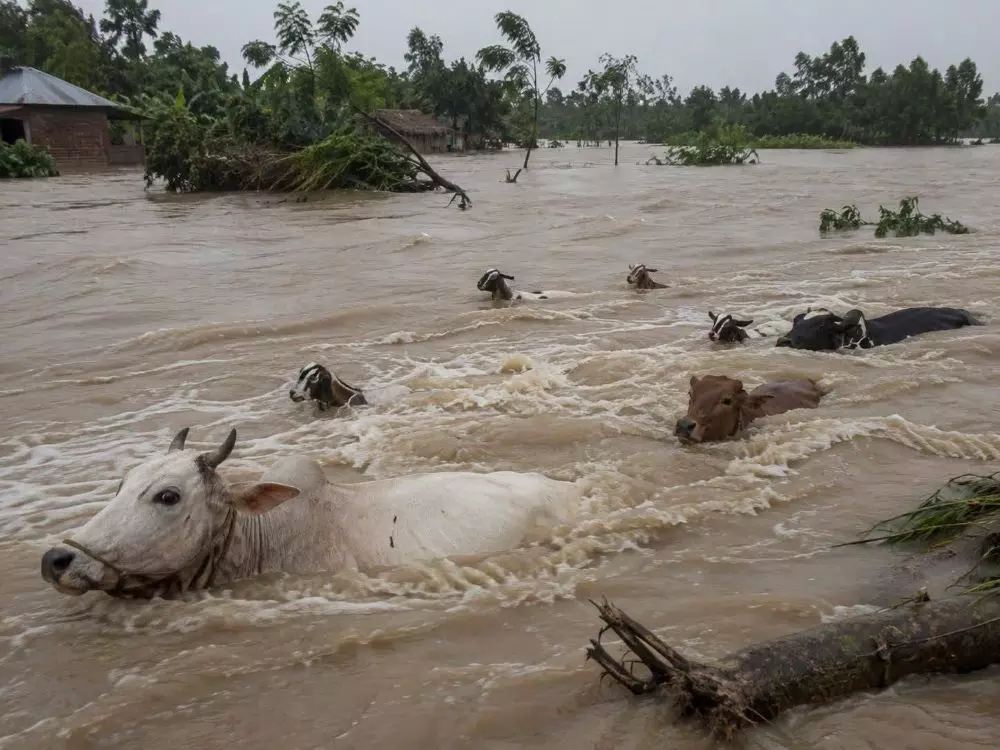
Animals try to swim to safety. Photo: By special arrangement
While the impact of climate change, environmental degradation and resulting phenomena such as cloud bursts (often associated with floods and landslides) are cited as common factors behind extreme weather conditions and natural disasters in recent years, experts here also talk of other localised contributing factors, specific to different areas of Assam.
For example, if Sarma talks about the impact of development activities in neighbouring Arunachal Pradesh, Nagaland and Meghalaya, as issues precipitating floods in the regions he mentions above, in Lakhimpur and Dhemaji — reportedly among Assam’s most flood-prone districts since the ‘90s — the phenomenon has often been linked to the release of excess water from the reservoirs of the Ranganadi Hydroelectric Power Project in Arunachal.
The two districts sit at the confluence of several flood-prone tributaries of the Brahmaputra, including the Subansiri, Ranganadi, Jiadhol, Simen and Singra, each of which is capable of flooding villages here within hours. The Ranganadi Hydroelectric Power Project, commissioned in 2002, just adds to the concern.
Release from the power plant’s reservoirs allegedly caused flash floods in May 2025, in September 2018 and in March 2017, before that. Residents claim to have repeatedly raised their concerns regarding failures in adequate flood alerts or advance information on the release of excess water from the dam, despite warnings and requests from the state government, with the North Eastern Electric Power Corporation Limited (NEEPCO), which operates the project, but to no avail.
The Federal reached both NEEPCO officials and the state government’s water resource department for comment, but received none till the time of publication of this report. The article will be updated if a response is received.
Similar to the alleged impact of the Ranganadi project on Lakhimpur and Dhemaji, the release of excess water from the reservoir of the Doyang Power Project is alleged to have resulted in flash floods in more than a hundred villages in Golaghat district.
Experts, however, trace the origin of Assam’s flood vulnerability to an earthquake on the Assam-Tibet border in 1950. British botanist Francis Kingdon-Ward, who was travelling near the epicentre when the earthquake struck, later wrote an account of its aftermath that has since become a reference point for understanding Assam’s flood history.
Researchers studying the period note that before 1950, serious floods on the Brahmaputra occurred roughly once every ten years, but became an annual event after the earthquake.
In his book “The Unquiet River: A Biography of the Brahmaputra”, historian Arupjyoti Saikia writes that the earthquake severely damaged the river’s capacity to carry water and that the pre-quake situation was never restored.
The earthquake had brought on landslides in Arunachal, which reportedly caused temporary dams to be formed on several tributaries of the Brahmaputra. These, when they broke, sent walls of sediment and water into the plains below. Geological studies have since shown that the earthquake introduced roughly 45 billion cubic metres of sediment into the river system through landslides, raising the height of the river bed by up to three metres at some locations by 1955. That rise, reducing the Brahmaputra's carrying capacity, is one reason cited by experts when explaining why even moderate rainfall now causes flooding in the state.
Also read: Why online trolling of Gen Z women dissenters is yet another proof of growing digital misogyny
Technical explanations, however, cannot mitigate the lived struggle of a people having to yearly grapple with the fury of gushing water that can wash away life within minutes.
Talking about the night of July 19, when the floods hit Nepal Khuti, a village in Sivasagar district, said to be the worst-hit in this year’s flood, resident Shivashankar Karmakar says, “Water started coming in at 6 am; by 11 am, it was completely flooded. We went up on the roof. Nobody could even take out their belongings. All the cows are gone. We had five or six.”
Now all that remains of the livestock in the village is the stench of rotting carcasses.
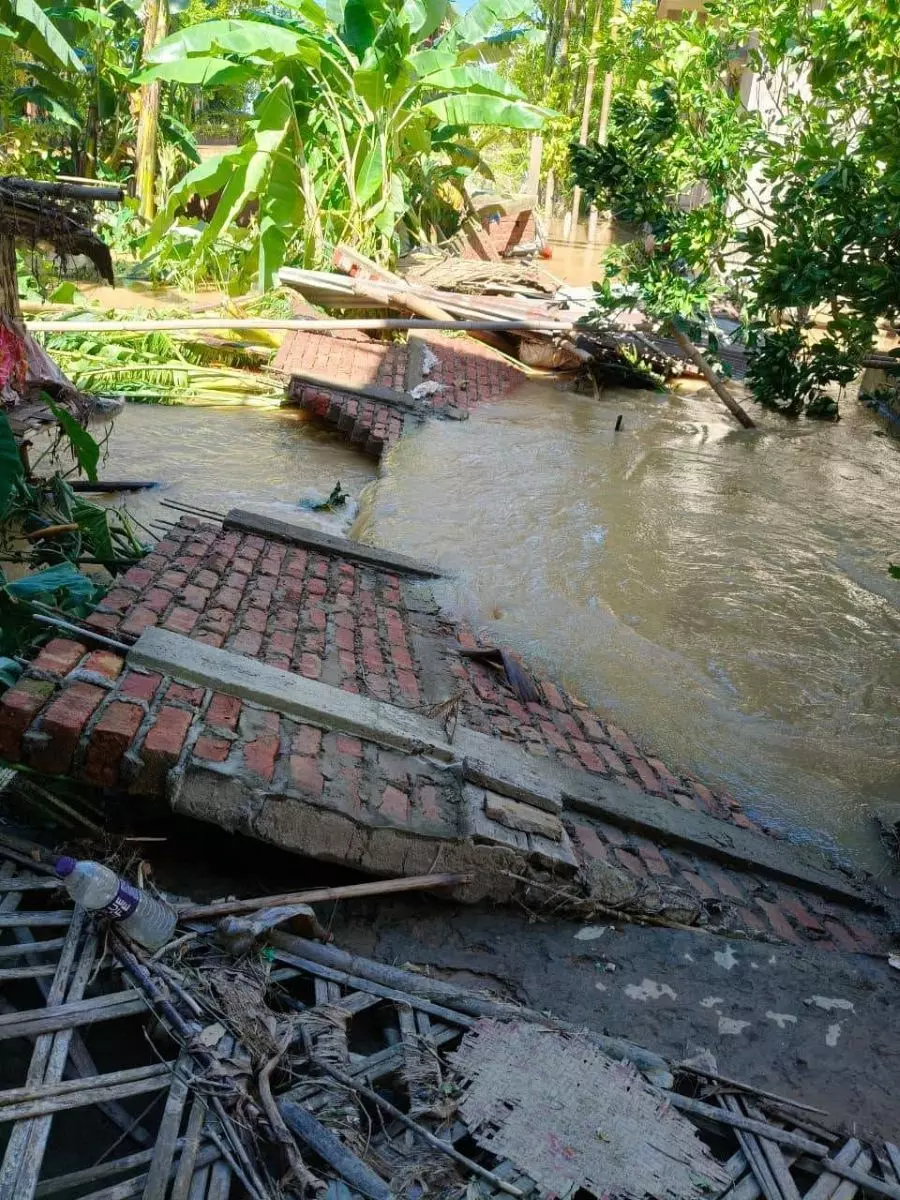
Ruins of homes. Photo: By special arrangement
The scars remain long after the water has receded… in the form of lives lost, homes devastated, fields ruined.
“After the floods, our people suffer from various diseases. We often lose our livestock. It is difficult to adjust to the new situation and rebuild our homes. The government’s relief and rehabilitation packages cannot revive our lives,” says Lokhima.
Ranjita Borgohain, a resident of Madhuri Gohain Gaon in Sivasagar district, says she developed eruptions on her face and legs after the water receded, accompanied by unbearable itching.
Another survivor from the same village, Lipika Saikia, has been running a fever since. Others talk of respiratory ailments and diarrhoea. Basanti Phukan, a pregnant resident, says she is “mentally shattered”.
Dr Prashanta Kumar Baruah, a doctor treating flood-affected families in Dhemaji, says the weeks immediately after a flood are often the most critical from a health standpoint. According to him, disease patterns in the aftermath are shaped largely by environmental conditions. Skin diseases, diarrhoea and malaria are among the illnesses likely to emerge as pollutants trapped in mud and silt allow bacteria, viruses, fungi and parasites to multiply.
Psychologist Chandana Bhuyan also talks of psychological first aid.
“People experiencing a disaster do not always need immediate counselling; they first need to feel safe. They need someone who can listen without forcing them to talk, understand their immediate needs, offer practical support, reconnect them with loved ones and help restore a sense of stability and control. Our disaster-response systems rightly prioritise rescue, food, shelter and medical care. But psychological support must also begin early,” she explains.
While the Assam State Disaster Management Authority does have a psychosocial telecounselling service for survivors of calamities like floods, the repeated burden of having to rebuild one’s life can result in not just fatigue, but defeatism.
The kind one senses in Lokhima. "There is no solution,” says the Lakhimpur resident, flatly, when talking about the future. “The government's relief and rehabilitation packages cannot compensate us.”