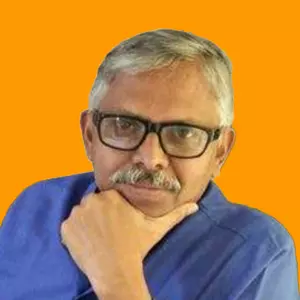
File photo of AB Venkateswara Rao.
AB Venkateswara Rao, a 1989-batch IPS officer, is waiting for the Election Commission's approval to launch a political party. Meanwhile, he has begun an aggressive campaign against CM N Chandrababu Naidu and his son and IT Minister Nara Lokesh, after hitting the road earlier with the 'Jagan Never Again' slogan against former CM Jagan Mohan Reddy. In the past, other former bureaucrats have launched political parties but received little success.

Former bureaucrats who want to make it big in politics after retirement usually prefer joining established political parties with a strong organisational base and a better chance of electoral success.
A 2025 study by researchers at the Dayananda Sagar University, Bengaluru, bears this out. The study examined the political preferences of 22 distinguished bureaucrats across the country who had entered politics between 1984 and 2023. As many as 54.5 per cent chose the Bharatiya Janata Party (BJP) as their best bet for electoral success. The Congress came next with 13.6 per cent, followed by Janata Dal (United) with 9.1 per cent. Bahujan Samaj Party (BSP), Lok Satta and Aam Aadmi Party (AAP) accounted for 4.5 per cent each, while only 4.5 per cent contested as Independents.
Very few think of building their own political party around an ideology they believe in.
In Andhra Pradesh, some former bureaucrats who have, over their years in service, developed serious grievances against the political establishment have chosen to launch their own parties in the name of social justice, good governance or political reform. But their numbers have been few and far between.
The most recent example is former Andhra Pradesh Indian Police Service (IPS) officer AB Venkateswara Rao.
Rao, a 1989-batch Indian Police Service (IPS) officer, is waiting for the Election Commission's approval to launch a political party. The failures of earlier parties floated by former bureaucrats do not appear to have deterred him. He has administrative experience. He has public visibility. He is able to mobilise resources. Above all, he is armed with an influential Kamma caste-social network. The Kammas are an agrarian-capitalist, land-owning community, descriped by sociologist MN Srinivas as a typical 'dominant caste'.
He has begun an aggressive campaign against the Telugu Desam Party (TDP)-led National Democratic Alliance (NDA) government in Andhra Pradesh, especially Chief Minister N Chandrababu Naidu, and his son and IT Minister Nara Lokesh, rather than merely confining himself to airing views on politics.
The larger question, however, is whether Rao can do what most former bureaucrats who launched political parties in Andhra Pradesh in the past failed to do — convert personal credibility and administrative experience, caste social capital into a durable political organisation.
Also read: Why Jarange-Patil winning Kunbi quota battle may not be the simple solution to Maratha issue
Rao became politically active after his retirement in May 2024. His decision followed a turbulent five years during the YS Jagan Mohan Reddy government (May 2019-June 2024), when he was kept without a posting, suspended and faced a criminal case. He challenged the actions taken against him in court and secured relief. He was reinstated in May 2024, shortly before his retirement, following a High Court directive.
After Jagan's defeat in the 2024 elections, Rao hit the road with the slogan, 'Jagan Never Again', arguing that "an ugly phenomenon like Jagan should not recur in the state". This was seen as the extension of typical Kamma versus Reddy caste rivalry.
Within two years, however, his guns were trained on CM Naidu and Nara Lokesh, as well.
Rao now appears to be positioning himself against both Naidu and his former bete noire, Jagan. He told The Federal: "There is no difference between them. Naidu is simply mimicking Jagan and they both should go." Incidentally, Rao also tried to contest the 2024 election on a TDP ticket. The proposal did not find favour with Naidu.
File photo of former CM Jagan Mohan Reddy.
Why did Rao fall out so bitterly with Jagan?
The former intelligence chief earned the wrath of the YSR Congress Party (YSRCP) leadership over his actions during Chandrababu Naidu's 2014–19 tenure, according to the YSRCP's perception of his role.
Rao's tenure was marked by controversies involving, among other issues, the investigation into the murder of Congress leader YS Vivekananda Reddy, the defection of YSRCP MLAs to the TDP, the 2018 knife attack on Jagan at Visakhapatnam airport and allegations concerning surveillance equipment imported from Israel.
The YSRCP viewed him not merely as an official performing his duties, but as someone who had become an instrument of Naidu's political battle against Jagan.
When Jagan came to power in 2019, Rao was immediately sidelined. He was later suspended over allegations of corruption and misconduct. The case against him included allegations of illegal procurement of Israeli surveillance equipment to benefit his son's firm. Rao denied the allegations and fought the government's actions in court.
When Chandrababu Naidu returned to power in 2024, Rao initially launched his 'Jagan Never Again' campaign. But his relationship with the TDP leadership, too, soured soon thereafter.
Rao, a Kamma and widely perceived as Naidu's 'Man Friday' during the latter's previous tenure, has since become one of the sharpest critics of Nara Lokesh. He has alleged that the present government has promoted the same set of vested interests fostered by Jagan. At one press conference, while speaking about alleged irregularities in the mining sector, Rao said: "Then they were Jagan's companies; now they belong to Lokesh".
Andhra Pradesh politics has been dominated by the competition between the TDP and YSR Congress, with two politically powerful social blocs represented by the Kamma and Reddy leaderships. The age-old political rivalry became particularly intense after the bifurcation of the state in 2014.
Rao, however, rejects the argument that either his 'Jagan Never Again' campaign or his earlier association with Naidu was driven by caste considerations. “It’s not fair to call me an ally of Naidu. I did my duties as a government servant,” he says. Talking to The Federal, Rao dismissed suggestions that his campaign against Jagan was anti-Reddy in nature. "Some sections think that I was vengeful and my campaign against Jagan was anti-Reddy in nature. Having seen Jagan from close quarters, I sincerely believe that a phenomenon like Jagan should be stopped in its tracks," he alleges.
As for Naidu, Rao says he initially believed that the TDP chief would provide an alternative to Jagan's style of governance. "With equal conviction, I had believed that Chandrababu Naidu would work in that direction. But I soon realised that Naidu was mimicking Jagan. This disillusioned me and forced me to think of launching a political party as a third alternative," he claims. Rao says his proposed party will be guided by libertarian philosophy, giving primacy to individual rights and limiting the role of the state.
If he receives the Election Commission approval to launch his party, Rao will not be the first former bureaucrat in Andhra Pradesh to launch a political party after developing differences with the political establishment.
Former IPS officer M.V. Bhaskar Rao, a Kapu by caste (traditionally land-owing agricultural community), resigned from service after alleging ill-treatment by the TDP government and floated Andhra Nadu in 1997. The party failed to make an impact in the 1999 elections and he later joined the Congress.
Dr Jayaprakash Narayan, a former IAS officer, followed a more ambitious route. He converted the popular Lok Satta movement into a political party and entered electoral politics. Also a Kamma, JP won an Assembly seat in 2009, but Lok Satta failed to emerge as a major political force. After losing the 2014 Lok Sabha election, JP withdrew from electoral politics.
Former Maharashtra-cadre IPS officer VV Lakshminarayana, a member of the Kapu community, also launched his own party in 2023 after his association with the Jana Sena did not work out. His Jai Bharat National Party (JBNP) failed to make an electoral impact.
In 2024, retired Dalit IAS officer G. Vijay Kumar launched the Liberation Congress, arguing that the policies of the major parties did not reflect the aspirations of the poor, Dalits, BCs and minorities, who together constitute a large majority of the population.
Another former Dalit IPS officer, PV Sunil Kumar, who launched Ambedkar's India Mission (AIM), has also spoken of a possible political initiative.
The list of former IAS officers in Andhra Pradesh who have contested elections for major political parties, both in assembly and Lok Sabha elections, is even longer.
Before 1999, the presence of former civil servants in politics was rare. In 1984, R Reddappa Reddy, a former IPS officer, joined the Congress, but could make a poll victory.
The first former civil servant to enter the Lok Sabha from Andhra Pradesh was Maddala Timma Raju, a retired Indian Civil Services (ICS) officer. The former chief secretary of Andhra Pradesh represented the Narsapur constituency as a Congress candidate between 1971 and 1977. For nearly 20 years after that, no ‘babu’ evinced interest in joining politics.
In 1991, however, Congress fielded retired IPS officer PV Rangaiah Naidu from Khammam, who won the election to become Union minister of state for communications in PV Narasimha Rao’s cabinet. Naidu had retired as DGP before moving to politics. K Vijaya Rama Rao, former Central Bureau of Investigation (CBI ) director, won his first election in 1999 from the Khairatabad assembly constituency in undivided Andhra Pradesh as a TDP Candidate and became minister. Later, following the bifurcation of the state (Telangana was carved out of Andhra as a separate state in 2014), he joined Telangana Rashtra Samiti (now BRS). Former IAS officer N Venkataswamy won the Tirupati Lok Sabha seat in the 1999 general election as a BJP candidate, while contesting in an alliance with the TDP. He defeated veteran Congress leader Chinta Mohan by a slim margin. JD Seelam, an IAS officer of the Karnataka Cadre, joined Congress, but lost the 1999 Lok Sabha election from Bapatla constituency. However, in 2004 he succeeded in getting into the Rajya Sabha.
Other IAS/IPS officers to have transitioned to politics as members of established parties include Dr Jayaprakash Narayan, a former IAS officer, who joined the Lok Satta Party and won the 2009 assembly polls in Andhra but lost the 2014 Lok Sabha elections and Thota Chandrasekhar, a former IAS officer of the Maharashtra cadre, who contested the 2019 assembly elections from Guntur West on a Jana Sena Party ticket, but was defeated. In 2014, Ravela Kishore Babu, a former officer of the Indian Railway Traffic Service (IRTS), won the 2014 Andhra assembly election on a TDP ticket and even became a minister. He was, however, subsequently dropped from the cabinet and went on to join first the Jana Sena, then the BRS and BJP, and is currently a member of the YSR Congress. Former Indian Railway Service (IRS) officer Chintala Parthasarathi contested the 2019 polls on a Jana Sena ticket, but lost. Tirupati Srinivasulu, an IPS officer of the Karnataka cadre, joined Congress and became a member of the state legislative council in 2007. Then there were N Ramarao, a former IAS officer of the Maharashtra cadre, who was fielded by film star Chiranjeevi’s Praja Rajyam Party, but couldn’t win electorally; Malyadri Sriram, a former IRS officer who went on to join the TDP and win the Bapatla Lok Sabha constituency in 2014 and V Dinesh Reddy, a former DGP, who was launched by YSR Congress, but failed to win a seat. Others to join politics but not win elections include Iqbal Ahmed Khan, a former IPS officer and later YSR Congress candidate and Chandragiri Yesuratnam, who lost from the Guntur West Assembly segment in 2019 as a YSR Congress candidate before being nominated to the state legislative Council.
The less-than-stellar political performance of their predecessors —especially those who attempted to float their own parties — has, however, not dampened the enthusiasm of other former bureaucrats who believe they can provide an alternative to established political parties.
The failure of former bureaucrats at the ballot box cannot simply be attributed to a lack of integrity, understanding of social issues, or moral credibility. Indeed, these are often the very qualities that initially give them public appeal, say experts. The problem is that such qualities do not automatically translate into political capital.
According to Md Shafiquzzaman, a 1977-batch IAS officer, parties built around ideology take time to produce electoral results, often disappointing their founders. "Electoral politics demands compromising values and ideologies. If you don't do that, you are destined to lose the election," he says.
File photo of CM Chandrababu Naidu.
Dr Chennur Satish, a sociologist at the Institute of Development Studies Kolkata, believes parties launched by former bureaucrats face a deeper structural problem.
"Bureaucracy is a system designed to govern or control the public. That becomes a trap when bureaucrats try to transform themselves into politicians. Their connection with the public is never organic and their networks among social groups are thin," he explains.
This perhaps explains the crucial difference between a career politician and a former bureaucrat entering politics. A party worker without a political family background may spend decades working at the grassroots before getting a ticket. Even after losing an election—or being denied a ticket — he usually remains in the political arena, continues working in his constituency or moves to another party. For him, politics is a long-term vocation.
Many former bureaucrats, by contrast, enter politics after completing a successful career. If the first major electoral experiment fails, they often withdraw from active politics. The real test, therefore, is not merely whether a former bureaucrat loses an election, but what he does after losing.
And in Rao's case, despite his claims to the contrary, there continues to be a perception and criticism that his campaign represents an intra-dominant-caste conflict for political influence rather than a larger struggle against misgovernance. Professor E Venkateshu of the University of Hyderabad says Rao represents sections of coastal Kamma interests that, in his view, the TDP leadership has failed to accommodate. "Rao and Chandrababu Naidu worked in tandem against YS Jagan Mohan Reddy between 2014 and 2019. Now they have parted ways because of a clash of interests. They do not represent the people at large, whatever values they preach," says Venkateshu, a professor of political science.
This interpretation is, however, rejected by Nalamotu Chakravarthy, a public policy analyst and associate of Rao, who claims, "Our campaign is basically to create awareness about the misrule, mining mafia involving YS Jagan and Nara Lokesh and the government's attempts to usurp the lands of the poor through Section 22-A of the Registration Act. People from all districts want to discuss their issues with us. We will intensify our activities soon.”
Meanwhile, Rao's campaign against both Naidu and Jagan is being closely watched in Andhra Pradesh.
Though Naidu and Jagan attack each other fiercely in public, Rao's campaign seeks to highlight what he describes as continuities in governance and the influence of business interests under both governments.
Until now, retired IAS officer EAS Sarma has been among the most persistent individual critics of government decisions relating to major contracts, land allocation and what he describes as a lack of transparency. He has repeatedly written to governments and investigating agencies and sought action on specific issues. With Rao embarking on a public campaign, these questions are now receiving a political voice.
Also read: Why for Dalits in Uttarakhand there is a silver lining in ‘purification’ row after Kharge visit
But field visits and press conferences alone do not create a political movement.
Voters often prefer a street-smart politician who has grown up among them, understands their day-to-day problems and has spent years building personal and organisational networks. That is where intellectuals and former bureaucrats who float political parties often face their greatest difficulty.
Can he convert his administrative knowledge, personal credibility and campaign against alleged misgovernance into an organisation that survives beyond his own personality?
And, most importantly, if he suffers an electoral defeat, will he continue the political struggle—or disappear like many former bureaucrats before him? The answer may determine whether Rao breaks the jinx in bureaucrat-to-politician transition or merely becomes another entry in its long list.