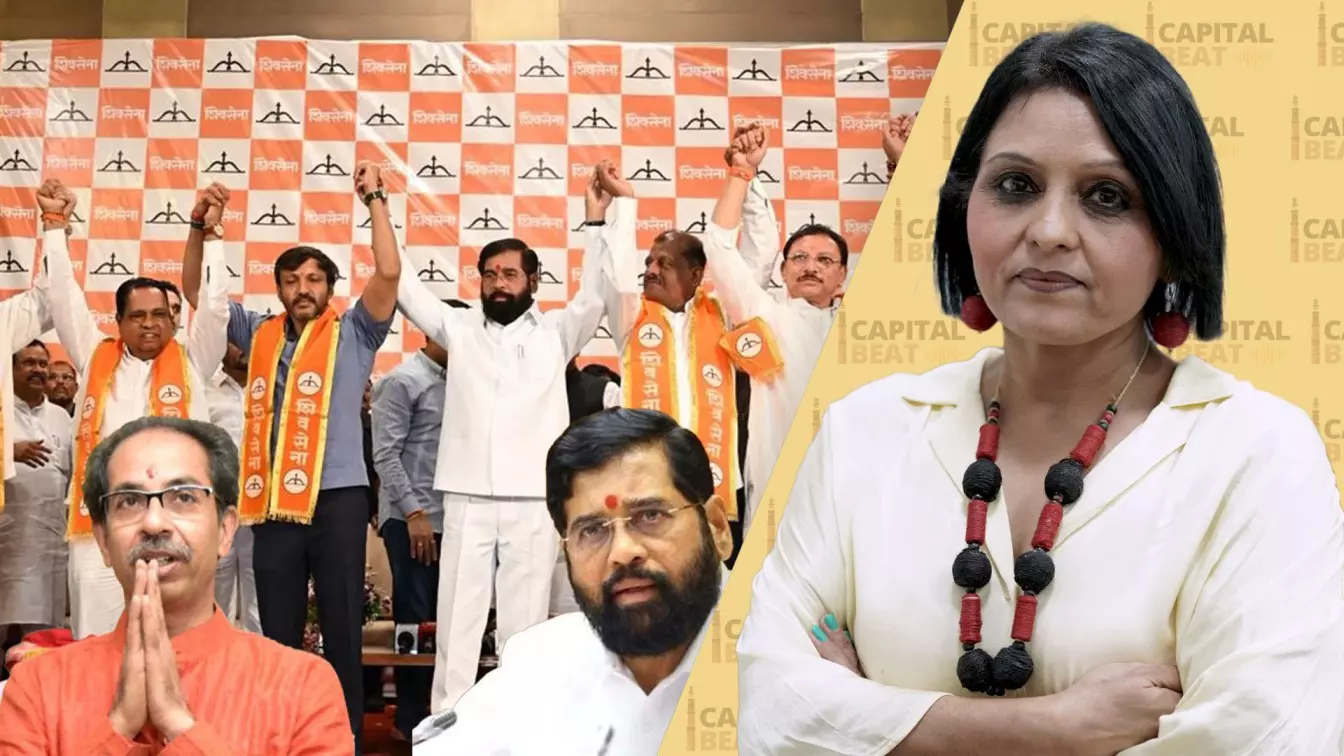
After MPs, Shinde eyes UBT's grassroots: Can Uddhav fight back?
Panellists on Capital Beat debate over Uddhav Thackeray's political future amid reports of growing defections to the Eknath Shinde-led Shiv Sena

A Capital Beat episode featuring senior journalist Yogesh Pawar and Shiv Sena (UBT) spokesperson Krishna Hegde focused on the growing political challenge facing Uddhav Thackeray after six Members of Parliament moved to the Eknath Shinde-led Shiv Sena. The discussion examined reports of possible defections by MLAs and corporators, the reasons being cited for the movement of leaders, and the implications for Maharashtra politics.
The programme noted that four prominent legislators were absent from a meeting called by Thackeray. The names mentioned were Sanjay Potnis from Kalina, Rahul Patil from Parbhani, MLC Sunil Shinde and Sanjay Derkar from Wani.
Also read: Hurt by Operation Tiger, Uddhav’s Sena pivots to 'true' Hindutva; will it work?
The discussion also highlighted reports of corporators moving towards the Shinde camp. Reference was made to the municipal strength of various parties in Mumbai and the possibility of further political realignments in local bodies.
Questions over the scale of defections
Pawar said there was still no complete clarity regarding the exact number of leaders who had crossed over.
"As of now, there is still a lot of smoke and mirrors going on. There is no categorical announcement, as so to speak."
Pawar noted that discussions about defections had moved beyond Members of Parliament and were now extending to MLAs, corporators and local representatives across Maharashtra's municipal and rural institutions.
Also read: What Shiv Sena (UBT) MPs’ defection means for Shinde, BJP and Maharashtra politics
He referred to conversations with corporators who indicated that their political decisions could depend on the actions of their local MLAs.
"So the corporators are bound to the local MLA, and they think we are watching what the MLA does and if the MLA jumps ship, then we are going to follow our leader in the house."
Debate over funding and political pressure
A major point of discussion was whether developmental funds were influencing political decisions.
Pawar argued that concerns raised by local representatives regarding access to funds deserved closer scrutiny.
"If this dispersal of these funds is being used as a tool to pressure people to quit a party or join another, then this speaks of another kind of tactic to break parties."
He said any disruption in the flow of development funds would directly affect citizens and local projects.
"Why am I being made to pay a price by a party which is using this to build its own political capital?"
Pawar also cited allocations reflected in civic budgets, arguing that areas represented by ruling alliance corporators appeared to receive greater funding compared to opposition-held areas.
Shinde camp rejects funding argument
Hegde rejected the suggestion that access to funds was driving the movement towards Eknath Shinde.
"I do not believe with Yogesh bhai that this is happening."
Hegde pointed to the growth of the Shinde-led Shiv Sena, saying support extended far beyond elected representatives.
"People who joined Eknath Shinde are in lakhs. They are maybe now 8 lakhs in number."
He argued that many leaders who held no elected office or access to government funds had still chosen to support Shinde.
"So it is not only because you are getting funds, but it is because possibly they believe in Eknath Shinde ji's leadership."
The Shiv Sena spokesperson also said leaders from other parties had approached the Shinde camp. "Congress leaders want to join Eknath Shinde."
Accommodation challenges and party growth
The discussion turned to the consequences of large-scale political migration.
Hegde acknowledged that rapid expansion could create challenges within a party structure. "We also need to make space for everybody."
He noted that accommodating new entrants should not come at the expense of long-time workers who had remained loyal to the organisation. "It will possibly be at the cost of the old faithfuls that new people coming into the party would get more benefits."
Pawar responded by questioning how many leaders any political organisation could realistically absorb. "How many people can you accommodate?"
The future of Uddhav Thackeray's camp
Asked whether Thackeray had been politically weakened, Hegde declined to describe any leader as finished.
"I would not say anyone is decimated in politics."
He pointed instead to organisational factors within the Shiv Sena (UBT), claiming that a small group around the leadership had alienated many leaders.m"There are four or five people in the party who do not let you come close to Uddhav Thackeray or Aditya Thackeray."
Hegde argued that this internal structure had contributed to the departure of senior leaders.
"That is one of the biggest reasons of people leaving."
He also linked the departures to ideological disagreements.
"The people have left because the son has diverted from the father's ideology."
Pawar highlights emotional appeal of Thackeray
Pawar argued that Thackeray continued to retain a significant emotional connection with sections of the electorate.
"Uddhav Balasaheb Thackeray continues to have that kind of an emotive appeal because he is directly a descendant of Bal Thackeray."
He said public perceptions regarding the split remained politically relevant.
"When people see that he has been backstabbed, that kind of a feeling remains."
Pawar also said discussions over defections should not be mistaken for settled political outcomes.
"It is all up in the air."
On the question of exact numbers, he maintained that clarity was still lacking.
"In terms of clarity of numbers, I think we are very, very, very far away from that."
Can the party rebuild?
The programme also examined whether Thackeray could rebuild support through grassroots mobilisation.
Pawar argued that electoral recovery would depend on organisation and outreach rather than sympathy alone.
"It requires some really hardcore grassroots-level politics and going and mobilising people."
He said the challenge for the Shiv Sena (UBT) would be retaining workers, rebuilding morale and reconnecting with voters.
"If they do that in a very proper planned way, it will make a difference."
The discussion noted that political outcomes would depend on how both camps approached the coming years and whether the reported defections translated into lasting organisational change.
(The content above has been transcribed from video using a fine-tuned AI model. To ensure accuracy, quality, and editorial integrity, we employ a Human-In-The-Loop (HITL) process. While AI assists in creating the initial draft, our experienced editorial team carefully reviews, edits, and refines the content before publication. At The Federal, we combine the efficiency of AI with the expertise of human editors to deliver reliable and insightful journalism.)