



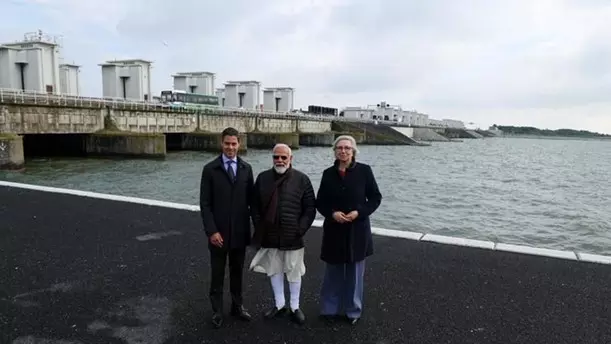
PM Modi visited the iconic Afsluitdijk Dam in the Netherlands. Photo: X|@BJP4India
Why Modi is betting on Dutch tech to save Gujarat’s mega-dam Kalpasar project
While an Indo-Dutch pact breathes fresh life into the Rs 90,000-crore Kalpasar Project, experts warn copying Afsluitdijk model faces local ecological challenges

Prime Minister Narendra Modi’s recent official visit to the iconic Afsluitdijk dam in the Netherlands has turned the spotlight on a critical priority for India: long-term water management and climate resilience.
Accompanied by Dutch Prime Minister Rob Jetten, PM Modi toured the massive barrier dam, which has shielded the Netherlands from devastating floods for nearly a century while simultaneously serving as a hub for freshwater storage, inland transport, and renewable energy generation.
According to India’s Ministry of External Affairs (MEA), the visit was far from a mere diplomatic formality. The engineering principles behind the Afsluitdijk project hold direct relevance for Gujarat’s ambitious Kalpasar Project, a multi-billion-dollar proposed freshwater reservoir and dam system across the Gulf of Khambhat that has been in development for decades.
India and Netherlands has signed a pact to fast-track this freshwater reservoir in Gujarat and the partnership became official during the bilateral visit. India’s Ministry of Jal Shakti and the Dutch government signing a Letter of Intent for technical cooperation on the Kalpasar project.
What is the Kalpasar project?
This is an ambitious mega-engineering initiative originally conceptualised during Prime Minister Narendra Modi’s tenure as Gujarat Chief Minister. The project envisions constructing a 30-kilometer dam across the Gulf of Khambhat to impound the flow of seven major rivers (including Narmada, Mahi, Sabarmati, and Dhadar) that currently empty into the sea, creating a colossal freshwater reservoir.
Designed as a strategic alternative to the Sardar Sarovar Dam, it aims to provide long-term water security, mitigating drinking water and irrigation shortages across Gujarat's drought-prone regions.
Also read: In Netherlands, Modi warns global crises could push millions into poverty
India’s intensifying interest in Dutch hydraulic engineering comes as the country too faces the compounding threats of climate change, marked by unpredictable monsoons, severe coastal erosion, urban flooding, and at the same time, acute water scarcity.
For Gujarat, the proposed Kalpasar Project offers solution to these challenges. If realised, it would create the world’s largest man-made freshwater reservoir in a marine environment, capable of storing roughly 10 billion cubic meters of water.
This supply would satisfy irrigation, drinking water, and industrial demands across the chronically water-stressed regions of Saurashtra and South Gujarat.
What's more, the top of the dam would accommodate a 10-lane transport corridor, slashing the travel distance between Saurashtra and South Gujarat by over 200 kilometers.
The Dutch blueprint
Meanwhile, the Afsluitdijk is a 32-kilometer-long engineering marvel built nearly 80 years ago. By constructing a massive barrier dam, the Dutch successfully cut off the North Sea from a saltwater inlet, transforming it into a massive freshwater lake (the IJsselmeer) and permanently shielding low-lying regions from catastrophic ocean surges.
For India, this is not just an impressive piece of European infrastructure; it is the exact model required for the Kalpasar project in Gujarat.
India hopes to replicate the Dutch model by turning a volatile saltwater gulf into a colossal 10-billion-T-meter freshwater reservoir for drinking water and irrigation.
Also read: Modi in Netherlands: Why PM's Veldhoven visit is key to India's semiconductor project
However, India isn’t just looking to copy a 20th-century engineering. PM Modi’s visit was highly strategic because the Netherlands is currently executing the "Afsluitdijk 2.0" modernisation programme, an €800 million overhaul specifically designed to fortify the dam against climate-induced superstorms projected to occur only once every 10,000 years.
Why delay in Kalpasar project
First conceptualised in the 1970s, the Kalpasar project carries an immense financial and ecological scope, with current cost estimates reaching between ₹85,000 and ₹90,000 crore.
If approved, construction alone is projected to take 12 to 15 years, pushing the total timeline close to two decades.
The project has suffered huge delays because striking a balance between massive infrastructure and ecological preservation remained a hurdle. A number of feasibility studies covering marine ecosystems, sedimentation, local fisheries, and navigation routes must be cleared.
By mid-2019, only 25 out of 43 mandatory studies had been completed, and the main dam has yet to secure final environmental clearance.
Moreover, taming the Gulf of Khambhat carries significant ecological anxieties. Unlike the clear waters of the North Sea, the rivers feeding into Khambhat carry colossal amounts of sediment.
Furthermore, blocking the tidal flow permanently alters local estuary salinity, threatening the livelihoods of thousands of traditional fishing families.
How Dutch tech may help
This is exactly where the Dutch model provides a vital case study.
The Netherlands demonstrates how a nation can successfully blend heavy engineering with sophisticated ecological management, transport infrastructure, and climate adaptation.
Critics also warn that without advanced Dutch silt-management technology, the envisioned freshwater reservoir could risk turning into a massive mudflat within a few decades.
Also read: Netherlands hands back Chola copper plates; ties to go up to strategic partnership level
As India navigates the daunting financial and environmental questions surrounding its own mega-dams, it hopes to draw from Afsluitdijk’s lesson: the future of infrastructure lies in holistic systems that protect, power, and sustain simultaneously.
Experts caution
Experts believe the Gulf of Khambhat is not the North Sea. It is one of the most dynamic, high-silt, and ecologically sensitive marine environments in the world.
As India moves to form an Indo-Dutch expert group to fast-track this ₹90,000-crore mega-dam, the project faces a quiet but fierce battle against environmental red flags, incomplete feasibility studies, and the threat of destroying local livelihoods.
Sediment heavy rivers: Unlike the relatively clear waters of the Dutch lakes, the seven rivers emptying into the Gulf of Khambhat carry colossal amounts of sediment. Environmentalists warn that building a 30-km dam risks turning the envisioned freshwater reservoir into a massive mudflat within a few decades, rendering the entire project useless unless continuous, prohibitively expensive dredging is done.
Threat to marine life and fishers: The Gulf is a thriving breeding ground for unique marine species and supports hundreds of traditional fishing villages. Blocking the tidal flow will permanently alter the salinity of the estuary, potentially decimating local fish populations, particularly the prized hilsa and bombay duck migrations, leaving thousands of families economically stranded.
Unfinished feasibility studies: Despite being on the drawing board for decades, the project’s environmental clearance remains blocked. Out of more than 40 required feasibility studies, covering everything from seismic vulnerability to hydrodynamic changes—nearly half have historically faced delays or remained inconclusive.
Can Dutch tech finally help? The Netherlands is currently spending €800 million on "Afsluitdijk 2.0", specifically to fix past ecological mistakes by adding fish migration corridors and restoring natural flows. India has to learn from the Dutch mistakes and not end up repeating them
Adapting Dutch tech to Indian envt
In the end, the collaboration may not provide a quick-fix solution. However, it provides India with the world's most advanced toolkit to be prepared for climate disasters and to solve its water scarcity issues.
The true test of the Indo-Dutch collaboration won't just be whether Royal Haskoning can design a structure strong enough to close the gulf, but whether India can adapt the modern, eco-conscious "Dutch Model" to protect a fragile ecosystem. Or, will Kalpasar ultimately become an engineering marvel that sparked an environmental disaster.