


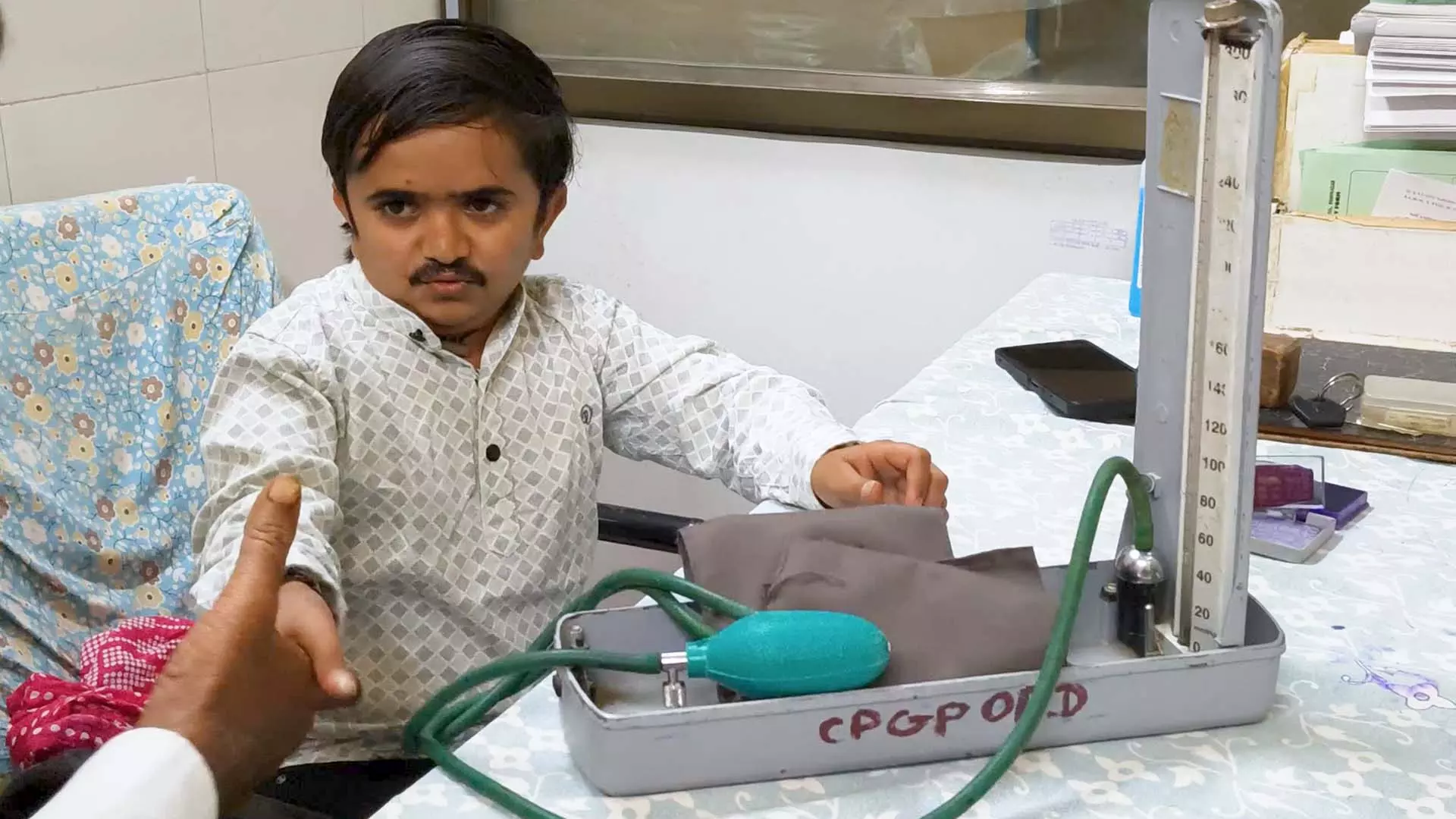
How 3-foot-tall Ganesh Baraiya with 72 pc disability became doctor after court battle
After being denied admission due to disability, Dr. Ganesh Baraiya succeeded in Supreme Court and is now serving patients. A story of resilience, legal justice and hope

A young three-foot-tall doctor from Gujarat — born with 72 per cent locomotor disability — has challenged systemic barriers to medical training and emerged victorious. Dr. Ganesh Uttal Bhai Baraiya is now serving as a medical officer after a long legal battle forced institutions to recognise his right to study and practice medicine.
Early life and challenges
Dr. Baraiya belongs to Talaja Taluka, Gorkhi village in Bhavnagar district, Gujarat. His schooling began in his village for primary education, followed by secondary studies in a nearby village. For science education after grade 12, he attended Neelkanth Vidya Peeth College.
Also read: India's '1:811' doctor-population ratio: Why are AYUSH practitioners counted?
In 2018, after clearing the NEET exam, Baraiya faced rejection from the Medical Council of India (MCI) — his physical disability was cited as a disqualifying factor. Disappointed but undeterred, he reached out to his college principal Dr. Dalpatbhai Katariya for support and decided to fight legally for his admission rights.
Battle in courts
Baraiya’s case eventually reached the Supreme Court. On October 22, 2018, the court ruled in his favour, allowing him to pursue MBBS without reappearing for NEET in 2019. With this ruling, he secured admission to the Government Medical College, Bhavnagar, Gujarat, in August 2019.
Baraiya completed his MBBS and internship, and on November 27, 2025, he began his first posting as a medical officer. Every stage of his journey — from classrooms to courtroom to wards — highlights an extraordinary struggle and triumph.
Professional duties and personal goals
Now actively working with patients, Baraiya aims not only to serve public health but also to improve his family’s living conditions. He shared his personal ambition: “My main goal now is to build a house for my family. They still live in a kaccha house…”
With the income from his posting, he hopes to construct a proper brick home — a dream delayed by financial constraints but renewed with purpose.
Baraiya’s journey from rejection to acceptance, from disability to duty, serves as a powerful example of what resilience, legal justice and willpower can achieve. It asks a deeper question: how many more aspirants lack the resources or platform to fight — and what must change so that their dreams don’t die in silence?
(The content above has been transcribed from video using a fine-tuned AI model. To ensure accuracy, quality, and editorial integrity, we employ a Human-In-The-Loop (HITL) process. While AI assists in creating the initial draft, our experienced editorial team carefully reviews, edits, and refines the content before publication. At The Federal, we combine the efficiency of AI with the expertise of human editors to deliver reliable and insightful journalism.)