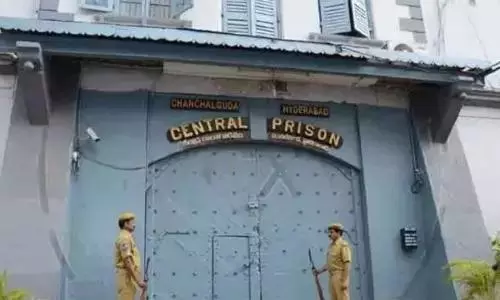
Officials arrested in Anti-Corruption Bureau (ACB) raids are sent to the Chanchalguda jail in judicial remand by the ACB court.
How Hyderabad's Chanchalguda jail turned into a millionaires’ hub
Nearly 30 high-value remand prisoners have entered the jail in three years, amid ACB action against officials accused of corruption and disproportionate assets

Hyderabad's Chanchalguda Central Jail is gradually turning into a ‘millionaires’ jail’, with most of the remand prisoners sent there over the past three years being wealthy officials. The market value of the assets allegedly accumulated by them is estimated to be well over Rs 100 crore.
Officials arrested in Anti-Corruption Bureau (ACB) raids are sent to Chanchalguda jail in judicial remand by the ACB court.
Around 27 remand prisoners have been sent to the jail over the past three years, including former Engineer-in-Chief Muralidhar Rao, who played a key role in the Kaleshwaram project; Hariram, who served as Engineer-in-Chief on the same project; Communications DSP Sankireddy Bheem Reddy; and Hyderabad Metropolitan Water Supply and Sewerage Board General Manager Saggam Anantha Lakshmi Kumar, among others.
Also read: Ex-Keralam DGP gets four years' RI in disproportionate assets case
The ACB became particularly active after the Bharat Rashtra Samithi (BRS) lost the November 2023 elections and the Congress came to power. Telangana Chief Minister A Revanth Reddy gave the agency a free hand, following which it stepped up raids and arrests. Revenue assistants, sanitary inspectors, MROs, SIs, CIs and employees of various departments have been arrested based on complaints. However, cases involving senior officials have received greater attention.
Raids continue
ACB officials have been detecting illegal assets and assets disproportionate to known sources of income. Some officials have also been caught red-handed while allegedly accepting bribes. Those arrested face proceedings before the ACB court before being sent to Chanchalguda jail in judicial remand.
Also read: Telangana: Irrigation dept official arrested in DA case
A 2008 Telangana government order stipulates that an employee’s suspension ordinarily cannot continue beyond two years, except in certain special circumstances. Experts say this provision has enabled several employees suspended in disproportionate assets cases to return to duty within two years or earlier.
The ACB has estimated the assets of recently arrested NIMS Hospital Additional Superintendent Lakshmi Bhaskar at around Rs 100 crore. The agency has also put the value of DSP Bheem Reddy’s assets at Rs 100 crore. The market value of the assets of Land Survey Department Deputy Director Sunkari Narahari Rao is also said to exceed Rs 100 crore. Delays in investigations are another concern. Witnesses and investigating officers change over time, while judges and lawyers handling cases may also change, potentially weakening prosecutions.
Secretariat backs alleged offenders
Retired IFS officer and Forum for Good Governance president Muthyala Padmanabha Reddy alleged that the Secretariat system is helping corrupt officials escape punishment.
Speaking to The Federal Telangana, Padmanabha Reddy said, “Procedural delay is the reason why many corrupt officials are escaping punishment.” He suggested that the rules should be amended so that if both the ACB Director General and Vigilance Commissioner recommend that an official caught with disproportionate assets is liable for punishment, the government should immediately initiate prosecution.
Also read: From Rs 6k salary to crores in lockers, massive assets: Odisha govt engineer under lens
He said, “Even if a corrupt official is caught on charges of possessing disproportionate assets and is suspended, the proceedings are delayed considerably because of various systems such as departmental inquiries and tribunals.”
M Padmanabha Reddy, Retd IFS officer and President of Forum for Good Governance
Padmanabha Reddy said the delays were undermining the deterrent effect of anti-corruption laws. “It now takes at least 15 years for an employee or official arrested in a corruption case to be punished,” he said.
He added, “Investigations are taking 10-15 years to complete. That is why corrupt officials have no fear of punishment or the law.”
This article was originally published in The Federal Telangana.