



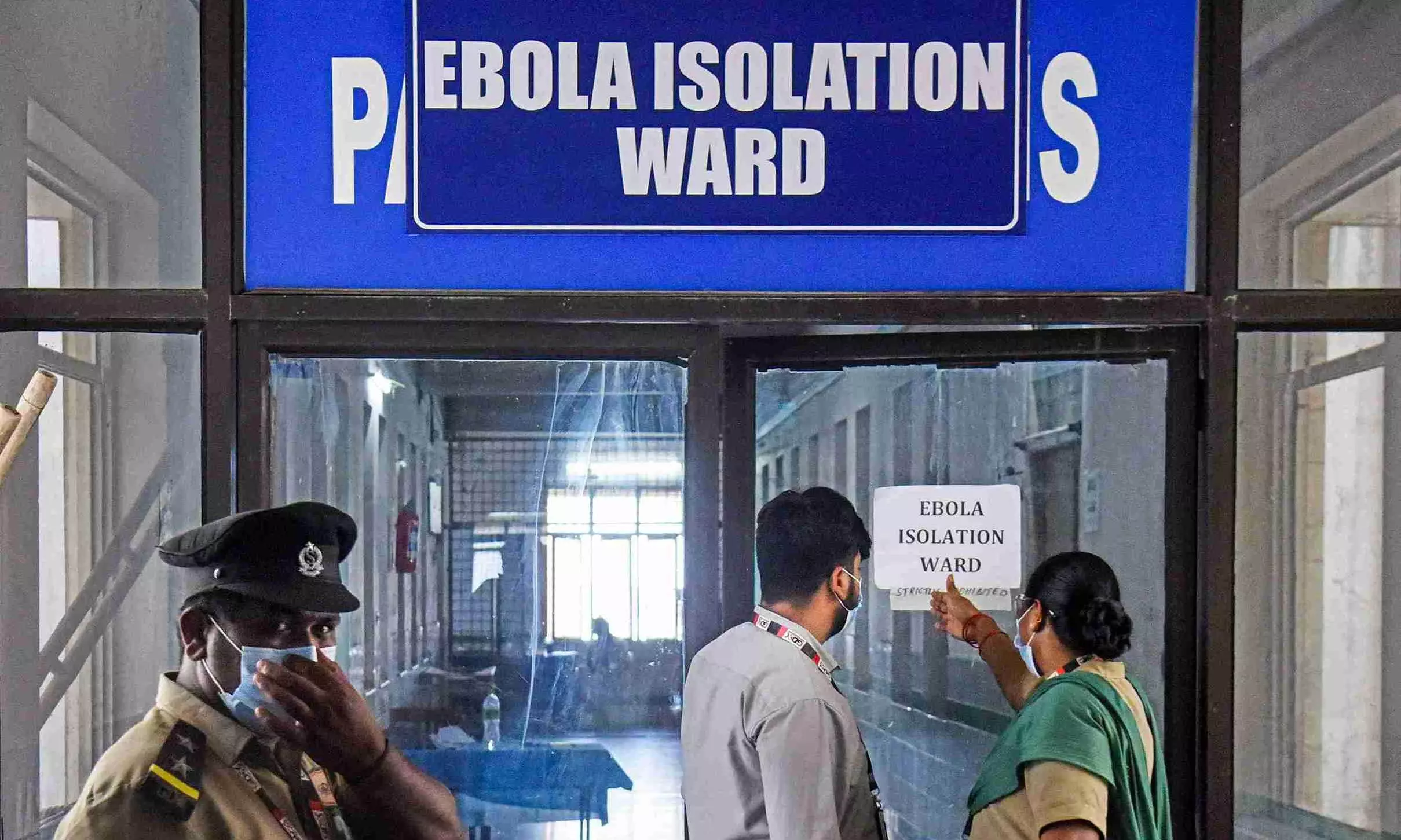
An Ebola isolation ward at Gandhi Hospital, in Hyderabad. Photo: PTY
Second Sudanese national admitted to Hyderabad hospital amid Ebola scare
The Telangana government has set up a special isolation ward with 10 beds at Gandhi Hospital for Ebola cases, as health officials await the test results of both the individuals

Hyderabad, Jun 5 (PTI) A Sudanese national with fever was admitted to the state-run Gandhi Hospital here, taking the total number of Ebola-related admissions at the facility to two, officials said on Friday.
The Sudanese national, a student in his 20s, was referred to Gandhi Hospital on Thursday evening from a private health facility, they said.
The student's condition improved, and he had no fever on Friday morning. His attendant was advised to stay in isolation at home.
Earlier, another Sudanese national, aged 35, who arrived at Rajiv Gandhi International Airport on Thursday, was shifted to the isolation ward of Gandhi Hospital for further tests after he was found to have a fever during thermal screening at the airport.
The 35-year-old, who had come to Hyderabad for knee surgery, had no fever as of Friday morning and was asymptomatic, officials said.
Test reports of both individuals are awaited.
The Telangana government has set up a special isolation ward with 10 beds at Gandhi Hospital for Ebola cases.
Last month, Hyderabad Airport issued an advisory stating that it was implementing enhanced public health preparedness measures in accordance with directives from the Directorate General of Civil Aviation (DGCA) and the Ministry of Health and Family Welfare (MoHFW) regarding the ongoing Ebola Virus Disease outbreak reported in certain countries.
The advisory applies to passengers arriving from or transiting through affected regions, including Uganda, the Democratic Republic of Congo (DRC), and neighbouring high-risk areas. Passengers arriving from or transiting through these countries may be required to complete a Self-Declaration Form (SDF) before deboarding, it said.
According to the WHO, Ebola is a severe and often fatal disease affecting humans and other primates.
The virus is transmitted to humans from infected wild animals—such as fruit bats, porcupines, and non-human primates—and subsequently spreads through direct contact with the blood, secretions, organs, or other bodily fluids of infected individuals, as well as through contaminated surfaces and materials such as bedding and clothing. PTI