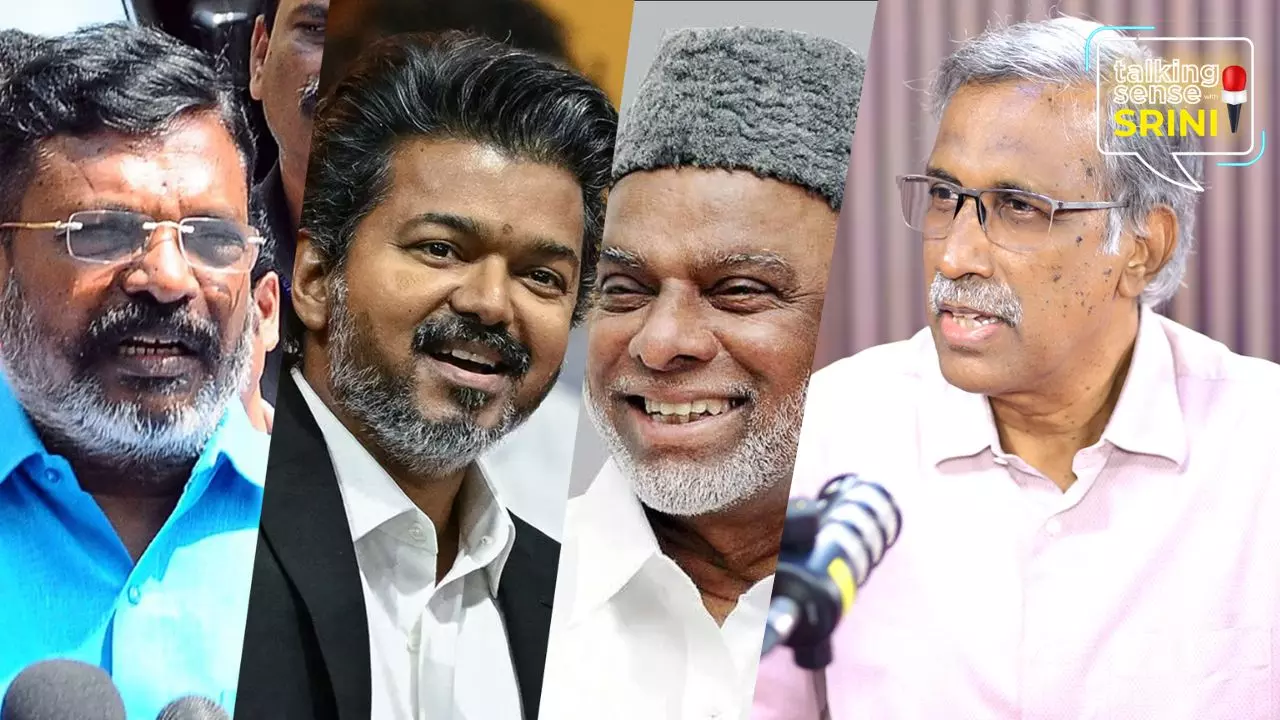
Why Vijay’s ‘inclusive Cabinet’ could become a new headache for DMK
Talking Sense with Srini | The Federal’s Editor-in-Chief decodes how TVK govt has turned on its head the social coalition that existed in Tamil Nadu for 59 years

Tamil Nadu Chief Minister C Joseph Vijay may have done more than just form a new government. He may have redrawn the state’s political power structure.
In the latest episode of The Federal's flagship YouTube program Talking Sense With Srini, The Federal Editor-in-Chief S Srinivasan argued that Vijay’s power-sharing model could fundamentally reshape Tamil Nadu politics.
For the first time in the state’s history, the Indian Union Muslim League (IUML) and the Viduthalai Chiruthaigal Katchi (VCK) have secured Cabinet representation while retaining their independent political identities. Unlike in the previous Dravidian governments, where minority and Dalit leaders often entered the ministry on a DMK or AIADMK ticket, leaders from the IUML and the VCK have entered the Cabinet after winning on their own party symbols.
How Vijay altered the balance of power
“This government has turned the social coalition that existed in Tamil Nadu for the past 59 years on its head,” Srinivasan said. According to him, Dravidian politics historically operated through a broad and inclusive coalition under the DMK and AIADMK, where minorities, Dalits and intermediate castes were accommodated within a larger umbrella. Vijay, however, has altered the balance of power by reducing the dominance of intermediate castes and widening representation.
Also read: Vijay expands cabinet with record 7 Dalit ministers, inducts 2 Congressmen
Srinivasan pointed out that Vijay’s Tamilaga Vettri Kazhagam (TVK) has brought together Dalits, Muslims, Christians and sections of intermediate castes into a new coalition framework. “The power is shared much more widely here,” he observed, highlighting the presence of several Dalit ministers and the appointment of a Christian leader, Marie Wilson, as finance minister.
The shift, he argued, poses a serious challenge to both the DMK and AIADMK. While the AIADMK continues to face internal fragmentation, the DMK risks losing sections of its long-standing minority and Dalit support base to TVK. “Dravidian politics is not ending,” Srinivasan noted. “But its character is changing under Vijay.”