Why has Chennai's AQI breached 160 despite the beach?
Coastal breeze is no longer enough to dilute effect of vehicular emissions, uncontrolled dust from construction and civic works, and industrial activity

Chennai, long regarded as a relatively cleaner city compared to pollution hotspots such as Delhi, is now facing an alarming deterioration in air quality. Residents have been noticing smog blankets during early mornings and late evenings, making breathing increasingly uncomfortable across the city.
The Air Quality Index (AQI) in Chennai has spiked to 160 and above, a level officially categorised as unhealthy. This marks a sharp shift for a city known for its coastal breeze and comparatively better air quality.
Data show that December 2025 is witnessing the poorest air quality in Chennai in the last six years, with an average AQI of 158. In contrast, May 2021 recorded the city’s least pollution, with an AQI of 53. The current spike is largely driven by fine particulate matter, or PM2.5, which penetrates deep into the lungs.
Worsening winter trend
AQI readings in Chennai typically peak during the winter months of December and January, often crossing 100. However, December 2025 has seen a far more serious situation unfold, registering the highest AQI levels in recent years.
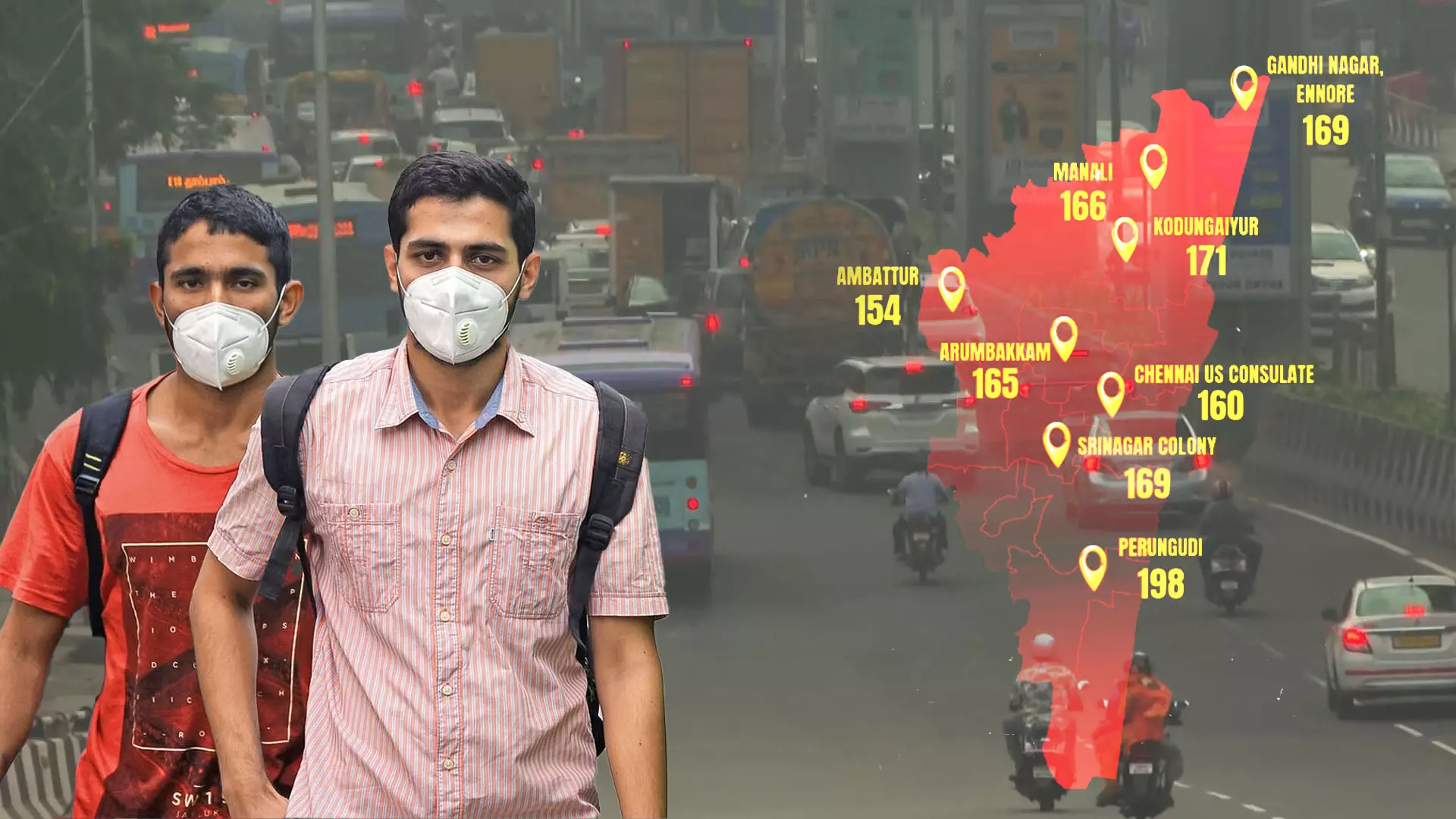
The deterioration in air quality is a city-wide issue, but certain localities have emerged as severe hotspots. In Perungudi, the AQI has surged to nearly 200, while Kodungaiyur has recorded readings exceeding 170.
Other areas such as Srinagar Colony, Gandhi Nagar, Manali, Arumbakkam and the Chennai US Consulate area have also seen AQI levels nearing 170. The situation has worsened to the extent that breathing in Chennai is now equivalent to smoking about 3.3 cigarettes every day.
Health risks rise
The immediate health risk is particularly high for the elderly, children and those with pre-existing conditions such as asthma and chronic obstructive pulmonary disease (COPD). Doctors have been advising vulnerable groups to stay indoors and use N95 masks when venturing out.
Dr Jayaraman S, Senior Consultant in Pulmonary Medicine at MGM Healthcare, warned that elevated pollution levels are aggravating respiratory conditions. “Patients with asthma, COPD and respiratory infections are experiencing exacerbated symptoms. Children and the elderly also remain at a high risk of respiratory infections and pulmonary illnesses,” he said.
Air quality is measured using five key pollutants — ground-level ozone, carbon monoxide, sulphur dioxide, nitrogen dioxide, PM2.5 and PM10. The AQI colour code ranges from green (up to 50) and yellow (50–100) to orange (101–150), which indicates poor air quality.
Unhealthy air levels
Red denotes AQI levels between 200 and 250, purple indicates very unhealthy air with values between 250 and 300, while maroon represents hazardous conditions with AQI above 300. In December 2025, Chennai’s AQI has largely remained between 150 and 200, firmly placing it in the unhealthy category.
Such air quality levels are linked to a wide range of health problems, including respiratory, cardiovascular, ocular and skin diseases. The risks become more pronounced during winter, when meteorological conditions trap pollutants closer to the ground.
PM2.5 poses a risk not just to vulnerable groups but to everyone. Scientific studies link it to respiratory illnesses and strokes, and show that it can cross both the placental barrier and the blood–brain barrier once it enters the bloodstream, affecting multiple organs.
Pollution sources
The World Health Organisation equates breathing air with PM2.5 levels of 22 micrograms per cubic metre to smoking one cigarette. When readings exceed this level, residents are effectively inhaling the equivalent of cigarette smoke, exposing even newborns to toxic air.
Environmental assessments point to a combination of sources driving Chennai’s pollution crisis. Vehicular emissions from congested roads, uncontrolled dust from construction and civic works, and industrial activity — particularly in North Chennai — are major contributors.
Dr Vishvaja Sambath, an environmental health researcher, stressed the need for long-term, structural interventions. “We need a paradigm shift. Our reliance on private vehicles is increasing daily. The priority must be to aggressively scale up public transport, protect walking and cycling corridors, and implement a strict dust-mitigation plan for all major construction. These are long-term, structural issues,” she said.
Call for action
Beyond immediate government initiatives to curb pollution, the onus is also on city planners to implement effective, long-term strategies. Chennai’s coastal breeze, once considered a natural advantage, is no longer enough to dilute what has become a largely man-made crisis.
Until meaningful solutions are put in place, residents face a daily choice — risk their health or stay indoors. Experts continue to urge people to monitor local AQI levels closely and take necessary precautions to reduce health risks.
The content above has been transcribed from video using a fine-tuned AI model. To ensure accuracy, quality, and editorial integrity, we employ a Human-In-The-Loop (HITL) process. While AI assists in creating the initial draft, our experienced editorial team carefully reviews, edits, and refines the content before publication. At The Federal, we combine the efficiency of AI with the expertise of human editors to deliver reliable and insightful journalism.