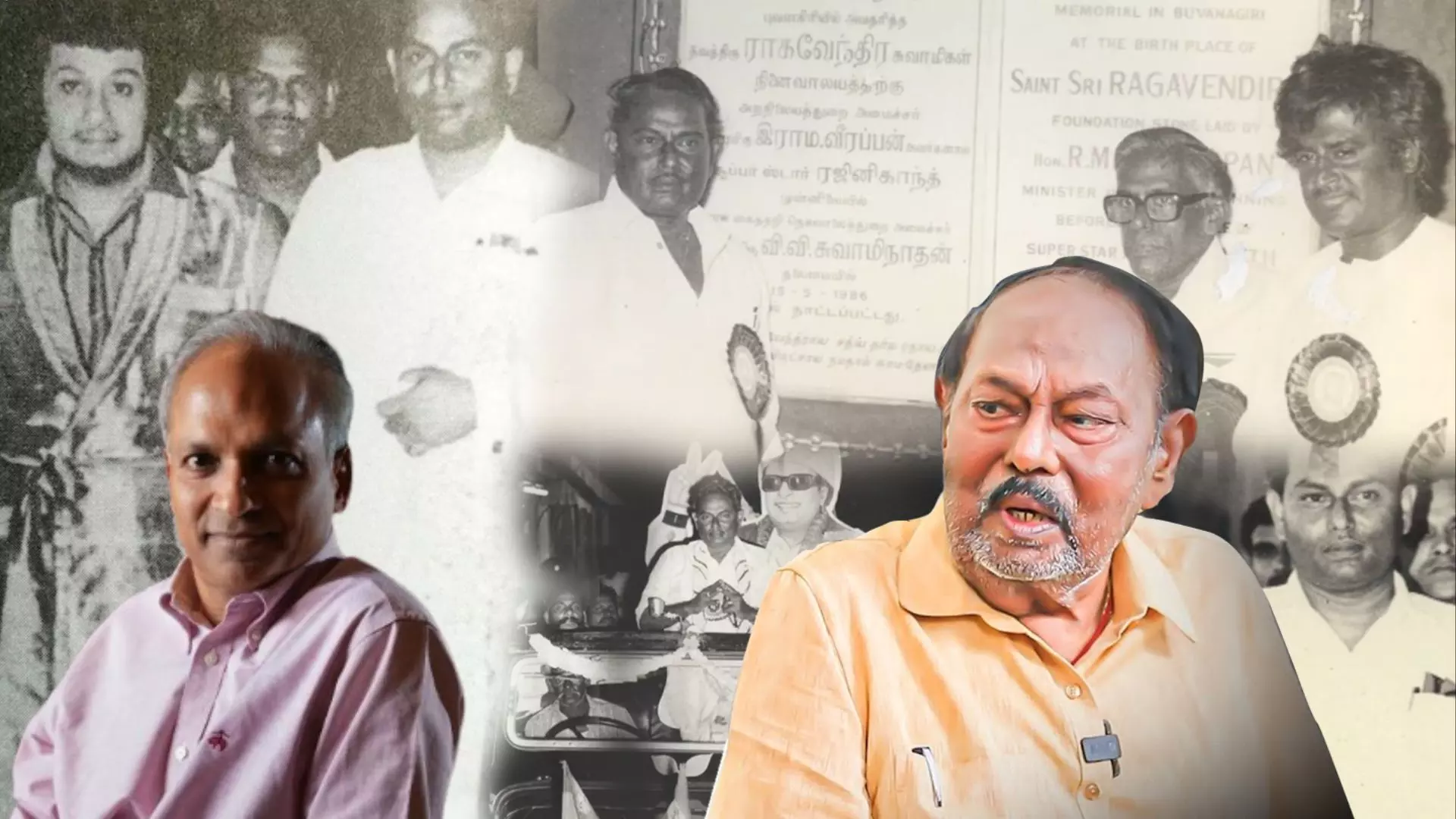
VV Swaminathan at 100: Tracing the legacy of a Dravidian movement pioneer
From abolishing hereditary village posts to shaping Dravidian politics, VV Swaminathan’s journey mirrors Tamil Nadu’s evolution, but what truly defines his legacy?

As Tamil Nadu heads towards the 2026 Assembly elections, it marks a historic milestone — the centenary year of veteran Dravidian leader VV Swaminathan. A former MLA, MP, and minister, his political journey spans nearly a century and mirrors the evolution of the Dravidian movement in the state.
In a conversation with The Federal, political analyst and author R Kannan discussed the significance of Swaminathan’s contributions and legacy in detail.
Born in 1927 in Vilvarai near Pazhaiyarai, Swaminathan’s life unfolded alongside the rise of the Dravidian movement — from the era of CN Annadurai to the present day.
Early influence
Swaminathan’s early political exposure began during his student years at Annamalai University, where he actively engaged with Dravidian ideology. He invited leaders like CN Annadurai to speak, at a time when such ideas were not widely accepted.
He also interacted with towering figures such as EV Ramasamy, M Karunanidhi, and MG Ramachandran, building close relationships across the political spectrum.
Recalling his early activism, Kannan noted how Swaminathan once raised the Dravidar Kazhagam flag in his university hostel, leading to conflict and even legal trouble — an episode that underlined his commitment to the movement.
Key reform
One of Swaminathan’s most significant contributions, according to Kannan, was his role in abolishing hereditary village posts such as “Grama Karanam.”
“His singular contribution… was the removal of hereditary village head positions and replacing them with recruited village administrative officers,” he said. This reform opened up opportunities for individuals from marginalised communities, breaking the monopoly of upper-caste dominance in village administration.
For the first time, village leadership positions could be accessed through merit-based recruitment via the Tamil Nadu Public Service Commission, marking a major step in social justice.
Political journey
Swaminathan served as a Rajya Sabha MP twice — first with the backing of M Karunanidhi in 1972, and later with the support of MG Ramachandran in 1978.
In 1984, he entered the Tamil Nadu Legislative Assembly and became a minister in MGR’s cabinet, handling multiple portfolios including excise, prohibition, and tourism.
Kannan described him as “a very straightforward, a very honest individual… a man of integrity and substance,” highlighting his reputation for clean politics.
Public service
As a parliamentarian, Swaminathan focused on public issues such as unemployment, train services, and flood relief.
“He was deeply rooted and committed to the public cause,” Kannan said, adding that his speeches reflected a strong sense of responsibility towards people’s issues rather than personal gain.
Despite holding significant positions, Swaminathan remained a low-profile leader, often working behind the scenes rather than seeking public attention.
Changing politics
Reflecting on today’s political culture, Kannan contrasted Swaminathan’s loyalty with the current trend of frequent party-switching.
“In the golden days, when you were part of a party, you stayed with the party,” he observed, noting how Swaminathan largely remained committed to the Dravidian ideology despite political shifts.
Even during the 1972 split in the DMK, when MG Ramachandran formed a new party, Swaminathan chose his path carefully, maintaining his political relevance.
Enduring legacy
Swaminathan also played a role in developing tourism sites like Pichavaram and handled as many as 13 ministerial portfolios during his career.
His integrity and knowledge earned him the respect of civil servants and colleagues alike, with many choosing to work closely with him.
As he completes a century of life, his journey stands as a testament to a different era of politics — one defined by ideology, integrity, and public service.
The content above has been transcribed from video using a fine-tuned AI model. To ensure accuracy, quality, and editorial integrity, we employ a Human-In-The-Loop (HITL) process. While AI assists in creating the initial draft, our experienced editorial team carefully reviews, edits, and refines the content before publication. At The Federal, we combine the efficiency of AI with the expertise of human editors to deliver reliable and insightful journalism.