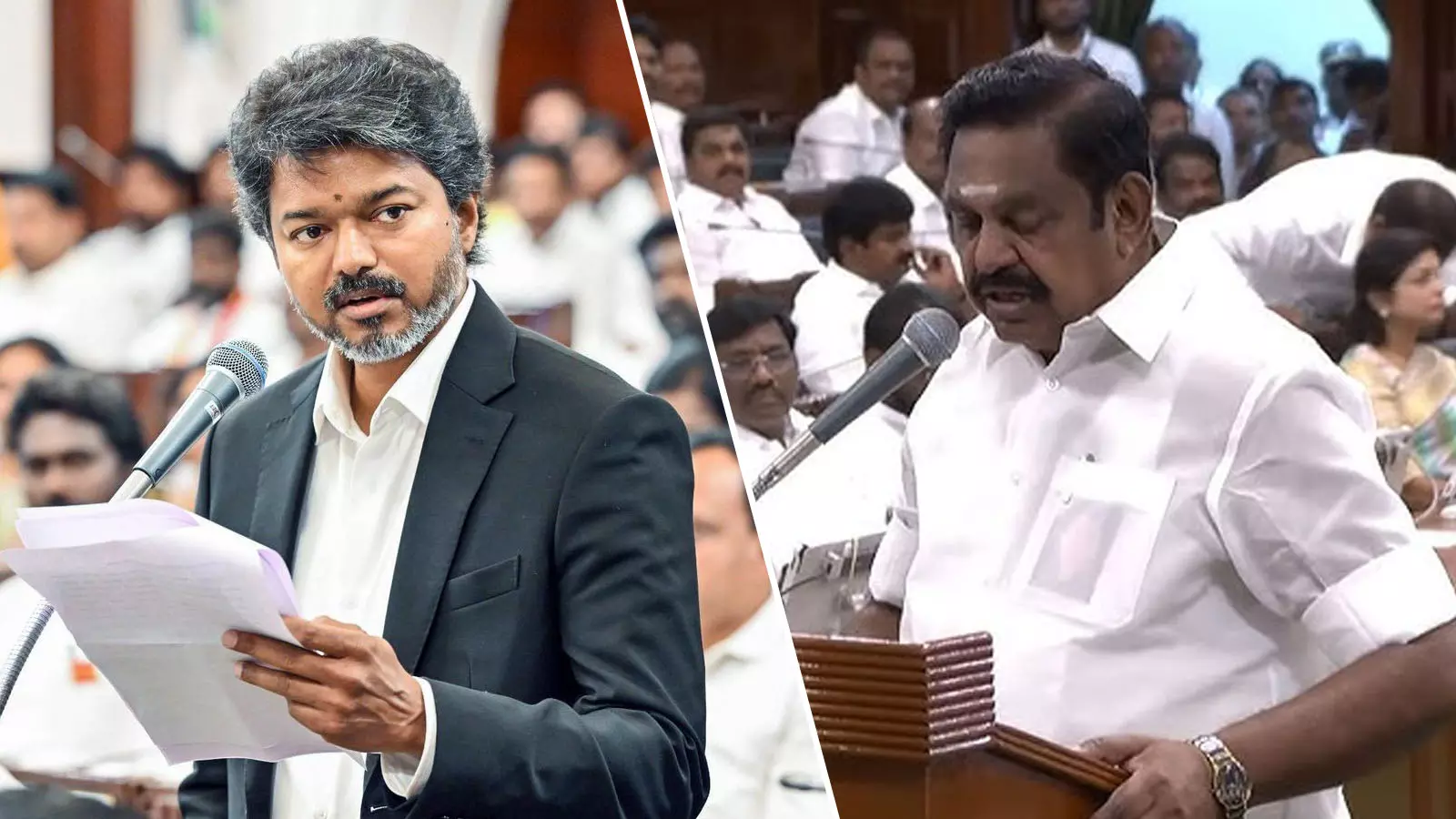
Vijay's TVK secured 144 votes in the confidence motion on Wednesday, while AIADMK general secretary Edappadi K Palaniswami faces a deepening rebellion within his own legislative rank
Trust vote won, but AIADMK's fracture is the real story
Vijay's minority government survived its first Assembly test on Wednesday with 144 votes, but a bigger political problem may arise for the actor-turned-politician

The Vijay-led minority government passed its first major test in the Tamil Nadu Assembly on May 13, securing 144 votes in the confidence motion. But even as the trust vote settled the immediate question of the government's survival, it opened a set of far more consequential ones — about the future of the AIADMK, the legal validity of rebel votes, and the political complications now entangling Vijay's own stated ideological positions.
The Federal's Editor-in-Chief S Srinivasan and legal journalist V Venkatesan unpacked the day's events in a live discussion following the vote.
Numbers behind the split
While Vijay's crossing of the floor test was largely anticipated, the voting pattern threw up details that few had fully accounted for. The DMK, with a bloc of 59 votes, staged a walkout during the proceedings. The more consequential development, however, came from within the AIADMK ranks.
"AIADMK got split vertically," Srinivasan said. "Yesterday, it was expected to split 30-17. What seems to have happened is about 24 people have supported him today." Of the party's 47 members in the Assembly, approximately 24 appear to have voted in favour of Vijay despite the party officially opposing the government — a direct and public defiance of the party line.
What this means for Palaniswami
The split carries particular significance for AIADMK general secretary Edappadi K Palaniswami, who retains formal control over both the party organisation and its legislative wing. A section of his MLAs has now openly broken ranks, but Srinivasan was careful to note that the rebellion does not yet constitute a clean organisational rupture.
Also Read: AIADMK left splintered as Vijay government sails through floor test
"The leader of the legislative party continues to be Edappadi Palaniswami. He is also the party leader. If there is any split, it is not just a legislative split. The other condition is that the split must also be endorsed by the party and by two-thirds of its executive members. All those things haven't happened," he said.
Maharashtra sets an uneasy precedent
Legal journalist V Venkatesan said the Tamil Nadu developments were likely to reopen unresolved constitutional questions that first surfaced during the Shiv Sena split in Maharashtra. He also noted that the Supreme Court had stayed a High Court order relating to the disqualification of one MLA's vote even as the confidence motion was being recorded inside the Assembly.
At the heart of the legal question is the relationship between the organisational party and the legislative party — and which of the two a Speaker recognises as the legitimate authority when internal splits occur.
Watch the full discussion here:
"The Supreme Court in the Subhash Desai judgment said the legislature party is different from the political party. The whip is appointed by the political party, not the legislature party," Venkatesan said.
He pointed out that in Maharashtra, Speaker Rahul Narwekar recognised the Eknath Shinde faction on the basis of legislative majority — a decision that remains under challenge before the Supreme Court. "What the Maharashtra Speaker said was: since those things are very complicated, I will take the legislative majority, which is easy to ascertain," he said.
Law no longer protects rebels
Venkatesan cautioned, however, that the anti-defection law closes off certain routes that rebel MLAs might otherwise have used. The 91st Constitutional Amendment, passed in 2003 during Atal Bihari Vajpayee's government, removed the earlier protection afforded to breakaway groups of one-third or more.
"The split provision was deleted from the Act in 2003. Only the two-thirds merger provision remains," he said.
Also Read: Vijay’s suit sparks debate on politics, identity and symbolism
The Tamil Nadu situation differs from Maharashtra in a further respect: the rebel AIADMK legislators have not formally merged with another party. "Now all the 32 are not merging with the ruling party. What they are saying is that 24 of them voted in favour and some voted against. They both violated each other's whips," he said.
Fight moves to courts
Despite the legal complexity ahead, Venkatesan said the validity of the trust vote itself was unlikely to be disturbed in the near term. "In the meantime, the 24 votes registered in favour of Vijay would continue to be valid. So therefore, the trust vote is valid. He has gone through and the legal fight may continue outside," he said.
The route that fight takes, he added, will be long. "These are all contestable areas. It will take a lot of time. First, the Assembly Speaker has to complete a decision. Then they will go to the High Court and they may go to the Supreme Court," he said.
Control of AIADMK symbol next
Srinivasan said the more immediate battle may shift away from the Assembly floor and towards the contest over who controls the AIADMK as an organisation. "The focus would be on who controls the real AIADMK, who has got AIADMK under his belt. I think that is where the fight is going to be," he said.
A parallel confrontation before the Election Commission now appears increasingly likely. "There will also be a fight before the Election Commission because they will have to fight for the symbol. The Supreme Court has said these two fights are separate," he said.
Political thorn for Vijay
The trust vote may have passed, but it has also handed Vijay an uncomfortable political complication. During the election campaign, he repeatedly described the BJP as his ideological rival. A portion of the support that carried him through the confidence vote came from AIADMK legislators operating within the NDA ecosystem.
"While he said on the one hand that this government will remain secular, the support which has come to him from NDA partners is going to be politically a thorn in his side," Srinivasan said. The DMK has already begun building a narrative around that contradiction. "That's going to be another point for DMK to drive home, that this government is being backed by ideological enemies," he added.
For now, Vijay has crossed the floor test hurdle. But the events inside the Assembly on May 13 may have triggered the most serious internal crisis in the AIADMK since the post-Jayalalithaa succession battle--one that is now set to play out simultaneously before the Speaker, the courts and the Election Commission.