







TN SIR goof-ups: Dead live on; living marked dead and deleted
Draft list triggers row as living voters are marked dead while deceased names remain; Chennai sees 35 per cent drop as citizens have until Jan 18 to fix errors

The draft roll published on December 19 following the Special Intensive Revision (SIR) exercise in Tamil Nadu has ignited a fierce political debate, with allegations being made that living voters have been excluded while invalid entries have not been fully purged.
In one glaring example highlighting the potential flaws in the system, K Ragu, a resident of Edappalayam in Alamathi village under the Madhavaram Assembly constituency, found his name struck off the rolls.
Also read: SIR drive: 97 lakh voters deleted from Tamil Nadu rolls
Officials reportedly told Ragu that his name had been removed because he was reported deceased. “I am alive and standing right here, yet you’ve stripped me of my voting rights by declaring me dead!” an astonished Ragu told authorities.
Chennai loses 35 per cent voters
The Election Commission (EC) has removed over 97.37 lakh voters from the draft list, reducing the state’s electorate from 6.41 crore to 5.44 crore. The deletions, the highest in absolute numbers among the states undergoing SIR, include 26.94 lakh marked as deceased, 66.44 lakh as permanently shifted or absent, and 3.39 lakh duplicates. Urban areas have borne the heaviest impact, with Chennai alone losing 14.25 lakh voters (over 35 per cent of its previous list).
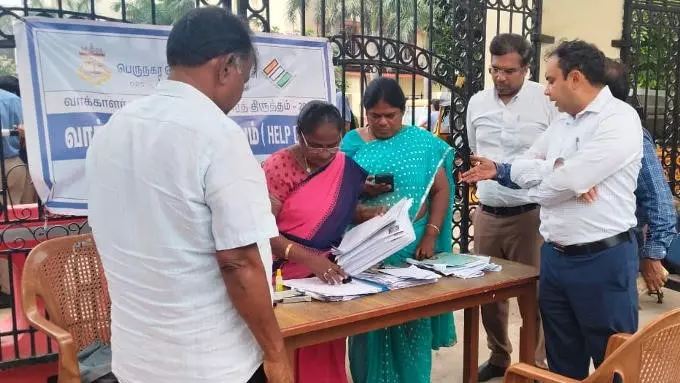
Ragu has since reapplied for inclusion and urged officials to ensure only genuinely deceased voters are removed, calling the incident a result of negligence. He spoke to media persons, demanding redress, stating that such errors must not recur and that citizens deserve franchise.
When questioned, the authorities concerned said an inquiry is underway to determine how Ragu’s name was erroneously removed. However, reports suggest that similar to Ragu, several other living voters across Tamil Nadu have been wrongly deleted from the electoral rolls under the category of deceased persons.
Ragu shows his voter card and the SIR form that he filled
‘Dead are living on, living search for themselves’
Compounding concerns, the name of renowned lyricist Pulamaipithan, who passed away four years ago, remains on the post-SIR draft roll in Mylapore constituency. DMK IT Wing state advisor Govi Lenin highlighted the irony in a scathing post, “The dead are living on, while the living search for themselves. This is the hallmark of SIR.”
Also read: Former CEC SY Quraishi slams SIR: ‘Why scrap 99 pc accurate voter roll?’
Lenin criticised the process broadly, noting inconsistencies like selective removals within families, husbands retained while wives deleted, or younger siblings kept but elders removed and duplicate entries left untouched in some cases. The ruling DMK has slammed the SIR as hasty and error-prone, potentially suppressing votes in a poll-bound state.
Lyricist Pulamaipithan, who passed away four years ago, remains on the post-SIR draft roll in Mylapore constituency
Lenin pointed out that despite fewer voters, polling booths have increased from over 68,000 to more than 75,000, potentially confusing electors and reducing the turnout. He urged voters to check the DMK’s Makkaludan Stalin app for details and file corrections via Forms 6 or 8 by January 18, 2026, with party agents assisting at weekend camps.
Need for door-to-door verification
Opposition parties, including the AIADMK and the BJP, welcomed the revisions as removing bogus entries. AIADMK leader Edappadi K Palaniswami credited the deletions for validating his party’s push for SIR.
Also read: EC tells SC its deduplication software was ineffective; what does it mean for SIR?
Senior journalist Tharasu Shyam pointed out that during the voter list revision conducted in Tamil Nadu from 2002 to 2005, around 50 lakh voters had been removed from the electoral rolls. Of these, around 27 lakh were categorized as deceased, he noted.
Shyam advised that political parties should now undertake door-to-door verification alongside the draft voter list to ensure accuracy and prevent similar large-scale errors. Affected voters have until January 18, 2026, to file claims and objections before the final roll in February.
