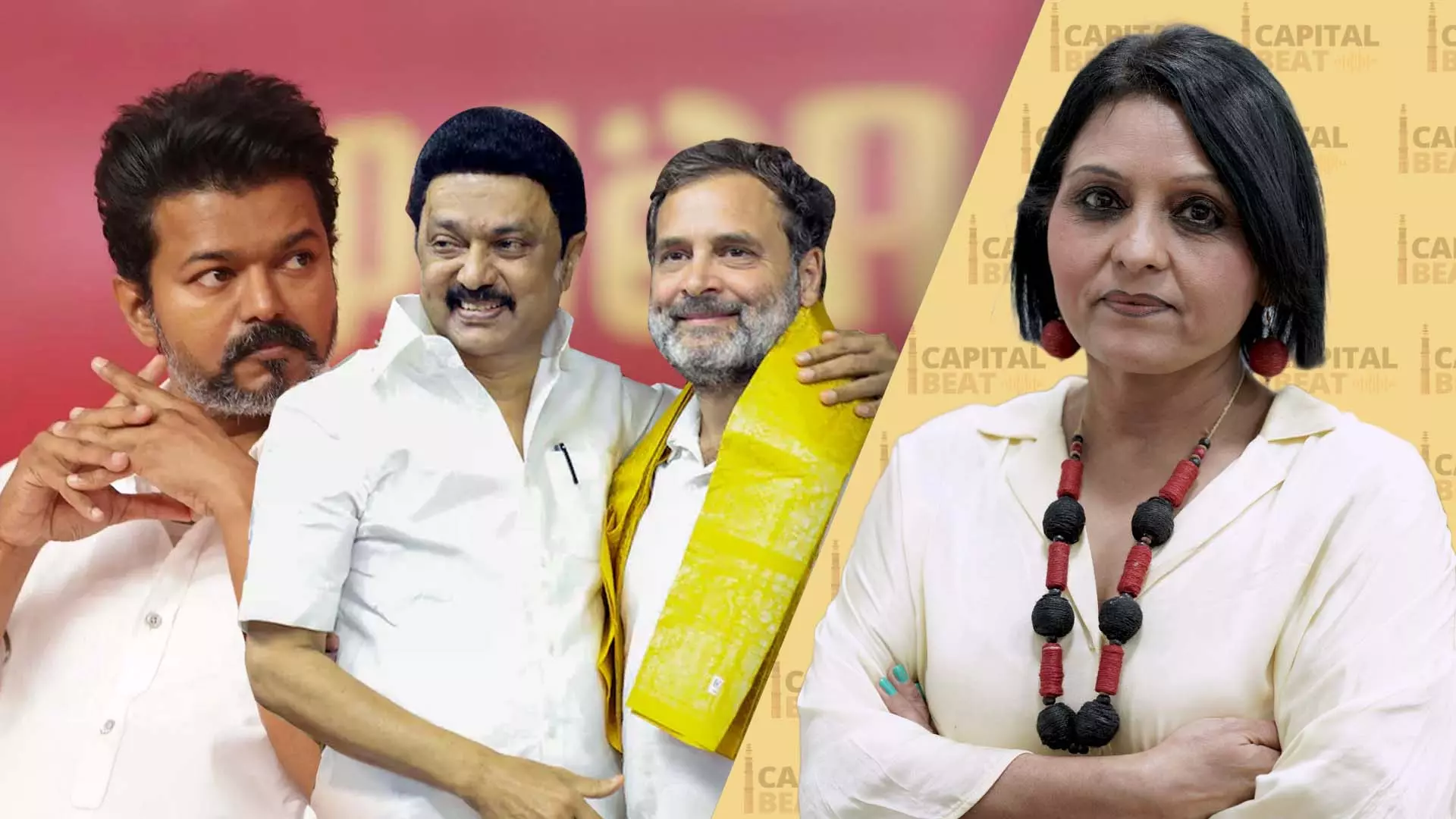
Is Congress using Vijay’s TVK to bargain harder with DMK?
With Manickam Tagore’s remarks, tensions surface in INDIA bloc; is it Congress' strategy?

“DMK is not our enemy. BJP is the primary enemy of the Congress party.”
That emphatic assertion from Tamil Nadu Congress spokesperson Iniyan Robert captures the tightrope the party is walking ahead of the 2026 Tamil Nadu Assembly elections. With murmurs of internal dissent, public criticism of the DMK by senior Congress leaders, and speculation about a possible alliance with Vijay’s TVK, questions are mounting over whether all is well within the DMK-Congress partnership.
In the Capital Beat episode, Tamil Nadu Congress spokesperson Iniyan Robert, at The Federal's Editor-Special Projects, Mahalingam Ponnusamy, and political analyst Kanniappan Elangovan unpack the latest developments and what they mean for the upcoming polls.
Internal churn
The immediate trigger for the debate came from reported remarks by Congress MP Manickam Tagore, who sharply criticised the DMK leadership over comments questioning Congress’ organisational strength. His remarks reignited speculation that a section within the Congress is dissatisfied with the alliance and may be exploring other options.
Congress needed a bargaining chip for two reasons. One, to remind the DMK that they still matter in Tamil Nadu. Two, to curb what they perceive as DMK’s big brother attitude
Robert, however, dismissed the idea of a formal split. “There is nothing Congress versus Congress in the organisation. The official stand of the AICC is to continue with the alliance. We prefer DMK to be a reliable partner as part of the INDIA alliance,” he said.
He acknowledged that a “rival faction” within the state unit is pushing for an alternative path, including leveraging the emergence of TVK as a bargaining tool. But he insisted that this group does not represent the official line. “Without the high command’s decision, going against the alliance is not right,” he added.
Bargaining chip?
Mahalingam offered a different reading of the situation. In his assessment, the Congress is engaged in calculated political posturing rather than preparing for a breakup.
TVK says it is secular and progressive, but it has not shown signs of speaking for federalism or state rights
“Congress needed a bargaining chip for two reasons,” he said. “One, to remind the DMK that they still matter in Tamil Nadu. Two, to curb what they perceive as DMK’s big brother attitude. Vijay’s TVK is a fantastic tool for that.”
According to him, if Congress truly intended to leave the DMK alliance, it would have already held formal talks with TVK leadership. “If Congress really wanted to ally with TVK, they would have moved heaven and earth by now. Why hasn’t even a single meeting been arranged?” he asked.
Mahalingam suggested that Congress is likely aiming for better seat-sharing terms or possibly an additional Rajya Sabha seat, rather than a full-scale rupture.
Power sharing demand
The core issue, however, appears to be Congress’ renewed push for power sharing in a future DMK-led government. Political analyst Elangovan framed it as a strategic recalibration.
“Any political party is formed for capturing power. Congress has been out of power in Tamil Nadu since 1967. Why not bargain now?” he asked.
Elangovan argued that the emergence of Vijay as a political force has altered the arithmetic. “Vijay has lakhs of young supporters. Congress did not bargain for power five years ago. It is bargaining now because there is an alternative on the table,” he said.
He also pointed out that Congress is seeking either a coalition model similar to Kerala or a long-term revival strategy. “If DMK refuses to share power, Congress has to decide whether it wants to rebuild itself independently,” he added.
DMK’s firm stance
Chief Minister M.K. Stalin has publicly ruled out power sharing in Tamil Nadu, reiterating that such an arrangement would not work in the state’s political culture. That categorical position complicates Congress’ demand.
Any political party is formed for capturing power. Congress has been out of power in Tamil Nadu since 1967. Why not bargain now
Mahalingam noted that despite forming a five-member seat-sharing committee months ahead of schedule, Congress is still waiting for DMK to formally initiate negotiations. “Congress formed a seat-sharing committee four months before the election announcement. But DMK has not yet formed its negotiation committee. Why is Congress still waiting?” he asked.
Robert responded that the committee was constituted to counter rumours of a split and reaffirm commitment to the alliance. “We formed the five-member committee to clarify that we are still travelling with the alliance,” he said, adding that seat discussions traditionally happen closer to elections.
He denied reports that DMK is pressuring the Congress high command to act against dissenting leaders. “There is no official information like that so far,” he said.
TVK factor
The rise of Vijay’s Tamilaga Vettri Kazhagam (TVK) looms large over the debate. While some Congress leaders see it as a possible ally, Robert was sceptical.
“TVK says it is secular and progressive, but it has not shown signs of speaking for federalism or state rights,” he said. He even warned that TVK could be a “trap to dismantle the INDIA alliance.”
Mahalingam, however, outlined what both sides might gain if such an alliance materialised. “TVK needs narrative and arithmetic. It wants partners. For Congress, Vijay’s charisma could help in Puducherry and even among Tamil-speaking voters in other states,” he said.
But he cautioned that aligning with Congress would also burden TVK with the Congress’ legacy issues in Tamil Nadu.
Elangovan took a broader view. “Congress needs manpower. TVK has young aspirants without political backing. That could help Congress rebuild,” he said. At the same time, he questioned the ideological consistency of all parties involved, arguing that Tamil Nadu’s alliance politics has historically been pragmatic rather than ideological.
Timing questions
A recurring question during the discussion was timing. If Congress were serious about leaving the DMK, why raise the issue so close to seat-sharing talks?
Elangovan suggested it was a pressure tactic. “It is for the DMK to open the door. They are testing whether DMK is ready for a coalition,” he said.
Mahalingam concurred that TVK is currently more a pressure point than a destination. “TVK is politely watching this drama. Congress is using TVK as a bargaining chip,” he said.
Robert maintained that any decision would ultimately rest with the high command. “If AICC takes a decision, we will abide by it. Until then, creating a drift within the alliance only harms minorities and Dalits who see this alliance as protection,” he said.
What next?
With senior Congress leader K.C. Venugopal in Chennai and February 22 mentioned as a possible date for clarity on talks, the coming days could be crucial.
Mahalingam observed that Venugopal has often met Chief Minister Stalin during previous visits, but this time such a meeting appeared uncertain. “By February 22, we will get a clear picture,” he predicted.
For now, the DMK-Congress alliance remains intact but under visible strain. Whether this is hardball negotiation or the beginning of a structural shift in Tamil Nadu politics will depend on how both parties handle the power-sharing question and the TVK wildcard in the weeks ahead.
The content above has been transcribed from video using a fine-tuned AI model. To ensure accuracy, quality, and editorial integrity, we employ a Human-In-The-Loop (HITL) process. While AI assists in creating the initial draft, our experienced editorial team carefully reviews, edits, and refines the content before publication. At The Federal, we combine the efficiency of AI with the expertise of human editors to deliver reliable and insightful journalism.