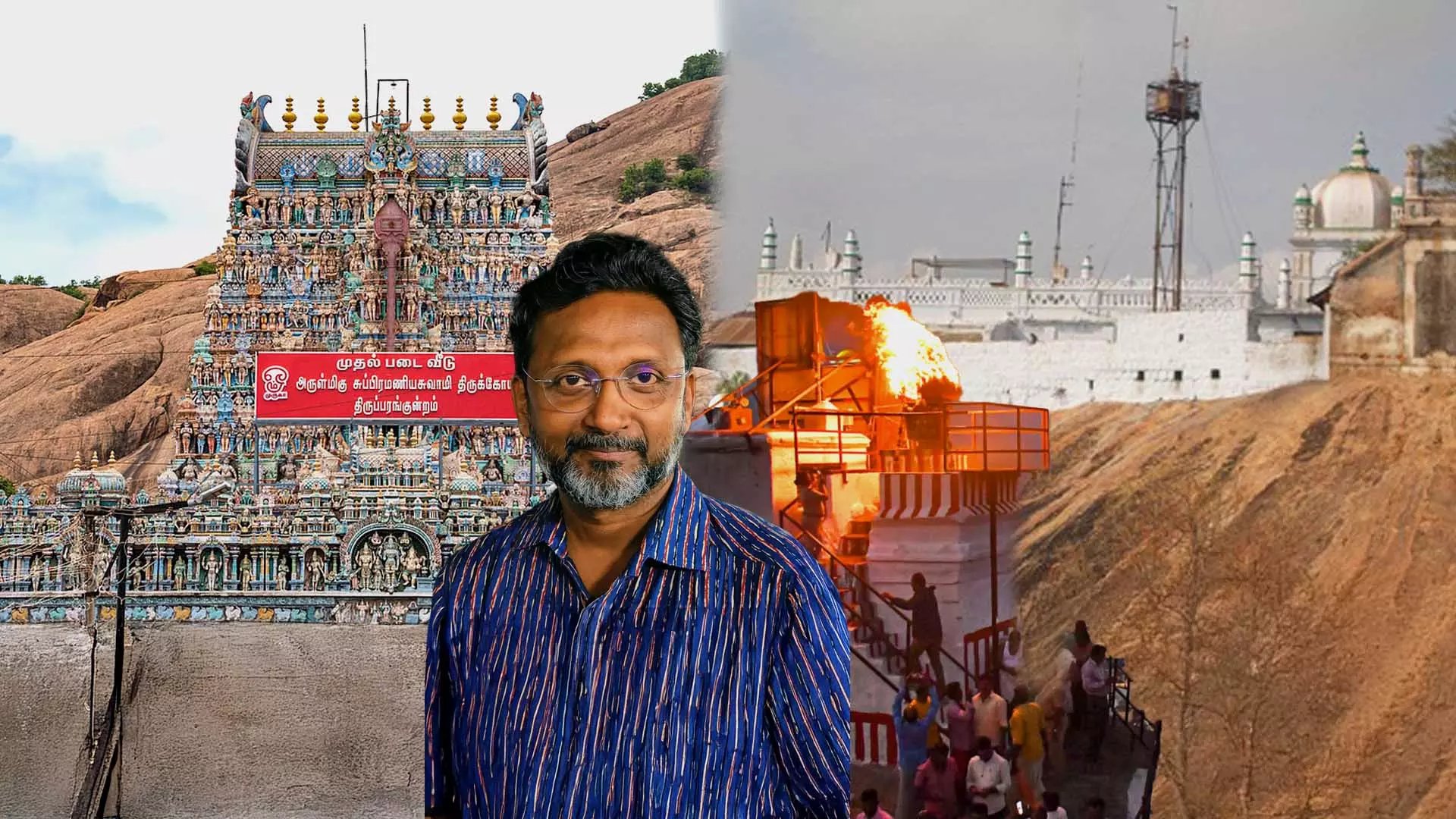
Tirupparankundram Deepam row: Writer Muthukrishnan debunks myths around stone pillar
A detailed conversation with Tamil writer Muthukrishnan on the history, inscriptions and political tensions behind the controversial “stone pillar deepam” demand

The long-running dispute over a request to light a ceremonial lamp on a stone pillar at Tirupparankundram Hill was revived this month after right-wing groups petitioned the Madras High Court. Writer and researcher A Muthukrishnan, who has documented the hill for decades, was asked to unpack the historical, epigraphic and political claims behind the demand, and to explain why the controversy matters locally.
Why is Tirupparankundram Hill significant, and what is found on it?
The hill is home to multiple religious and historical sites: a Murugan temple, Jain caves with inscriptions, a rock-cut Jain temple later repurposed as a Hindu cave temple, the Kashi Vishwanath temple at the rear, and a dargah on the upper hill.
The topography is explained as bifurcating into several hillocks and flat terraces — notably the Nelli Thoppu — from which separate routes lead to the dargah and to the Kashi Vishwanath shrine. A primary stair that climbs from the town centre has been described; the hill’s nooks and contours are said to have been frequented by local youth for day-long and overnight visits, resulting in a deep, lived familiarity with the place.
What exactly is the stone pillar at the centre of the dispute?
The pillar is identified as a British-era survey marker, not as a traditional sacred lamp pillar. It is said that six such pillars exist on the hill; they were erected in the late 1800s and early 1900s for mapping and surveying. Over time, the use of such markers for small, personal moksha deepam rituals (lit for the dead) has been described, but no evidence is presented that the pillar was ever a ceremonial site for a Karthigai Deepam.
Was a Karthigai Deepam tradition ever associated with the hilltop?
It is asserted that no Karthigai Deepam tradition was historically associated with Tirupparankundram. Recollection is given that, in childhood, Karthigai Deepam was observed chiefly at Sabarimala and Tiruvannamalai, not at Tirupparankundram. It is further explained that the push to establish a new Karthigai Deepam on the hilltop began in the 1990s, when fringe right-wing groups reportedly promoted such a ritual and openly advocated the removal of the dargah.
What do local temple practices and histories reveal about who lights the lamp and where?
The temple’s structure is described as rising level by level toward a rock-cut sanctum (a kudu varai), where several deities are housed — including Jain, Siva and Vaishnava images, with the latter said to receive no active worship. It is explained that the administration of ritual duties in the town has historically been organised by families assigned hereditary roles, and that no family duty or grant has ever been recorded for lighting a hilltop Karthigai Deepam at the survey pillar. This absence is offered as evidence that the pillar was never part of traditional temple ritual.
What do inscriptions say about where the ceremonial lamp should be lit?
Reference is made to a Tamil Nadu Archaeology Department publication on Tirupparankundram inscriptions. It is stated that the inscriptions specify the lamp to be lit on the “head of the rock” — understood to mean the rock of the sanctum near the Uchippillaiyar Temple. The HR&CE Department’s annual large-scale lighting there is noted, and it is emphasised that no inscription, manual, or hereditary grant supports a deepam at the survey pillar.
Why are right-wing groups insisting the deepam be lit at the survey pillar?
A political motive is argued to be behind the demand: for decades a campaign to remove the dargah from the hilltop and to claim the hill as a purely Hindu site has been asserted. It is stated that the survey pillar lies within land historically recognised as belonging to the dargah (a 1926 Privy Council judgment is referenced), and that access to the pillar necessarily requires passage through dargah land. The demand for a ceremonial deepam at the pillar is therefore framed as an attempt to secure physical and symbolic entry into that space, which could be used to escalate territorial and religious claims.
Why is an individual devotee being prevented from lighting the lamp at the pillar?
It is explained that, under Tamil Nadu practice, ritual authority rests with the HR&CE Department; individuals are not permitted to invent new ritual practices or unilaterally appropriate temple spaces. The point is made that if one individual’s claim were allowed, it would open the door for arbitrary claims at other temples. The lack of any hereditary family duty, ritual grant or historic precedent for a pillar-based Karthigai Deepam is again cited as justification for the state’s refusal.
How are the judicial developments being viewed in this controversy?
The legal history is described as having several settled judgments (including decisions referenced from 1926, 2000, 2016 and 2017). Concern is expressed that a single judge’s direction — to allow the lamp at the survey pillar after an inspection — appears to run counter to earlier bench rulings. This judicial move is portrayed as unprecedented and worrying, and it is suggested that judicial pronouncements are being aligned with the talking points of certain right-wing groups.
How do local residents view the dispute and its possible consequences?
Local sentiment is strongly in favour of peace. The town’s economy is said to depend heavily on pilgrimage and tourism; daily temple activity, marriages and seasonal flows are cited as sources of livelihood. It is argued that every recurrence of the dispute brings heavy police presence, tension and the risk of communal unrest, which would harm the town’s peace and its reputation as a safe pilgrimage site. The established, large deepam lit at Uchippillaiyar Koil is said to be accepted and valued by residents, who are opposed to escalating a non-traditional practice into a communal flashpoint.
What is the larger fear if the political agenda succeeds?
It is cautioned that if the political agenda succeeds, the hill’s centuries-old coexistence of Jain, Hindu, and Muslim traditions could be placed at risk. Tirupparankundram’s long-standing plural fabric is seen as vulnerable, and the community’s greatest fear is that its peace, social harmony, and economic stability may be disrupted.
The content above has been transcribed from video using a fine-tuned AI model. To ensure accuracy, quality, and editorial integrity, we employ a Human-In-The-Loop (HITL) process. While AI assists in creating the initial draft, our experienced editorial team carefully reviews, edits, and refines the content before publication. At The Federal, we combine the efficiency of AI with the expertise of human editors to deliver reliable and insightful journalism.